Top Hard Enduro Hydration Pack
Stability over capacity. A harness that does not bounce reduces fatigue; choose a durable pack that works cleanly with your protection.
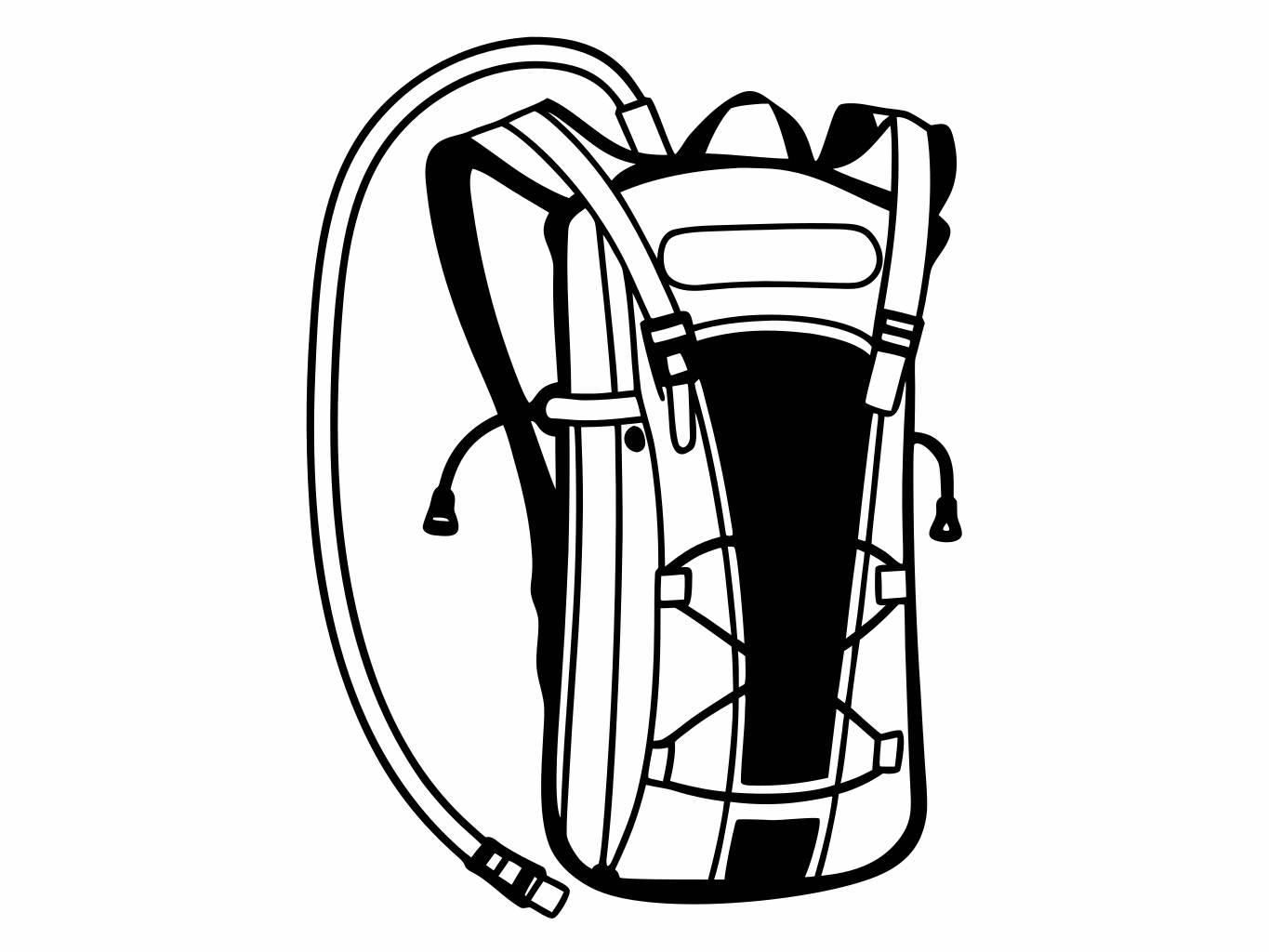
A hard enduro day is hours of hard work at low speed, often in heat, with long stretches of pushing and walking the bike. Running dry costs you performance and raises the risk of heat illness. This guide covers how much to carry, how to pick a pack that stays put over your armor, and how to keep the bladder clean.
On this page
Why hydration matters in hard enduro
Hard enduro is slow, but it is not easy. You climb, lift, push and walk the bike, often for hours. At Erzberg, the Red Bull Hare Scramble gives 500 starters 4 hours on one mountain, per the organizer.
What the science says
The American College of Sports Medicine's position stand on exercise and fluid replacement sets the goal of drinking during exercise: to prevent "excessive (>2% body weight loss from water deficit) dehydration and excessive changes in electrolyte balance to avert compromised performance." Because sweat rates and sweat electrolyte content vary widely between people, it recommends customized plans.
The National Athletic Trainers' Association's position statement on fluid replacement adds three points:
- People who drink to thirst, with fluid freely available, replace roughly two-thirds of their sweat losses.
- Sweat rates vary widely. Its own example contrasts 0.4 L/h with more than 2 L/h.
- A body-mass deficit greater than 5% is consistently associated with impaired performance, extreme thirst and headache.
Heat illness
The NHS lists the signs of heat exhaustion, including tiredness, dizziness, headache, cramps, a high temperature and being very thirsty. Its advice: move somewhere cool, remove unnecessary clothing, drink water or an isotonic sports drink, and cool the skin. The person should improve within 30 minutes. Hot skin without sweating, confusion, a seizure or loss of consciousness are signs of heatstroke and need emergency help. See also our first aid basics and the hydration section of our arm pump guide.
No safety standard covers hydration packs
A hydration pack is a carrying system, not protection. No EN or ECE rating covers a pack, its harness or its bladder. The certified protection on your back comes from your back protector, covered in the chest protector guide.
So "zero bounce" and "100% bounce-free" are maker claims, not test results. Judge a pack on what you can measure: bladder volume, pack weight, total volume, chest-size range and harness adjustment.
Keep hard objects out of the pocket over your spine, because the pack sits directly on your back and hard enduro falls land you on rocks and logs. A soft tool roll spreads a load. A loose wrench does not.
How much water to carry
Both ACSM and NATA say to base your intake on your own sweat rate. NATA's method:
- Weigh yourself before and after the ride, in kilograms.
- Sweat loss (L) = weight before − weight after + fluid drunk (L) − urine (L).
- Sweat rate (L/h) = sweat loss ÷ hours ridden.
NATA recommends repeating this in realistic conditions, wearing your sport's clothing and equipment. For you, that means full kit on a real hard enduro loop.
A worked example
These numbers are illustrative, not data. An 80 kg rider's 2% line is 1.6 kg. If that rider sweats 1.0 L/h, a 4-hour race costs 4.0 L. A 3.0 L bladder leaves a gap even if every drop gets drunk, and drinking to thirst alone replaces only about two-thirds of losses, per NATA.
Our view: for most hard enduro days, carry a 3 L bladder and plan where you will refill. Keep a 1.5 L race pack for short loops or races with pit support. That advice comes from three things: the worked example above, where a 4-hour race at 1.0 L/h costs 4.0 L; the 4-hour Erzberg format; and NATA's example sweat rates of 0.4 L/h and more than 2 L/h.
Water or sports drink?
ACSM says drinks with electrolytes and carbohydrates can give benefits over water alone under certain circumstances. NATA warns about the opposite risk: overdrinking can cause exercise-associated hyponatremia, which it reports in 10% to 20% of distance athletes after events. Drink to a plan, not to the bottom of the bladder.
Bladder volume versus total weight
Water weighs 1 kg per liter. On any pack, the water is the heaviest thing you carry. Here is what the makers list:
| Pack | Pack weight (maker) | Bladder | Total volume |
|---|---|---|---|
| USWE OUTLANDER Moto 2L | 310 g, excl. bladder | 1.5 L | 2 L |
| USWE OUTLANDER Moto 4L | 340 g, excl. bladder | 3.0 L | 4 L |
| USWE Moto Hydro 8L | 596 g, excl. bladder | 3.0 L | 8 L |
| CamelBak Chase Adventure 8 (bike vest) | 400 g | 2 L | — |
| CamelBak M.U.L.E. Pro 14 (bike pack) | 1,130 g | 3 L | — |
Pick the bladder size first and the pack second. The table above shows why. The listed pack weights span 310 g to 1,130 g, and USWE quotes its weights without the bladder. The difference between a full 1.5 L and a full 3.0 L bladder is 1.5 kg of water alone.
Harness, fit and stability
On a log or a rock step your body moves hard and fast. A pack that lags behind pulls on your shoulders and shifts your balance, which makes good body positioning harder.
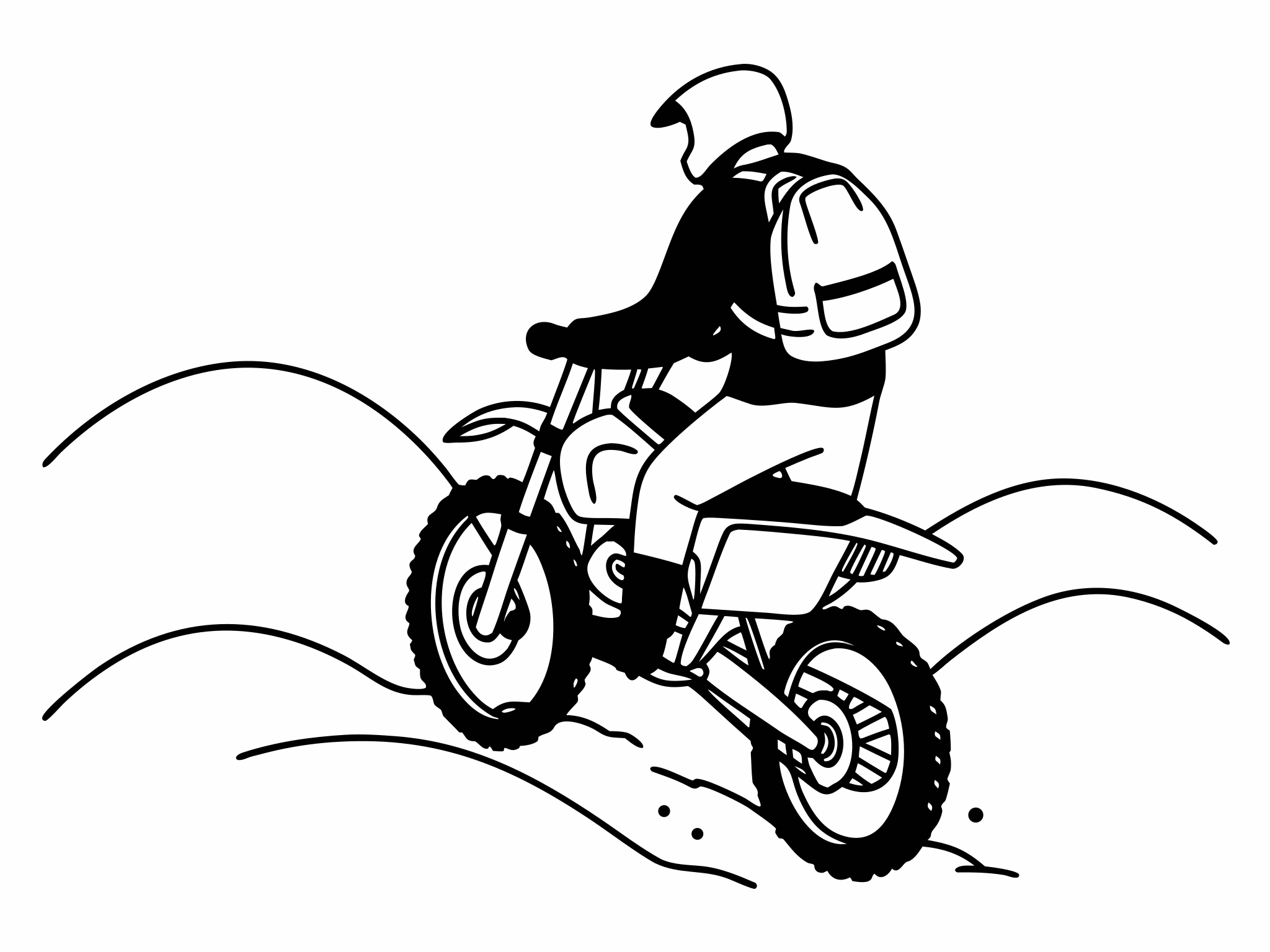
USWE's NDM harness
USWE builds its moto packs around its No Dancing Monkey (NDM) harness. USWE says the harness is patented, uses 4-point suspension with elastic chest straps that expand as you breathe, and makes the packs "100% bounce free". These are the maker's claims. USWE's setup steps:
- Adjust the horizontal chest straps to a comfortable length. Two D-rings switch between a larger and smaller size.
- Adjust the vertical shoulder straps so the center buckle sits around the height of your solar plexus.
USWE lists a chest range of 84 cm to 110 cm for both of its packs here. Measure your chest over your armor.
CamelBak's approach
The M.U.L.E. Pro 14 uses a mesh harness, a sternum strap and a hip belt that CamelBak says adds stability. The Chase Adventure 8 vest uses dual sternum straps, and CamelBak calls its fit "stable, bounce-free". CamelBak sells both as bike products.
Our view: test stability standing on the pegs, not standing in the shop. The logic is simple: hard enduro is ridden mostly standing, and a pack that sits still when you are upright can shift when you lean forward.
Fitting a pack with a chest protector and neck brace
Your pack shares your torso with a chest protector and, for many riders, a neck brace.
Over armor
Check the specific model, not the brand:
- USWE says the OUTLANDER Moto 2L's elastic harness "stretches to fit over moto gear and body armor".
- USWE says the standard Moto Hydro 8L "is designed for a close fit without body armor", and points chest-protector wearers to its Adventure Fit version with extended straps.
- CamelBak lists both of its packs here as compatible with its own Impact Protector panel.
With a neck brace
Try brace, chest protector and pack together, in your riding stance, before you ride. Check that the top of the pack does not push on the brace and the straps do not lift it. We say this because all three bear on your shoulders and upper back at once, so a shift in one moves the others. Brace fit is covered in the neck brace guide.
Routing the hose
USWE says the OUTLANDER Moto 2L's fixed tube coupling keeps the hose secure, and that you can clip the hose to the harness so it does not flap. We'd route it so you can grab the bite valve fast, clear of the brace and goggle strap, because in hard enduro you mostly drink in short stops, such as while waiting at a jammed climb.
Stability over capacity
- Choose the bladder first. Use your sweat rate and your longest stretch between refills. For most hard enduro days that points to 3 L.
- Choose the smallest pack that carries it and your essentials. Space you do not need tempts you to fill it. The bike setup guide helps decide what can live on the bike.
- Prioritize a harness that clamps the pack to your torso, such as a four-point design. Stability matters more than storage, because on a log or a rock step your body moves hard and fast, and a pack that lags behind shifts your balance.
- Check the fit over your armor. Use the maker's chest range and armor guidance.
- Route the hose clear of your chest protector and neck brace.
- Pack tools and food for the route length and the heat. Keep hard items off your spine.
- Try the full kit at home. Stand on the pegs and move.
Cleaning, storage and checks
The pack
Both makers say no washing machine. CamelBak's care guide says it can twist or tear straps and fixtures, wear away the weatherproof coating, and void the warranty. CamelBak says to soak a dirty pack in water with mild soap, rinse it thoroughly with cool water and hang it to dry. USWE says to empty the pack after every ride, brush soiled areas with soapy water, hand wash only (a machine or dryer damages the PU coating), keep zippers clean, and store it closed in a dry, ventilated place.
The bladder
USWE says to rinse its Elite bladder with warm water after each ride and let it air dry completely, opening propped open, to prevent mold. For a deeper clean, turn it inside out like a sock, put it in the dishwasher or wash it with mild soap, and dry it while reversed. CamelBak's reservoir wash: fill it half full of warm water and mild soap, shake, hold it so the bite valve is below the reservoir, pinch the valve so the solution runs through the tube, then rinse, drain and air dry so no moisture is trapped inside.
Before each season
CamelBak's checklist: inspect the reservoir, run clean water through it, tug both ends of the tube (if it comes off too easily, trim an inch off and refit it), then fill, cap and squeeze it to check for leaks. If the cap leaks, CamelBak names two likely causes: grit in the threads, especially in sand, or a twisted O-ring. Check the threads after every muddy ride or water crossing. That follows from CamelBak's note about grit, and from the silt a hard enduro day leaves on your kit.
Common hydration mistakes
- Drinking only when thirsty on a long day. NATA reports that drinking to thirst replaces roughly two-thirds of sweat losses. Over four hours, the gap grows.
- Drinking plain water by the liter with no plan. NATA links overdrinking to exercise-associated hyponatremia.
- Riding with loose straps. Set the harness up the way the maker describes. USWE's own setup steps above show how.
- Buying the biggest pack. The water is the weight. A larger pack mostly adds room for more.
- Leaving the bladder wet in the pack. Both makers say to dry it fully. USWE names mold as the reason.
- Never trying the pack with armor and a brace. USWE's own armor guidance differs by model.
For the rest of your kit, see the gear overview, and build the fitness for long days with endurance training.
Priority: ★★★★☆. Suggested share of a full kit's budget: 5%.
What the rating rests on: Hydration gets four stars because the sports-science guidance is clear: the American College of Sports Medicine sets the goal of avoiding more than a 2% body-weight loss from water deficit, and a hard enduro race such as Erzberg's Hare Scramble runs for 4 hours. It gets 5% of the budget because the packs listed here run $109.99 to $176.00 at list, less than any certified helmet, boot or brace on this site.
Our suggested picks for hard enduro Hydration Pack
Grouped by the maker's list price. No paid placements, no affiliate links. Every fact on a card links to the maker's own page.
OUTLANDER Moto 2L Hydration Pack
- USWE
- 310 g
- US$109.99 list price (US)
An ultralight moto race hydration backpack with a 2 L total volume, a 1.5 L bladder and USWE's NDM 4-point harness.
Features: No Dancing Monkey (NDM) 4-point harness, HydraPak Elite Hydration Bladder with fixed coupling
USWE describes the OUTLANDER Moto 2L as a race hydration backpack for competitions and fast rides where speed matters more than carrying gear. It weighs 310 g without the bladder, has a 2 L total volume and comes with a 1.5 L (50 oz) Elite Hydration Bladder with a fixed tube coupling, made by HydraPak. Dimensions are 30 cm long, 15 cm wide and 12 cm deep. USWE lists a chest circumference range of 84–110 cm and says the pack is for moto, enduro, hard enduro, adventure and dual-sport riding.
USWE says its patented No Dancing Monkey 4-point harness makes the pack "100% bounce free", and that the elastic harness stretches to fit over moto gear and body armor. USWE says the pack has no room for tools or a spare tube, and points riders who need storage to the OUTLANDER Moto 4L or 9L.
Why it is listed: it is the lowest list price on this page ($109.99) and the lightest pack, built for moto riding. The 1.5 L bladder suits short races and loops with support. For longer days, USWE's OUTLANDER Moto 4L carries a 3.0 L bladder at 340 g.
Moto Hydro 8L Hydration Pack
- USWE
- 596 g
- US$169.99 list price (US)
An off-road motorcycle hydration backpack with 8 L of storage, a 3.0 L bladder and USWE's NDM 1.2 harness.
Features: No Dancing Monkey (NDM) 1.2 harness, HydraPak Elite Hydration Bladder with Plug-N-Play coupling
USWE describes the Moto Hydro 8L as an off-road motorcycle hydration backpack for enduro riding. It weighs 596 g without the bladder, has an 8 L total volume with a main compartment, two zippered pockets and external attachment straps, and comes with a 3.0 L (100 oz) Elite Hydration Bladder with Plug-N-Play coupling, made by HydraPak. Dimensions are 42 cm long, 19 cm wide and 12 cm deep. USWE lists a chest circumference range of 84–110 cm.
USWE says its patented No Dancing Monkey 1.2 harness, with elastic straps and an NDM buckle, delivers "absolute zero bounce". USWE says the standard version is designed for a close fit without body armor, and recommends the Adventure Fit version with extended straps for riders wearing a chest protector.
Why it is listed: it is a moto-specific pack with a 3.0 L bladder and room for tools, food and a layer, at $169.99. That combination fits a full hard enduro day. Pick the Adventure Fit version if you ride in a chest protector.
Sources
M.U.L.E. Pro 14 100oz
- CamelBak
- 1,130 g
- US$176 list price (US)
A bike hydration pack with a 3-liter Crux reservoir, an Air Support back panel, a hip belt and an integrated tool roll.
Features: Air Support Pro back panel, 3D vent mesh harness, Hip belt, Crux reservoir (3 L)
CamelBak sells the M.U.L.E. Pro 14 as a bike pack. It has an Air Support Pro back panel, a 3D vent mesh harness, an adjustable sternum strap, a hip belt with cargo storage that CamelBak says adds stability, an integrated tool roll and a 3-liter Crux reservoir. CamelBak lists dimensions of 45 cm x 19 cm x 23 cm and a weight of 1,130 g. It is compatible with CamelBak's Impact Protector panel, sold separately.
Why it is listed: it has the highest list price on this page ($176.00) and the most organized storage, with a hip belt that spreads the load. It is a mountain-bike product, and at 1,130 g it is the heaviest pack here. Choose it if you carry a full tool kit on long self-supported rides.
Sources
Budget tiers explained
Where a category has picks, they sit in three tiers. The tier follows the maker's list price within the category. A higher tier does not mean a higher certification level: check the label.
- Budget:
- Entry price. The essentials without the extras: a sound start for new riders or occasional use.
- Value:
- More for the money. More enduro-specific features, better adjustment and ventilation, at a mid-range list price.
- Premium:
- Top tier, fewer compromises. Lighter materials, more adjustment or more coverage, often with diminishing returns unless you ride a lot.
Explore other Top Hard Enduro Gear Categories
Gear lowers the cost of a fall. Control lowers how often you fall. Train it in Controls 101.