Top Hard Enduro Chest Protector
Focus on EN 1621 levels, coverage, and ventilation. Brand matters less than build quality and compatibility with a neck brace and hydration pack.
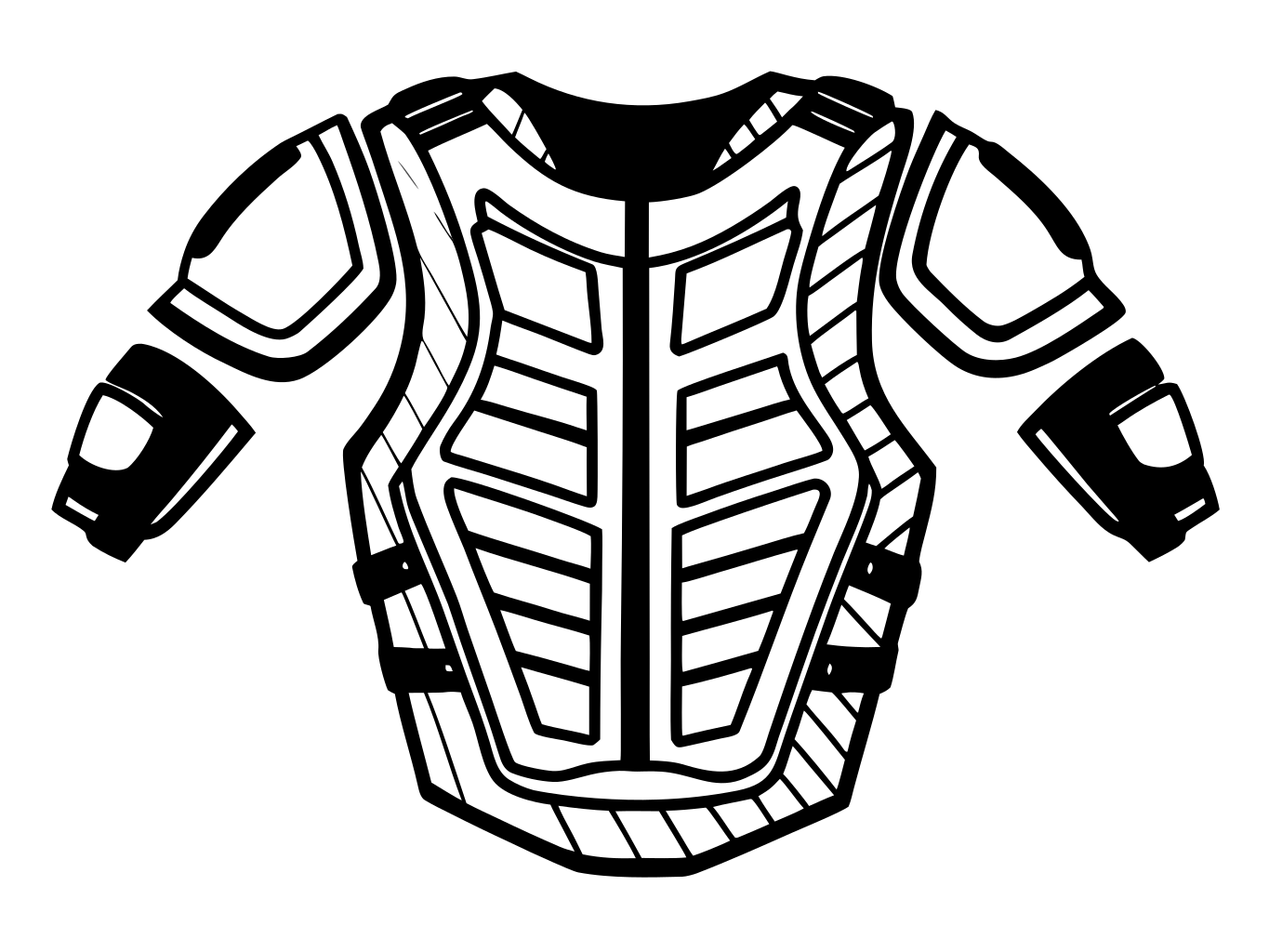
A chest protector is the only armor between your ribs and a rock edge, a log or your own handlebar. This guide explains what EN 1621-3 (chest) and EN 1621-2 (back) actually test, how a certified protector differs from a roost guard, and how to pick one you will still wear in hour six of a hot hard enduro day.
On this page
What a chest protector does in hard enduro
Most hard enduro crashes happen at walking pace. A tip-over on a rock step. A slide off a wet root. A failed climb that ends with you and the bike tumbling back down. Speed is low, but the torso lands on whatever is under it: a rock edge, a log, the bar clamp, the bike itself.
That is the job a certified chest and back protector is built for. The chest standard, EN 1621-3, says its tests are designed to show protection against impacts on edges such as kerbstones or the corner of a car roof. A rock step is the off-road version of that edge. The back standard, EN 1621-2, uses the same kerb-edge logic.
What the injury data says
- Enduro racing. A three-year prospective study at the Erzbergrodeo followed 2,923 starters. 6% had an accident. Most accidents happened in a curve when the front tire slid, and they mostly injured the arm and leg. More than 80% of counted injuries were superficial.
- When the torso is hit, it is serious. A pediatric trauma center reviewed 162 children injured in motocross. 30 (18.5%) had chest or abdominal injuries. 27% of those needed surgery and 50% needed intensive care. The authors describe focal, high-impact injuries to the chest and abdomen.
- Evidence for back protectors is thin. A 2016 systematic review found only two small cross-sectional studies on back protectors for motorcyclists. It concluded the evidence is too limited to be certain of the effect on spinal injuries, while noting hard-shell and standard-compliant protectors may be associated with fewer back and spine injuries.
Our view: a chest protector is a low-frequency, high-consequence item. The first two studies above are the basis for that. That is why it sits at four stars, below the five-star helmet, goggles, boots and knee protection.
Roost guard or certified protector: EN 14021 vs EN 1621
Two very different products look almost the same on a shelf.
- A roost guard (stone shield) is certified to EN 14021. BSI describes it as giving "limited protection against lofted stones and debris" in motocross and other off-road riding. It is not meant for people with a chest girth below 75 cm.
- A certified chest protector is certified to EN 1621-3, often paired with a back protector certified to EN 1621-2. These standards measure how much impact force passes through the protector.
EN 1621-3 draws the line itself. Its scope says that if a product only protects against lofted stones, EN 14021 applies. If it protects against impacts and stones, EN 1621-3 applies.
EN 14021 has a further catch. When BSI published it as a British Standard, the national foreword warned that the UK "consistently voted against its approval". UK experts said the average peak force requirement "may be too high".
A real example
Fox sells both kinds in the same Raceframe family:
| Product | What Fox states |
|---|---|
| Raceframe Roost Chest Guard | "CE EN 14021 certified stone shield"; foam inserts for extra chest and back protection sold separately |
| Raceframe Impact Soft Back CE D3O Chest Guard | "CE EN 1621-2 level 1 certified full back protection"; "CE prEN 1621-3 level 1 certified chest protection" |
A roost-only guard is the wrong tool for hard enduro, and the standards' own scopes show why. EN 14021 covers flying stones. Only EN 1621-3 and EN 1621-2 test what happens when you land on a rock.
EN 1621-3 and EN 1621-2 explained
The legal frame: PPE Regulation (EU) 2016/425
In the EU, motorcycle impact protectors are personal protective equipment under Regulation (EU) 2016/425. Alpinestars' EN 1621-3 manual classes its chest protectors as Category II. Category II covers "risks other than those listed in Categories I and III". For Category II, the regulation requires an EU type-examination (module B) by a notified body, then conformity to type (module C). A type-examination certificate is valid for a maximum of five years.
The regulation also sets what the maker must tell you: the protection classes, the standards used with their dates, the notified body, the internet address of the EU declaration of conformity and, where applicable, the month and year or period of obsolescence.
EN 1621-3:2018 — chest protectors
EN 1621-3 was prepared by CEN technical committee CEN/TC 162 and approved by CEN on 14 November 2018. The key points from the standard's own text:
- Two shapes. A full chest protector is one piece. A divided chest protector is two halves.
- Two sizes. Type A is the smaller protector and Type B the larger. The minimum protected zone is set for each type.
- Two levels. Level 1 is for soft protectors that meet the force transmission requirement only. Level 2 is for more rigid protectors that meet both force transmission and force distribution requirements. The standard notes that Level 2 can bring weight and restriction penalties.
- The test. The equipment list includes a dropping apparatus, a bar impactor, a hemispherical impactor, an anvil and force measurement. Samples are tested at ambient temperature and wet, with optional high and low temperature tests.
Why a distribution test? Alpinestars' user manual cites the EU-funded APROSYS research: spreading an impact load over the chest matters more than how much energy the protector absorbs. That is what Level 2 adds.
EN 1621-2:2014 — back protectors
EN 1621-2 defines three shapes:
| Code | Shape | Area it covers |
|---|---|---|
| FB | Full back | Central back and shoulder blade (scapula) area |
| CB | Central back | Central back (new in the 2014 edition) |
| LB | Lower back | Lumbar region |
Back protectors are sized by waist-to-shoulder length, measured on the body with a tape. The standard says this is used because there is no consistent link between that length and body height. The 2014 edition made the wet impact test mandatory and added optional high and low temperature tests.
The two levels carry force limits, set in Table 2 of EN 1621-2:2014 (clause 4.4). A 5 kg bar impactor hits the protector with 50 J of energy, and a load cell under the anvil measures the force that gets through. Level 1 allows a mean of no more than 18 kN, with no single strike above 24 kN. Level 2 allows a mean of no more than 9 kN, with no single strike above 12 kN. A protector only earns a level if it meets it in every test condition it claims, including the mandatory wet test. Lower transmitted force means better protection.
Shoulders: EN 1621-1
Some chest protectors add shoulder cups certified to EN 1621-1, the limb protector standard. MotoCAP describes that test as a 5 kg weight dropped from 1 m onto the protector. The full EN 1621-1 label guide is on our knee protection page.
What the standards do not cover
- Real crash forces. Both EN 1621-2 and EN 1621-3 say the force levels in their tests do not compare directly with the forces riders meet in accidents.
- Road-riding origin. The EN 1621-2 scope refers to "riders in normal traffic situations". Off-road riders use it because it is the back protector standard that exists.
- Abrasion. A 2016 review notes that EN 1621-2 assesses ergonomics and impact force reduction, not abrasion resistance.
- The neck. The EN 1621 series has four parts: limbs, back, chest and inflatable protectors. None covers the neck. See our neck brace guide.
How to read the label
The Alpinestars EN 1621-3 user manual explains the chest marking field by field. The back protector codes come from EN 1621-2 itself.
| Marking | What it means |
|---|---|
| CE | The maker declares conformity under Regulation (EU) 2016/425 |
| Motorcycle pictogram | The protector is intended for motorcycle use |
| EN 1621-3:2018 | Chest protector standard and its edition |
| C | Full (one-piece) chest protector |
| DC + L or R | Divided chest protector, left or right half |
| TYPE A / TYPE B | Smaller / larger protected zone |
| 1 or 2 | Protection level. A Level 2 chest protector also passed the force distribution test. A Level 2 back protector has the lower force limit |
| T+ / T– | Optional hot / cold impact test passed at the same level. SAS-TEC states T– as minus 10 °C and T+ as plus 40 °C |
| EN 1621-2:2014 FB / CB / LB | Back protector standard and shape |
| Size range, e.g. 46-50 | The waist-to-shoulder length range the back protector is certified for |
| EN 14021 | Stone shield only. No impact attenuation rating |
Check the zone, not just the CE mark
A "CE" chest protector can carry different certificates in different zones. The makers on this page list them per zone. The Leatt Chest Protector 6.5 Pro lists chest EN1621-3 Level 2, back EN1621-2 Level 2 and shoulder EN1621-1 Level 1. Read each line.
Watch for "prEN"
Fox lists its Raceframe Impact chest plates as "prEN 1621-3", the draft designation. When EN 1621-2:2014 was published, Part 3 was listed as "under development". The final EN 1621-3 was approved in November 2018. If the edition matters to you, check the EU declaration of conformity.
The declaration of conformity
Under the PPE Regulation, the product must come with the declaration or the web address where you can read it. Alpinestars publishes its declarations at eudeclaration.alpinestars.com. The declaration names the standard with its date and the notified body that examined the product.
Fit and sizing
A protector that has moved is not protecting anything. The makers' fitting rules:
- Size by the maker's chart, not by jersey size. Fox sizes its Raceframe Impact Soft Back by height and chest: S/M for 160–177 cm and a 85–102 cm chest; L/XL for 178–185 cm and a 104–117 cm chest. Leatt gives a 160–196 cm height range across S/M, L/XL and XXL for the 6.5 Pro.
- Check the back length. EN 1621-2 sizes back protectors by waist-to-shoulder length, not height. A plate that is too short leaves the lower spine bare.
- Tighten the shoulder straps until taut. Alpinestars' manual says to slide the strap adjusters up until the straps are tight.
- Put the plate on the upper chest. The same manual says the protector belongs on the upper chest, not the stomach.
- Check arm movement in riding posture. The protector should not be so wide that it limits your arms when you stand on the pegs.
- Try it with everything you ride in. Jersey, neck brace, hydration pack. Alpinestars says to try a protector with the garment it will be worn with.
What matters in hard enduro: heat, packs, braces and rocks
Heat and ventilation
Hard enduro days run long and hot, and most of the effort is off the seat. The PPE Regulation itself requires protectors that enclose the body to minimize perspiration. The makers answer with vents: Leatt lists ventilation slots, Fox "extensive laser perforated venting", Alpinestars a channeled, highly perforated back protector and a ribbed lining for airflow.
Alpinestars also warns that high or low temperatures can change how a protector performs, even when T+ or T– is marked.
Our view: for most hard enduro riders, Level 1 chest protection with the best back level you can tolerate is the right balance. Two things support that: the standard itself says Level 2 brings weight and restriction penalties, and hard enduro is ridden for hours at high effort, often walking and pushing the bike.
Over or under the jersey
Fox says its Raceframe Impact models can be worn over or under the jersey. Leatt says the 6.5 Pro's removable plates and BraceOn system allow a neck brace fit over or under the shirt. Alpinestars says the BNS neck support straps can go over or under the jersey. Whichever you choose, the fit rules below still apply.
Hydration packs
Pack straps sit on the same shoulders as the protector. Fit the pack and protector together, and reject any combination that drags the plate down your chest. The Alpinestars manual's fit rules are clear: the plate must stay on the upper chest and must not limit arm movement. See our hydration pack guide for harness types.
Neck brace integration
- Leatt's chest protectors use BraceOn. Leatt says all its body protection includes it and a Leatt brace can go over or under.
- The Alpinestars A-4 Plasma is BNS compatible via pull tabs on the shoulder pads.
- Leatt's FAQ says a brace can sit over a chest protector if it sits correctly on the shoulders, chest and thoracic area. The best place for the thoracic strut is against the body, under the chest protector.
The full fitting rules are in our neck brace guide.
Rocks, logs and handlebars
EN 1621-3 tests with a bar impactor and a hemispherical impactor. That is a fair lab stand-in for landing on a rock edge or the end of a log, because the standard's stated aim is protection against impacts on edges. It is also why a flexible roost shield is not enough when you practice log and rock crossings.
Coverage & compatibility
Use this order when you choose:
- Confirm a real impact standard. Look for EN 1621-3 on the chest and EN 1621-2 on the back. EN 14021 alone means a roost guard.
- Read the level per zone. A Level 2 chest plate also spreads the load. On the back, EN 1621-2 caps the mean transmitted force at 18 kN for Level 1 and 9 kN for Level 2.
- Check the back shape. FB covers the central back and shoulder blades. CB and LB cover less.
- Check side and shoulder coverage. The Leatt 6.5 Pro adds flank panels and EN 1621-1 shoulders. The A-4 Plasma adds detachable rib and shoulder padding.
- Confirm neck brace compatibility if you wear one: Leatt BraceOn, Alpinestars BNS tabs.
- Try it with your pack and brace in riding posture.
- Weigh the heat trade-off. The more rigid and complete the protector, the more it weighs. Leatt lists the 6.5 Pro from 1.99 kg.
- Check what is removable. Removable plates help cleaning. They do not mean you can ride without them.
Care, inspection and replacement
Cleaning
- Alpinestars: clean the chest protector with a damp cloth and soapy water. Do not submerge it. Never use strong cleaning agents or solvents.
- Fox: the Raceframe care label says machine wash cold and gentle, gentle detergent, line dry. No bleach, no iron, no dry cleaning.
- Leatt: follow the product care label. Leatt's FAQ calls following the washing instructions "a great start" for function and longevity.
Storage
Alpinestars says to store standalone protectors flat, with nothing heavy on top, in a dry ventilated area away from heat and direct sunlight. A hot van or a garage window is the opposite.
Inspection
Leatt says its products must be inspected before each use. Stop using one with torn seams, holes or damaged protectors.
Alpinestars says to replace a chest protector if it is degraded, cracked, chipped or delaminated. Replace it after a severe impact, especially if the plastic has turned lighter in color at the impact point. After lesser impacts, have it checked by a dealer. Never paint it or add stickers.
Age
Alpinestars strongly recommends replacing its protectors every 5 years under normal use. MotoCAP reports a jacket whose impact protectors had crumbled into powdery fragments inside the armor pockets, and warns that heat, moisture and age break protector materials down.
Date your protector the day you buy it. The 5-year guidance above needs a start date, and the MotoCAP case shows the damage can be invisible from the outside.
Common mistakes
- Buying a roost guard as impact armor. EN 14021 covers lofted stones only. The EN 1621-3 scope says so.
- Trusting "CE" without reading the zones. Chest, back and shoulders can each carry a different standard and level. Read every line on the label.
- Riding without the plates. Alpinestars says using a garment without its removable protectors voids the certification and gives no impact protection. Pulling the back plate on a hot day leaves the spine bare.
- Wearing it low. A plate sitting on the stomach leaves the upper chest open. The fit rule is upper chest.
- Keeping a whitened or cracked shell. Alpinestars treats lightened plastic at an impact point as a sign to replace it.
- Stacking a neck brace on shoulder pads. Alpinestars says the BNS shoulder pads must sit directly on the shoulders, not on shoulder protectors. Check the fit with both on. See our neck brace guide.
For the rest of the kit, see our hard enduro gear guide and how we build these pages on the gear methodology page.
Priority: ★★★★☆. Suggested share of a full kit's budget: 10%.
What the rating rests on: Four stars and about 10% of the kit budget. Torso impacts are less frequent than arm and leg injuries in enduro racing: a three-year study of Erzbergrodeo starters found most crashes injured arms and legs. But chest and abdominal injuries in off-road motorcycling tend to be serious when they happen: in a pediatric motocross trauma series, half of truncal injuries needed intensive care. A certified chest and back protector is the one piece of kit certified against that impact in a lab test. The maker list prices of the picks here run from $189.95 to $349.00 (USD).
Our suggested picks for hard enduro Chest Protector
Grouped by the maker's list price. No paid placements, no affiliate links. Every fact on a card links to the maker's own page.
Alpinestars A-4 Plasma Chest Protector
- Alpinestars
- US$189.95 list price (US)
Alpinestars pairs a semi-rigid thermoplastic chest protector with a Nucleon PLASMA back protector in the A-4 Plasma, profiled for off-road riding.
Certification declared by the maker
- Back protector: EN 1621-2:2014 LEVEL 1
- Chest protector: EN 1621-3:2018 LEVEL 1
Coverage: Chest (EN 1621-3:2018 Level 1), back (EN 1621-2:2014 Level 1), detachable rib and shoulder padding
Materials: Semi-rigid thermoplastic chest shell, Nucleon PLASMA bio-based viscoelastic compound, 3D mesh chassis
Features: Nucleon PLASMA back protector, BNS pull tabs, Detachable rib and shoulder padding
The A-4 Plasma combines a semi-rigid thermoplastic chest shell based on geodesic polyhedrons with a Nucleon PLASMA back protector made from a bio-based viscoelastic compound with no less than 25% bio-based content. It has over-injected flexible side wings, detachable and adjustable rib and shoulder padding, adjustable shoulder and side straps, a ribbed back lining and a perforated 3D mesh chassis. An optional Nucleon PLASMA Extended Roost Coverage kit lets the chest protector be used without the back protector.
Alpinestars lists the standards as back protector EN 1621-2:2014 Level 1 and chest protector EN 1621-3:2018 Level 1. It is compatible with the Alpinestars Bionic Neck Support via BNS pull tabs on the shoulder pads. Sizes are M/L and XL/2XL.
Why it is listed: it has EN 1621-3:2018 Level 1 chest and EN 1621-2:2014 Level 1 back certification at the lowest list price of the three picks, $189.95, which makes it the budget tier. It replaces the A-4 Max, which Alpinestars no longer lists.
Fox Raceframe Impact Soft Back CE D3O Chest Guard
- Fox
- US$199.95 list price (US)
Fox describes the Raceframe Impact Soft Back as its top-level chest guard, with D3O armor and a low-profile design worn over or under the jersey.
Certification declared by the maker
- CE EN 1621-2 level 1 certified full back protection
- CE prEN 1621-3 level 1 certified chest protection
Coverage: Chest (prEN 1621-3 Level 1), full back (EN 1621-2 Level 1)
Materials: D3O, ABS, EVA, Polyester, Polyurethane, Nylon
Features: D3O impact insert, Removable chest and back plate armor inserts
Fox calls the Raceframe Impact Soft Back CE D3O Chest Guard its top-level chest guard. It has an articulated, low-profile design built for the Rider Attack Position, removable chest and back plate armor inserts, D3O impact armor, laser-perforated venting, adjustable shoulder straps and waistband, and concealed buckles. Fox states it can be worn over or under the jersey.
Fox lists its certifications as "CE EN 1621-2 level 1 certified full back protection" and "CE prEN 1621-3 level 1 certified chest protection". Materials are listed as 31% ABS, 26% EVA, 21% polyester, 15% polyurethane and 7% nylon. Sizes are S/M (160–177 cm, 85–102 cm chest) and L/XL (178–185 cm, 104–117 cm chest). Care: machine wash cold and gentle, line dry.
Why it is listed: it pairs a Level 1 chest plate with Level 1 full back protection in a low-profile shell, at a $199.95 list price. That sits between the other two picks, so it is the value tier.
Leatt Chest Protector 6.5 Pro
- Leatt
- 1,990 g
- US$349 list price (International (int.leatt.com))
Leatt builds the Chest Protector 6.5 Pro from hard shell and 3DF AirFit soft impact foam for chest, back and shoulder protection, with flank panels for side impacts.
Certification declared by the maker
- Chest EN1621-3 Level 2
- Back EN1621-2 Level 2
- Shoulder EN1621-1 Level 1
- FFM - French Motorcycle Federation Certified
Coverage: Chest (EN 1621-3 Level 2), back (EN 1621-2 Level 2), shoulders (EN 1621-1 Level 1), flank panels
Materials: Hard shell, 3DF AirFit ventilated soft impact foam, Mesh base layer
Features: BraceOn, 3DF AirFit, Removable front and rear plates
Leatt lists the Chest Protector 6.5 Pro as CE tested and certified as impact protection: chest EN1621-3 Level 2, back EN1621-2 Level 2 and shoulder EN1621-1 Level 1. It uses a hard shell with 3DF AirFit ventilated soft impact foam, a multi-layer, multi-plate articulating design, adjustable over-the-shoulder straps, flank panels, ventilation slots and a mesh base layer.
The front and rear plates are removable. Leatt's BraceOn system allows a Leatt neck brace fit over or under the shirt. Leatt also lists it as FFM (French Motorcycle Federation) certified. Weight is listed as from 1.99 kg (4.39 lb). Sizes are S/M, L/XL and XXL, covering 160–196 cm.
Why it is listed: it is the only pick here with Level 2 on both chest and back, plus EN 1621-1 shoulders and flank panels. It is also the heaviest and the most expensive of the three at a $349.00 list price, which places it in the premium tier.
Sources
Budget tiers explained
Where a category has picks, they sit in three tiers. The tier follows the maker's list price within the category. A higher tier does not mean a higher certification level: check the label.
- Budget:
- Entry price. The essentials without the extras: a sound start for new riders or occasional use.
- Value:
- More for the money. More enduro-specific features, better adjustment and ventilation, at a mid-range list price.
- Premium:
- Top tier, fewer compromises. Lighter materials, more adjustment or more coverage, often with diminishing returns unless you ride a lot.
Explore other Top Hard Enduro Gear Categories
Gear lowers the cost of a fall. Control lowers how often you fall. Train it in Controls 101.