Top Hard Enduro Boots
Primary defense for feet, ankles and shins. Prioritize EN 13634 certification, torsional protection and a sole that grips when you walk; allocate more budget here.
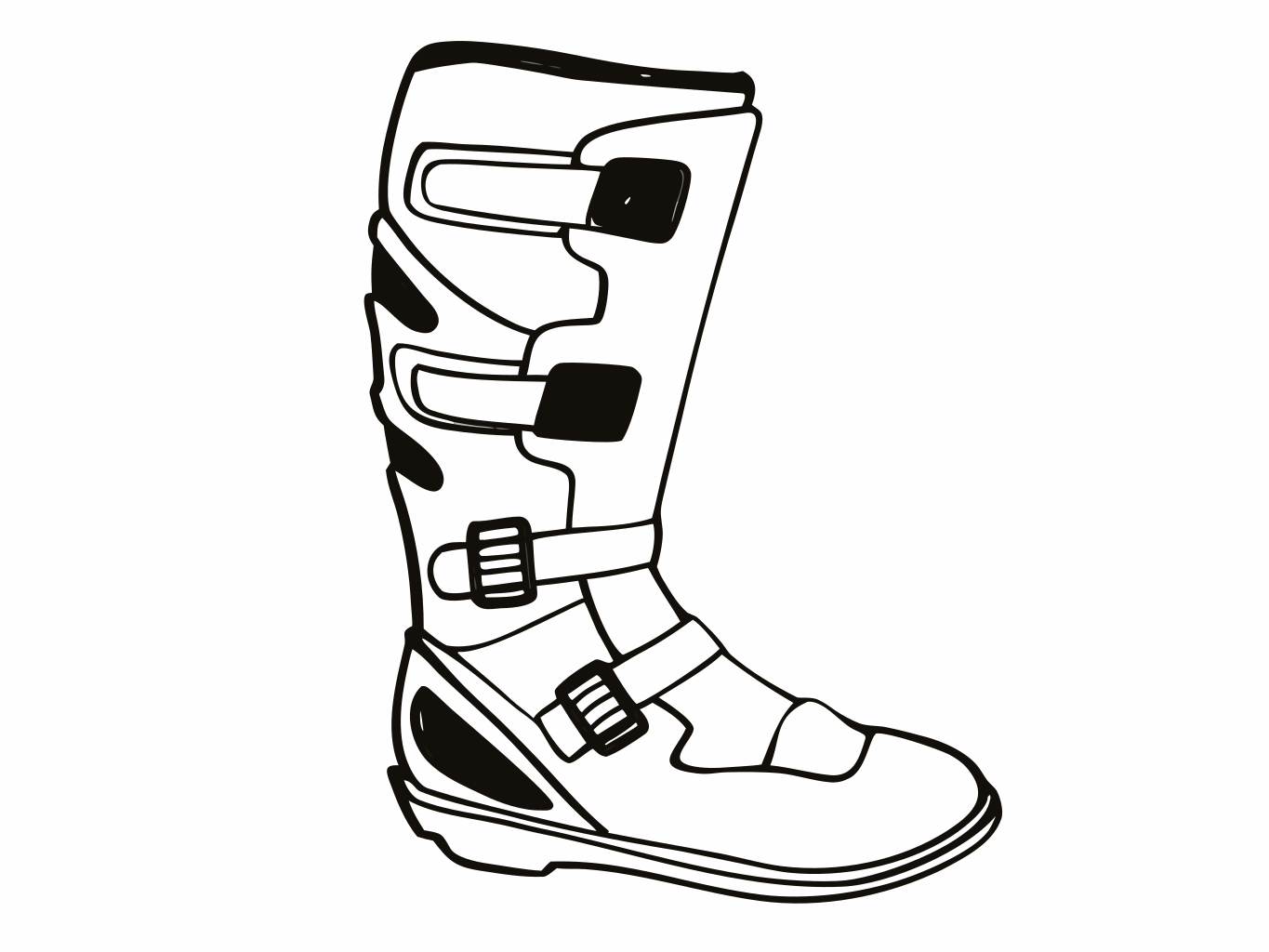
Boots take more abuse in hard enduro than any other piece of kit. They hold the pegs, fend off rocks and logs, and carry you on foot when the bike stops. This guide shows how to read the EN 13634 label, what the standard does and does not test, and how to pick a boot for slow, rocky, wet terrain.
On this page
What boots protect in hard enduro
A hard enduro boot protects the foot, ankle and shin from impact and crushing. It controls how far the ankle can bend. And it lets you walk, push and climb when the bike can't. Hard enduro loads all three at once. Speeds are low, but falls are frequent: on rock steps, roots and logs, at close to walking pace. The bike can land on a leg, or a foot can get caught between rocks as you dab. Then you get up and push. A boot you can't walk in costs energy all day. A boot that folds under a falling bike is worse.
The injury data points at the lower leg:
- Erzberg Rodeo, three years, 2,923 starters. A prospective study at the Red Bull Erzberg Rodeo found that 6% of starters had an accident. Most accidents happened in a curve after the front tire slid, and they mostly affected the arm and leg. More than 80% of the recorded injuries were superficial.
- UK motocross, five years, 210 patients. A regional trauma unit in Shrewsbury recorded motocross foot and ankle injuries prospectively from August 2010 to August 2015. 36% of patients needed an operation. Ankle fracture (23%) and ankle sprain (21%) were the most common injuries.
Our view: in hard enduro, boots rank just behind the helmet. Two things put them there. The Erzberg and Shrewsbury figures above point at the lower leg. And your feet are the part of you in contact with the rock all day.
EN 13634:2017 explained
EN 13634:2017, Protective footwear for motorcycle riders – Requirements and test methods, is the European standard for motorcycle boots. CEN publishes it and national standards bodies adopt it. The Estonian Centre for Standardisation lists EVS-EN 13634:2017 as valid from 2 January 2018. It replaced the 2015 edition and is linked to the PPE Regulation. Its scope covers footwear "for use while riding motorcycles for on or off road activities". So the same standard applies to a road touring boot and to a hard enduro boot.
Where it sits in EU law
Motorcycle boots are personal protective equipment under Regulation (EU) 2016/425. Annex I sorts PPE into three risk categories. Category I lists minimal risks, such as superficial mechanical injury. Category III lists risks that can kill, such as falls from a height or drowning. Everything else is Category II, which is where motorcycle boots sit. For Category II, a notified body type-examines the design (module B) and the maker ensures each boot conforms to that type (module C). Alpinestars' EN 13634:2017 booklet names its notified body on the back cover.
What the lab tests
The UK test house SATRA summarizes the standard's tests:
- Design: upper height and seam construction.
- Whole boot: upper-to-outsole bond strength and transverse rigidity.
- Components: tear strength, lining and insole abrasion, pH, and chrome VI in leather.
- Upper protection: impact abrasion and impact cut, using EN 13595 parts 2 and 4.
- Outsole: abrasion, hydrolysis (for polyurethane), bond strength, cleat design and thickness.
The two protective tests come from the clothing standard. In the EN 13595-2 impact abrasion test, a specimen drops 50 mm onto a 60-grit abrasive belt moving at 8 m/s. A trip wire under the sample times how long it takes to hole. In the EN 13595-4 impact cut test, a striker with a blade drops onto the material and the lab measures how far the blade gets through.
Level 1 and Level 2 in numbers
The standard scores four properties at two levels. Alpinestars' EN 13634:2017 user booklet prints the requirements:
| Property | Level 1 | Level 2 |
|---|---|---|
| Height of the upper (EU sizes 41–42, H2 / H1) | at least 113 / 70 mm | at least 178 / 123 mm |
| Impact abrasion | flex areas ≥ 1.5 s, upper ≥ 2.5 s | flex areas ≥ 5 s, upper ≥ 12 s |
| Impact cut | penetration ≤ 25 mm in flex areas (2.0 m/s) and upper (2.8 m/s) | ≤ 25 mm in flex areas (2.0 m/s), ≤ 15 mm in the upper (2.8 m/s) |
| Whole-boot transverse rigidity | peak value ≥ 1.0 kN | peak value ≥ 1.5 kN |
The height requirement grows with size. For H2 it runs from 103 mm (Level 1, EU 36 and below) to 192 mm (Level 2, EU 45 and above). H1 and H2 are two measuring points on the upper defined in a figure in the standard.
Level 2 means more protection in that property. Alpinestars' booklet adds that Level 2 "is often associated with heavier and bulkier products".
Optional tests
SATRA lists five optional properties a maker can claim, from shin and ankle impact protection to water resistance. Each has its own code on the label (see the next section).
What EN 13634 does not cover
- Twisting and hyperextension. None of the tests in SATRA's summary measures how well a boot stops the ankle from twisting or over-bending. Pivots, hinges and inner braces are maker designs. The label does not score them.
- Everything the lab can't simulate. Alpinestars' booklet says its boots give "ONLY limited protection against abrasion, cuts by blunt objects and lateral compression of the foot". It also warns that high or low temperatures can change how the protection performs.
For hard enduro, the height and transverse rigidity digits matter more than the abrasion and cut digits. That comes down to what each test models. The abrasion test runs a belt at 8 m/s, which reflects a slide on a hard surface. Hard enduro crashes happen at walking pace, where the loads are a bike landing on the foot and rocks hitting the lower leg from the side.
How to read an EN 13634 boot label
The marking sits on a label inside the boot. Alpinestars' booklet shows the layout: the CE mark, a motorcycle pictogram, the standard, and a row of four digits with optional codes after them. It gives "1 2 1 2" as its example, with this order:
| Position or code | Meaning |
|---|---|
| Motorcycle pictogram | The item is for motorcycle use |
| EN 13634:2017 | The standard the boot was certified to |
| 1st digit (a) | Height of the upper: level 1 or 2 |
| 2nd digit (b) | Impact abrasion: level passed |
| 3rd digit (c) | Impact cut: level passed |
| 4th digit (d) | Transverse rigidity: level passed |
| IPA | Ankle impact protection tested and passed |
| IPS | Shin impact protection tested and passed |
| WR | Water resistance tested and passed |
| WAD | Insole or insock meets the water absorption/desorption requirement |
| FO | Outsole resistance to fuel oil tested and passed |
| SRA, SRB or SRC | Outsole slip resistance tested and passed |
| B | Water vapor permeability of the upper tested and passed |
So "2 2 2 2" is top level in every field. "1 2 1 2" is a lower boot with Level 2 abrasion and Level 2 rigidity. A boot with "WR" has passed a water test; a boot with no "WR" may still use a membrane, but that claim is not part of its certification.
The label also carries the production year and month, which matters for replacement.
Where to find the levels
The Alpinestars and Gaerne product pages for the boots below state only "EN 13634:2017", without the digits. Alpinestars' booklet says to "read the level your footwear reaches directly in the label". Forma is an exception: its US site lists the Predator 2.0 as "CE Level Protection (2/2/2/2)". Check the label in the shop, or ask the maker before you buy online.
The declaration of conformity
Annex II of the PPE Regulation says the maker's instructions must name the notified body (with its number), give the standard with its date, and give the web address of the EU declaration of conformity. Alpinestars publishes its declarations at eudeclaration.alpinestars.com. If a boot sold in the EU claims protection but has no CE mark, no standard on the label and no declaration, treat it as uncertified.
Sizing and fit
A protective boot only protects if it stays put on your foot and leg. Alpinestars' booklet for its EN 13634 boots gives a clear fitting routine:
- Start from your normal shoe size, but try the boot. Sizes vary between models.
- Wear the socks you ride in.
- Close the fasteners from the bottom buckle up. Adjust for a snug fit that is not too tight.
- Walk, bend over and sit on a bike. Check for pressure points in each position.
- Expect off-road boots to feel stiff until they are broken in. Alpinestars advises erring on a tighter fit that loosens with time, rather than a loose fit that gets slack.
Two checks to add for hard enduro:
- Try them with your knee braces. The top of the boot and the bottom of a brace share the same few centimeters of shin. Gaerne makes the top two buckles of the SG12 Enduro adjustable "to accommodate larger legs or knee braces". The Tech 7 Enduro has "expanded calf adjustability". See knee protection for brace fit.
- Walk up a slope in the shop. Watch for heel lift. A heel that lifts on a ramp will rub on a long push. Why: the heel moves most when the ankle bends, and pushing a bike uphill bends the ankle for minutes at a time.
What matters in hard enduro boots
Walking and pushing
Hard enduro adds long spells on foot. Look for a flex zone in the forefoot. Alpinestars gives the Tech 7 Enduro a "front flex zone" for "better walking comfort", and the Tech 10 Enduro "an ultra-thin and flexible forefoot area". Break the boots in before a big event, not at it. Alpinestars notes that off-road boots are stiff until broken in.
Rock and log hits at low speed
Low speed does not mean low load. A rock edge or a falling bike can hit the foot from the side or the top. Hard toe boxes, heel counters and shin plates take these hits. Alpinestars lists TPU protection on the toes, foot, heel, ankle, calf and shin of the Tech 7 Enduro, with harder compounds on the toe box and heel. Gaerne gives the SG12 a PU-injected shin plate and a shaped heel cup. The transverse rigidity digit on the label tells you how much side load the whole boot passed. For line choice on rock, see logs and rocks.
Sole grip vs stiffness
A motocross sole is made for peg feel. An enduro sole adds tread for walking and climbing. The makers here all sell enduro soles: Alpinestars' "Enduro dual-compound sole", the "Gaerne Enduro Sole" on the SG12 Enduro, and Forma's Enduro Terra replacement sole. Stiffness comes from what sits under the foot. The Tech 3 Enduro and Tech 10 Enduro use a metal shank, and the Forma Predator 2.0 a steel shank.
For hard enduro, we'd choose an enduro sole over a motocross sole, because you spend far more time on foot on rock and roots than a motocross rider does, and the enduro tread is designed for exactly that. Some peg feel is the trade-off.
Water: drainage vs waterproof
Alpinestars sells the Tech 7 Enduro in three versions: plain, Drystar (a "waterproof, breathable Drystar inner bootie") and GORE-TEX. Plain boots use gaiters that "help seal out excessive water and dirt entry". That is not the same as waterproof.
Our view: for rides with deep crossings, a boot without a membrane is often the better choice. The reason: once water comes over the collar, a membrane that keeps water out also keeps it in, and a flooded waterproof boot stays wet for the rest of the day. For cold, wet trail days with shallow water, a membrane keeps feet warmer. If waterproofing matters to you, look for "WR" on the label; that is the only certified water claim. For technique, see water crossings.
Heat
The inside of the boot rests against the frame and passes near the exhaust. Alpinestars uses a medial TPU panel "for heat resistance and abrasion resistance". Gaerne's "Grip Guard" rubber doubles as "heat-resistant padding against the inner leg". The Tech 10 Enduro has ventilation windows in the shin plate. For heat management on long days, see hydration.
Hinges and pivots
Every premium boot here uses a hinge or pivot system to control ankle movement:
| Boot | System (maker's name) | What the maker says it does |
|---|---|---|
| Alpinestars Tech 7 Enduro | Medial and lateral dual pivot | Supports controlled movement |
| Alpinestars Tech 10 Enduro | Frontal Flex Frame, ankle control system, inner ankle brace | Prevents over-compression and hyperextension |
| Gaerne SG12 Enduro | DSPS (Dual Stage Pivot System) | Lateral support; prevents over-compression and hyperextension |
| Forma Predator 2.0 | FCS Dual-Pivot Bracing | Minimal lateral movement during flex |
Remember that EN 13634 does not test these systems. They are the makers' own engineering. For more on the brand, see Alpinestars.
Knee-brace compatibility
Check the top of the boot with your brace on. Adjustable top buckles and calf straps make room. Fit boots and braces together, on the same day. That's because the boot collar and the bottom of the brace share the same part of the shin, so each changes how the other fits.
Boots priorities
- Certification first. Look for EN 13634:2017 on the label and read the four digits. For hard enduro, give most weight to a "2" in height (first digit) and a "2" in transverse rigidity (fourth digit).
- Protection you can see. Shin plate, toe box, heel counter and a hinge or brace system. Sturdy buckles that close with gloves on.
- An enduro sole. Tread for off-bike traction on rocks and logs, not a flat motocross sole.
- Fit with your gear. Wear your riding socks and knee braces. No heel lift. Room in the calf.
- Water strategy. Membrane for cold and wet trail days. No membrane for deep crossings and heat.
- Replaceable parts. Soles, buckles and straps sold separately extend a boot's life. Alpinestars lists a Tech-7 Sole Set at $38.95 (US). Gaerne and Forma sell buckles, straps and inserts for the SG12 and Predator.
- Budget. The picks below run from $299.95 (Tech 3 Enduro) to $749.95 (Tech 10 Enduro), Alpinestars US list prices.
Care, resoling and replacement
Cleaning and drying
Alpinestars' care rules for its EN 13634 boots:
- Clean under running water with a sponge. High-pressure washing is not recommended.
- Never use strong cleaning agents or solvents. They can weaken materials and affect the plastic.
- Wipe off surface water and dry the boots on their sides. This stops the top of the boot compressing the ankle area.
- Remove any inner bootie and let it dry separately.
- Never dry boots on a direct heat source such as a fire or radiator. Leather goes stiff.
- Condition leather occasionally.
Storage
Keep boots closed between rides so they hold their shape. Store them dry and ventilated, never in plastic bags, which Alpinestars says promote mold.
Parts, soles and repairs
- Alpinestars sells buckles, straps and soles for some models and shows how to fit buckles and straps. Otherwise it tells users not to repair boots themselves and to ask a dealer about its repair service.
- Gaerne builds the SG12 with a Goodyear welt, which it says "allows for easy resoling".
- Forma sells an Enduro Terra replacement sole for the Predator and "any boots with a welt sole (stitched)". It must be fitted by a professional cobbler. Forma's Predator pivot bolts need blue liquid Loctite on the threads.
When to replace
- After a crash: inspect the boots thoroughly. If a boot can no longer be fastened properly, or has holes or tears, Alpinestars says it is no longer fit for use.
- Worn soles and buckles: check tread depth and buckle function regularly, per Alpinestars.
- Age: Alpinestars "strongly recommends replacing your footwear 5 years from date of manufacture". The year is on the internal label. Plastic parts age with riding stress, heat and sunlight. Leather and textiles lose structural integrity over time.
Common mistakes
- Trusting the word "enduro" instead of the label. The product page often says only "EN 13634:2017". The digits that matter are inside the boot.
- Riding hard enduro on a motocross sole. It is made for the pegs, not for pushing on wet rock.
- Buying boots loose. Alpinestars notes new off-road boots loosen with use.
- Drying boots by the fire or pressure-washing them. Alpinestars advises against both. Direct heat stiffens the leather.
- Assuming waterproof is always better. On rides with deep water, a membrane holds water in once it floods.
- Ignoring loose pivots and buckles. Check screws and bolts after rides. Forma specifies thread-locker for its pivot bolts.
- Riding boots past their life. Alpinestars recommends replacing footwear five years from manufacture, sooner after crash damage.
Priority: ★★★★★. Suggested share of a full kit's budget: 20%.
What the rating rests on: Boots get five stars and 20% of the budget because the foot and ankle are where off-road fractures cluster: at four International Six Days Enduro events, foot and ankle fractures were the most common fractures (36%), and in a five-year UK trauma-unit study of 210 motocross foot and ankle injuries, 36% of patients needed surgery and ankle fracture was the most common injury. Boots also have their own EN standard, EN 13634:2017, whose scope names off-road riding. And a certified enduro boot is a large purchase: maker list prices for the boots below run from $299.95 to $749.95.
Our suggested picks for hard enduro Boots
Grouped by the maker's list price. No paid placements, no affiliate links. Every fact on a card links to the maker's own page.
Alpinestars Tech 3 Enduro Boots
- Alpinestars
- US$299.95 list price (US)
Alpinestars' entry enduro boot, with a dedicated enduro compound sole and CE certification to EN 13634:2017.
Certification declared by the maker
- EN 13634:2017
Materials: Microfiber upper, TPU shin plate and protectors, Rubber compound outsole
Features: Biomechanical medial blade system, Metal shank, Replaceable buckles, sole and footpeg insert
Alpinestars builds the Tech 3 Enduro on a one-piece, dual-compound TPU foot shell with a metal shank. The upper is microfiber, with TPU calf, medial, lateral ankle and heel protection and an injected TPU shin plate. A biomechanical medial blade system allows front and rear flex while supporting the ankle. It closes with three polymer buckles on a self-aligning, quick-release system, and Alpinestars states that all the buckles are replaceable. The enduro compound sole and the footpeg insert are also replaceable. A waterproof version, the Tech 3 Enduro Waterproof, lists at $354.95.
Why it is listed: it is the lowest-priced boot here at $299.95 (Alpinestars US list price), it carries EN 13634:2017 certification, it has an enduro-specific sole, and its sole and buckles are replaceable.
Alpinestars Tech 7 Enduro Boots
- Alpinestars
- US$519.95 list price (US)
An enduro version of the Tech 7 with a dual-compound enduro sole, medial and lateral dual pivots and CE certification to EN 13634:2017.
Certification declared by the maker
- EN 13634:2017
Materials: PU-reinforced microfiber upper, TPU protection, Microfiber gaiter
Features: Medial and lateral dual pivot, Enduro dual-compound sole, Shock-absorbing front bellow inserts
Alpinestars describes the Tech 7 Enduro as built for "technical enduro terrain". It has an enduro dual-compound sole, a medial and lateral dual pivot system, and a PU-reinforced microfiber upper. TPU protection covers the toes, foot, heel, ankle, calf and shin, with harder compounds at the toe box and heel. A medial TPU panel resists heat and abrasion. Buckles are polymer on a high-impact aluminum frame with a self-aligning quick release. A front flex zone aids walking, and the calf adjustment is expanded. Alpinestars also sells the boot as the 2026 Tech 7 Enduro Drystar ($529.95), with a waterproof, breathable inner bootie and swappable buckles, outer sole and footpeg inserts, and as the Tech 7 Enduro GORE-TEX ($599.95). A Tech-7 Sole Set lists at $38.95.
Why it is listed: it has EN 13634:2017 certification, an enduro sole, a dual-pivot ankle system and replaceable soles, at $519.95 (Alpinestars US list price), the middle of the price range on this page.
Alpinestars Tech 10 Enduro Boots
- Alpinestars
- US$749.95 list price (US)
The enduro version of Alpinestars' flagship Tech 10, with a redesigned enduro sole and CE certification to EN 13634:2017.
Certification declared by the maker
- EN 13634:2017
Materials: Microfiber upper, TPU lower shell with metal shank, Poly-fabric lining with 3D open-cell foam
Features: Frontal Flexion Control Frame, Dynamic Heel Compression Protector, Inner ankle brace
The Tech 10 Enduro takes Alpinestars' flagship motocross boot and fits a dedicated enduro dual-compound sole to a multi-density foot base. The patented Frontal Flexion Control Frame works with front and rear blade connectors to control forward and rearward flex. An ankle control system in the outer shell works with an inner ankle brace and the patented Dynamic Heel Compression Protector. The TPU lower shell has a metal shank. The microfiber upper carries TPU protection on the toes, foot, heel, ankle, calf and shin. The shin plate has ventilation windows. It closes with polymer buckles on an aluminum frame. Alpinestars also sells a Tech 10 inner bootie separately ($239.95).
Why it is listed: it is the most expensive boot here at $749.95 (Alpinestars US list price), with EN 13634:2017 certification, an enduro sole, the patented Frontal Flexion Control Frame and the Dynamic Heel Compression Protector.
Gaerne SG12 Enduro
- Gaerne
- €579.9 list price (EU (Italy))
The enduro version of Gaerne's SG12, with the Gaerne Enduro Sole, the Dual Stage Pivot System and a resoleable Goodyear welt.
Certification declared by the maker
- EN 13634:2017
Features: DSPS (Dual Stage Pivot System), Goodyear welted construction, Grip Guard heat-resistant inner panel
Gaerne's SG12 Enduro uses the Dual Stage Pivot System (DSPS) for lateral support against over-compression and hyperextension. It has a PU-injected shin plate, a shaped heel cup and four lightweight, replaceable buckles plus a Velcro top strap. The top two buckles adjust to fit larger legs or knee braces. "Grip Guard" rubber on the inner side grips the bike and acts as heat-resistant padding. The sole is the Gaerne Enduro Sole on a Goodyear welted construction that Gaerne says allows easy resoling. Gaerne states it is made in Italy and CE certified to EN 13634:2017 and Regulation (EU) 2016/425. Gaerne's spare-parts page lists SG12 steel toe kits and aluminum ankle protector inserts.
Why it is listed: EN 13634:2017 certification, an enduro sole, knee-brace-friendly top buckles and a resoleable welted build, at €579.90 (Gaerne EU list price).
Forma Predator 2.0
- Forma
- €449.95 list price (EU (Italy))
Forma's top off-road boot, with FCS Dual-Pivot Bracing and a stated CE level of 2/2/2/2.
Certification declared by the maker
- CE Level Protection (2/2/2/2)
Features: FCS Dual-Pivot Bracing, Steel shank, Stainless toe cap
Forma's US site lists the Predator 2.0 with "CE Level Protection (2/2/2/2)" and FCS Dual-Pivot Bracing, an ankle support frame built into the boot to limit lateral movement during flex. It has a Pro Motocross Sole, a steel shank, a stainless toe cap, heat gripper inserts, injection-molded protection, a four-strap alloy buckle system with locking straps and a quick-dry lining. Forma gives an average weight of 6 lb per boot. It is made in Europe. Forma sells Predator strap and retainer kits and pivot bolts, and lists its Enduro Terra replacement sole as compatible with the Predator; it must be fitted by a professional cobbler.
Why it is listed: it is the only boot here whose maker publishes all four EN 13634 digits, and all four are Level 2. It comes with a motocross sole, so for hard enduro, budget for the Enduro Terra sole swap. List price €449.95 on Forma's EU site.
Budget tiers explained
Where a category has picks, they sit in three tiers. The tier follows the maker's list price within the category. A higher tier does not mean a higher certification level: check the label.
- Budget:
- Entry price. The essentials without the extras: a sound start for new riders or occasional use.
- Value:
- More for the money. More enduro-specific features, better adjustment and ventilation, at a mid-range list price.
- Premium:
- Top tier, fewer compromises. Lighter materials, more adjustment or more coverage, often with diminishing returns unless you ride a lot.
Explore other Top Hard Enduro Gear Categories

Gear lowers the cost of a fall. Control lowers how often you fall. Train it in Controls 101.