Top Hard Enduro Goggles
Eye protection is critical because eyes are very vulnerable in hard enduro. Clear vision is control. Prioritize a secure fit in your helmet, a wide field of view, anti‑fog, and tear‑off/roll‑off compatibility for wet days.
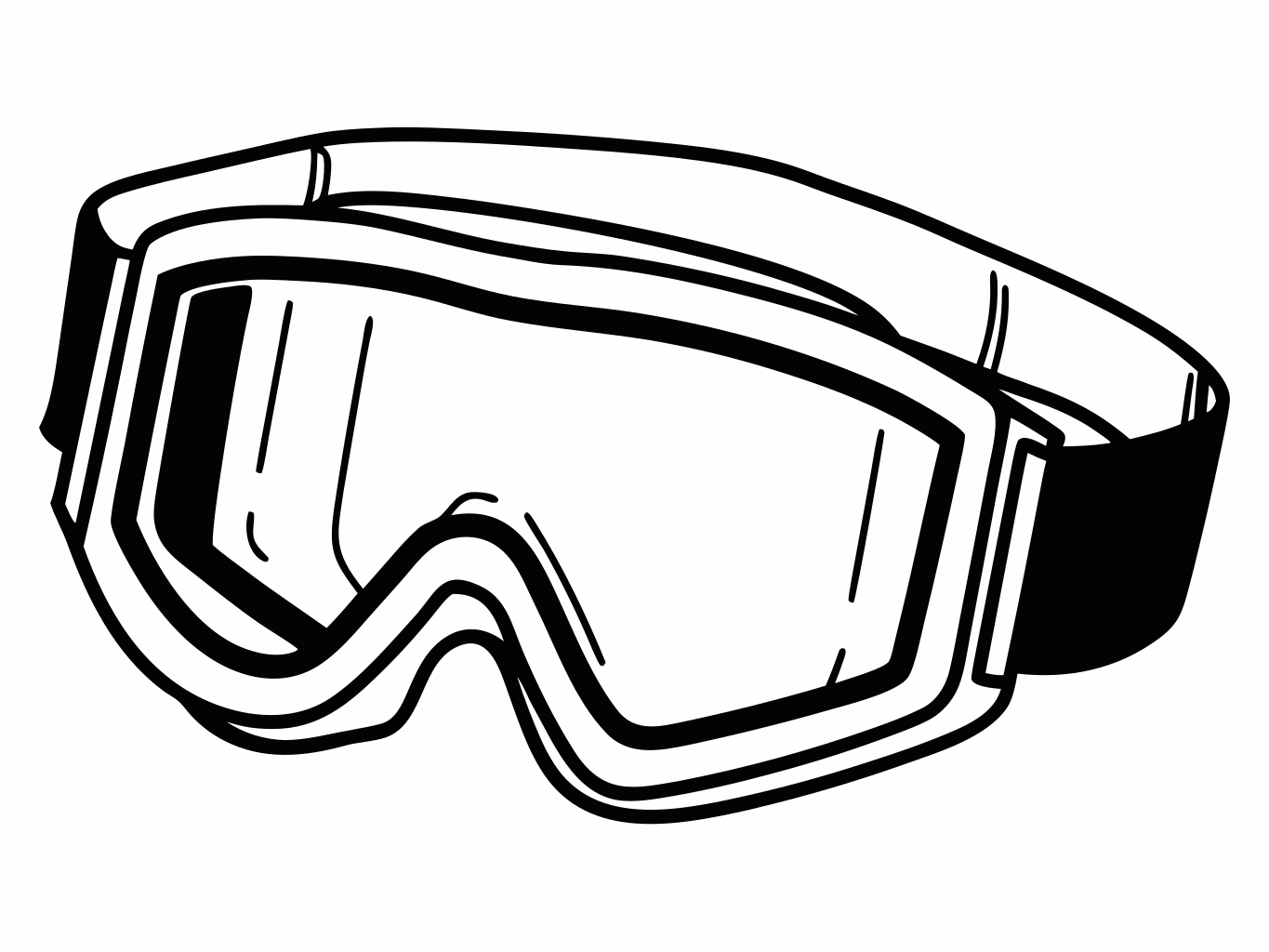
Off-road helmets have no visor, so your goggles are your eye protection. This guide explains the European goggle standard, EN 1938, what the lens markings mean, how to deal with mud and fog, and how to fit goggles to your helmet. It then lists current goggles with each maker's own specs.
On this page
- What goggles do in hard enduro
- The standard: EN 1938 (and what ANSI Z87.1 is)
- How to read goggle markings and lens categories
- Lens types: clear, tinted, mirror, dual-pane
- Tear-offs vs roll-offs
- Fog: why it happens and what helps
- Glasses under goggles (OTG)
- Fit the goggle to your helmet
- How to choose goggles for hard enduro
- Care, inspection and replacement
- Common goggle mistakes
What goggles do in hard enduro
An off-road helmet has a peak and an open eye port. It has no visor. NHTSA's own description of off-road helmets says they "require goggles" (NHTSA). The goggle is the only thing between your eyes and what the trail throws at them.
In hard enduro that means:
- Roost and stones from the rider in front on climbs.
- Branches and twigs on tight forest singletrack.
- Mud and water from water crossings and your own front wheel.
- Dust on dry days.
- Fog. Slow riding and hard work produce heat and moisture with little air moving through the goggle.
Clear vision is control. You cannot pick a line over rocks and logs that you cannot see. A goggle that fogs or clogs with mud forces you to stop, or to ride half-blind. The goggle does not replace your helmet. The two have to work as one.
The standard: EN 1938 (and what ANSI Z87.1 is)
EN 1938: goggles for motorcycle and moped users
The European standard for motorcycle goggles is EN 1938:2010, "Personal eye protection. Goggles for motorcycle and moped users". BSI publishes it in the UK as BS EN 1938:2010, identical to EN 1938:2010. BSI lists it as current and under review, and as a designated standard. Its catalogue subjects include impact testing, transmittance, ultraviolet radiation, field of vision, marking and instructions for use.
In the EU, goggles are personal protective equipment under Regulation (EU) 2016/425. Under that regulation, protective equipment that conforms to a harmonised standard published in the Official Journal is presumed to meet the regulation's essential health and safety requirements (Commission Implementing Decision (EU) 2020/668, recital 1).
What the makers here actually claim
- 100% Armega. The booklet states the goggle is made "in conformity with the basic requirement established by the Regulation (EU) 2016/425", is marked "EN 1938:2010", and was certified by CERTOTTICA (notified body 0530) in Italy. It points to an online EU declaration of conformity (Armega booklet).
- Oakley Airbrake MX. Oakley's product page states it "meets EN 1938 standard for eyewear protection" (Oakley).
- 100% Accuri 2 OTG. 100%'s product page does not name a standard.
What the Armega booklet says the goggle is for
100% is plain about the limits. Its booklet says: "This is not a safety goggle. This goggle is intended for motorsports use only except official races and competitions. It is for protection from wind, solar radiation, and impacts from water and mud." Read your own goggle's leaflet. It tells you what the maker certified it for.
ANSI Z87.1 is a workplace standard
ANSI/ISEA Z87.1 is titled "Occupational and Educational Personal Eye and Face Protection Devices". It is the standard OSHA points to for workplace eye protection (29 CFR 1910.133). It is not a motorcycle goggle standard, and none of the three goggle pages here claims it. The US motorcycle helmet rule, FMVSS No. 218, applies to helmets only.
Where UN Regulation No. 22 fits
UN Regulation No. 22 approves helmets and their visors, not goggles. It does require that a helmet without visor mounts does not prevent the wearing of goggles (paragraph 6.5). Its tear-off rule applies to visors: tear-off films "are not for use on the road and are not covered by this Regulation" (paragraph 2.10.2).
How to read goggle markings and lens categories
The markings 100% lists for the Armega are the standard number (EN 1938:2010) and the brand. The booklet also gives the filter categories used for its lenses (Armega booklet).
| Filter category | Visible light transmission | 100%'s lens example and use |
|---|---|---|
| 0 | 80–100% | Clear: "maximum light allowance for all conditions" |
| 1 | 43–80% | Smoke: "medium to bright light conditions" |
| 2 | 18–43% | Silver mirror on smoke base: "bright light conditions" |
The booklet warns: "Lenses with luminous transmittance less than 75% are not suitable for night or twilight use." Category 2 is "not suitable for night driving or twilight conditions".
What to look for
- The standard number on the goggle or in its leaflet (EN 1938:2010 for Europe).
- A filter category or light transmission figure for each lens you buy.
- For EU sales, the name of the notified body and a link to the EU declaration of conformity.
- UV protection. 100% states its lenses block UVA, UVB and UVC up to 400 nm (UV400). Oakley states the same for its Plutonite lens.
- Genuine replacement lenses. 100% says to trust only its own "CE certified replacement lenses, parts and accessories".
Lens types: clear, tinted, mirror, dual-pane
- Clear. Category 0. The one lens 100% rates for all conditions.
- Tinted and mirror. Categories 1 and 2. For bright, open ground. Not for dusk, forest shade or night.
- Contrast lenses. 100% sells HiPER lenses, which it says enhance "detail and contrast". Oakley sells Prizm MX lenses. These are the makers' own tint designs.
- Dual-pane. Two lens layers instead of one. 100% makes an Accuri 2 Enduro Moto version "with a dual pane lens".
- Lens material. 100%'s goggle lenses are polycarbonate. The Armega uses an "injection-molded 2mm lens". Oakley uses injection-molded Plutonite.
Our view: in hard enduro, carry a clear lens first and a tint only for open, sunny ground. Two facts drive this. In 100%'s own ratings above, clear is the only lens rated for all conditions. And hard enduro runs in and out of forest shade, where a tint below 75% transmission is not rated for low light.
Lens change systems
A fast lens change matters when a lens is scratched or caked. Oakley uses Switchlock. The Armega uses a dual-lever quick-release with six locking tabs. The Accuri 2 uses a 9-point lens retention system, and 100% says the Racecraft 2, Accuri 2 and Strata 2 share the same lens and tear-offs.
Tear-offs vs roll-offs
Tear-offs
Tear-offs are thin clear films on posts at the side of the lens. You pull one off to clear the view. 100% explains the two kinds (100% FAQ):
| Type | How it works | 100%'s guidance |
|---|---|---|
| Standard | Single sheets, pulled one at a time | Up to 5 fitted at once |
| Laminated | Sheets bonded in the field of view, with 7 pull tabs per stack | Up to 4 stacks, 28 tear-offs in total |
100% adds: "always ensure that your vision is not impaired prior to riding." Laminated stacks with a perimeter seal must have the backing removed and be pressed on firmly (Armega booklet). Oakley ships the Airbrake MX with a stack of 7 laminated tear-offs.
Roll-offs
A roll-off, or film system, replaces the tear-off stack with a film fed from a canister across the lens. 100% sells its ForeCast system for the Armega and a ForeCast version of the Accuri 2. Its parts list shows what the system involves: a clear shield and an "engine canister" kit.
Which one for hard enduro
Use roll-offs for sustained mud and tear-offs for dust and occasional splashes. The numbers above explain why: tear-offs are a fixed count (28 at most in 100%'s laminated system), and a mud race can use them up. A roll-off costs more and adds parts: 100% lists the Armega ForeCast film system at $74.95.
Whatever you use, carry the used films home. They are litter on the trail.
Fog: why it happens and what helps
Hard enduro is ridden slowly and hard. You breathe hard and sweat. Warm, wet air from your face meets a cooler lens, and at walking pace little air moves through the goggle to carry it away.
What the makers build in:
- Anti-fog coatings. Oakley: "optically correct lens with F3 Anti-fog coating". 100% Accuri 2: "anti-fog coated polycarbonate lens".
- Airflow. Armega: "air intake and exhaust ports filters air through goggle", plus a sweat channel that carries sweat out through the frame.
- Dual-pane lenses. The 100% Accuri 2 Enduro Moto version has one.
- Foam that absorbs sweat. Both 100% goggles and the Oakley use triple-layer face foam.
How to keep coatings working
Coatings are easy to ruin. 100% says: "Never use any chemical to clean the lens – only water and a microfiber cloth." The Armega booklet adds: blot the lens dry, and do not use paper products, which damage the lens and coatings.
Carry a spare goggle or lens on long days. The makers' own care rules are the reason: once a coating is scratched or wiped wrong it cannot be restored on the trail, and 100% says scratched lenses should be replaced immediately.
Glasses under goggles (OTG)
OTG means "over the glasses". An OTG goggle has a deeper frame and cut-outs so your glasses fit inside.
The 100% Accuri 2 OTG has an "integrated temple arm pocket with cushioning foam" and is described as fitting "comfortably over most eyewear". Try it with your own frames and your own helmet. Check that the goggle does not press the frames into your nose or temples.
100% also points riders who need a prescription to its prescription-compatible range (100% FAQ).
Fit the goggle to your helmet
The goggle has to seal to your face and sit in the helmet's eye port at the same time. Makers design for this:
- Oakley says the Airbrake MX is "engineered to fit securely with most helmets" and includes outrigger strap attachments.
- 100% says the Armega's outriggers "improve helmet-compatibility".
- Strap width and grip: 48 mm with silicone on the Armega, 45 mm with silicone coating on the Accuri 2 OTG.
- Both the Armega and the Airbrake MX have a removable nose guard.
Fit check, in order
- Put your helmet on and fasten it. Fit the helmet first.
- Fit the goggle. Adjust the strap so it sits flat around the back of the helmet.
- Check the foam seal all round. No gaps at the nose or cheeks. Dust and mud get in through gaps.
- Check nothing presses on the bridge of your nose.
- Look up, down and to the sides. The helmet peak and the goggle frame should not block your view.
- If you wear a neck brace, look up with it on. Check the goggle strap and helmet do not push against each other.
How to choose goggles for hard enduro
- Fit the helmet first, then confirm the goggle seal without hotspots. Take your helmet to the shop, or buy where returns are easy.
- Check the standard. In Europe, look for EN 1938 on the goggle or in the leaflet.
- Look for anti-fog coatings and good ventilation. Dual-pane lenses help in cold and wet. Compare what each maker actually builds in: coating, airflow, dual pane.
- Wider straps and outriggers improve stability over rough terrain. Silicone-lined straps grip the helmet.
- Choose a lens change system you can use with gloves on. A quick-change lens saves time at the side of the trail.
- Consider roll-offs for mud races; tear-offs for dry conditions. Check the goggle takes the system you want. The Armega takes both triple-post tear-offs and the ForeCast film system.
- Wear glasses? Buy an OTG model and try it with your own frames.
- Budget for spares. A clear spare lens and a stack of tear-offs cost less than a ruined ride.
Care, inspection and replacement
From 100%'s booklet and FAQ (Armega booklet, 100% FAQ):
- Clean the lens with mild pH 5.5 soap and water, or water and a microfiber cloth only. No other chemicals.
- Blot the lens dry with the goggle bag or a soft cloth, or let it air dry. No paper.
- Goggles can go in the washing machine on a delicate cycle with the lens removed. No harsh detergents. Hang to dry.
- Store the goggle in its bag, in a cool, dry place, out of direct sun and heat.
- Do not put the goggle down lens-first. Do not bend it more than needed.
- Inspect it regularly. Check the foam for deterioration when you refit the lens.
- Replace a damaged lens or goggle straight away. 100% says scratched lenses should be replaced immediately.
100%'s one-year warranty covers manufacturing defects. It does not cover scratched lenses or normal wear.
When to replace the whole goggle
- The frame is cracked or the lens no longer locks in.
- The face foam is crumbling or no longer seals.
- The strap has lost its stretch or its silicone grip.
- After a crash that hit the goggle hard. The makers' guidance is to replace damaged goggles.
Common goggle mistakes
- Wiping the inside of a wet lens. 100% warns against paper products and chemicals because they damage the lens and coatings. Blot, do not scrub.
- Riding a tinted lens into the forest. Lenses below 75% transmission are not suitable for twilight use, per 100%'s booklet. Our view: treat dense forest late in the day as low light, and apply the same 75% rule from 100%'s booklet.
- Stacking too many tear-offs. 100% gives a maximum of 5 standard or 4 laminated stacks, and says to check your vision is clear first.
- Buying the goggle without the helmet. Fit depends on the eye port of your helmet.
- Using third-party lenses. 100% tells riders to use only its own certified lenses and parts.
- Assuming "UV protection" means "safety rated". UV400 is one claim. Check for EN 1938 as well.
Priority: ★★★★★. Suggested share of a full kit's budget: 5%.
What the rating rests on: Five stars but only 5% of the budget. The stars rest on function: an off-road helmet leaves the eye port open, and NHTSA describes off-road helmets as ones that require goggles. The small budget share rests on price: the two 100% goggles here list at $59.95 and $109.95 on 100%'s US store, a fraction of the price of a certified helmet. A goggle is cheap next to what it protects, so there is no reason to ride without a good one.
Our suggested picks for hard enduro Goggles
Grouped by the maker's list price. No paid placements, no affiliate links. Every fact on a card links to the maker's own page.
100% Accuri 2 OTG
- 100%
- US$59.95 list price (US)
Over-the-glasses version of the Accuri 2, with a temple arm pocket and triple-post tear-off support.
Materials: Anti-fog coated polycarbonate lens, Triple-layer face foam
Features: OTG temple arm pocket, 9-point lens retention, Triple-post tear-off compatible, 45 mm silicone-coated strap
100% builds the Accuri 2 OTG to fit over most eyewear, with an integrated temple arm pocket lined with cushioning foam. It has an anti-fog coated polycarbonate lens held by a 9-point lens retention system, ultra-thick triple-layer face foam, and a 45 mm silicone-coated strap. It supports triple-post tear-offs. 100% says the Racecraft 2, Accuri 2 and Strata 2 share the same lens and tear-offs, so spares are easy to find.
Why it is listed: it is the lowest-priced goggle here at $59.95 on 100%'s US store, and the only one built to go over glasses.
100% Armega
- 100%
- US$109.95 list price (US)
Moto goggle with an injection-molded 2 mm lens, quick-release lens change and ForeCast roll-off support.
Certification declared by the maker
- EN 1938:2010
Materials: Injection-molded 2 mm lens, Bonded dual-injection frame
Features: Dual-lever quick-release lens, 6-point locking tabs, Outriggers, Triple-post tear-off compatible, ForeCast roll-off compatible, 48 mm silicone-lined strap
The Armega has an injection-molded 2 mm lens in 100%'s Ultra HD lens technology, with 3DPlane molding for optical alignment. The lens changes with a dual-lever quick-release and is held by six locking tabs. The frame is bonded and dual-injected, with air intake and exhaust ports and a sweat channel that carries sweat out of the goggle. It has perforated triple-layer face foam, outriggers for helmet fit, a 48 mm silicone-lined strap and a removable nose guard. It takes triple-post racing tear-offs and the ForeCast mud film system, both sold separately.
100%'s Armega booklet states the goggle conforms to Regulation (EU) 2016/425, is marked EN 1938:2010, and was certified by CERTOTTICA (notified body 0530).
Why it is listed: it adds a stated EN 1938 certification, a quick-change lens and roll-off compatibility. It lists at $109.95 with a clear lens on 100%'s US store ($119.95 with a mirror lens).
Oakley Airbrake MX
- Oakley
Oakley MX goggle with Switchlock lens change and a Plutonite lens, stated by Oakley to meet EN 1938.
Certification declared by the maker
- EN 1938
Materials: Plutonite lens, O Matter faceplate, Triple-layer face foam
Features: Switchlock lens change, F3 anti-fog coating, Outrigger strap attachments, 7 laminated tear-offs included
Oakley's Airbrake MX uses Switchlock lens change technology and an injection-molded Plutonite high-impact lens that Oakley says gives 100% protection against UVA, UVB, UVC and blue light up to 400 nm. The lens is optically correct with an F3 anti-fog coating. The frame is a rigid exoskeleton with a flexible O Matter faceplate and removable, serviceable triple-layer face foam. It has an interchangeable, adjustable strap with silicone lining. Oakley says it is engineered to fit securely with most helmets. It comes with a stack of 7 laminated tear-offs, a removable nose guard, outrigger strap attachments for conversion to tear-offs and a microbag. Oakley states it meets EN 1938.
Why it is listed: it combines a stated EN 1938 certification, a fast lens change and tear-offs in the box.
Budget tiers explained
Where a category has picks, they sit in three tiers. The tier follows the maker's list price within the category. A higher tier does not mean a higher certification level: check the label.
- Budget:
- Entry price. The essentials without the extras: a sound start for new riders or occasional use.
- Value:
- More for the money. More enduro-specific features, better adjustment and ventilation, at a mid-range list price.
- Premium:
- Top tier, fewer compromises. Lighter materials, more adjustment or more coverage, often with diminishing returns unless you ride a lot.
Explore other Top Hard Enduro Gear Categories

Gear lowers the cost of a fall. Control lowers how often you fall. Train it in Controls 101.