Top Hard Enduro Neck Brace
Designed to limit extreme head and neck movement in a crash. Fit and integration with your helmet and chest protector decide whether it works.
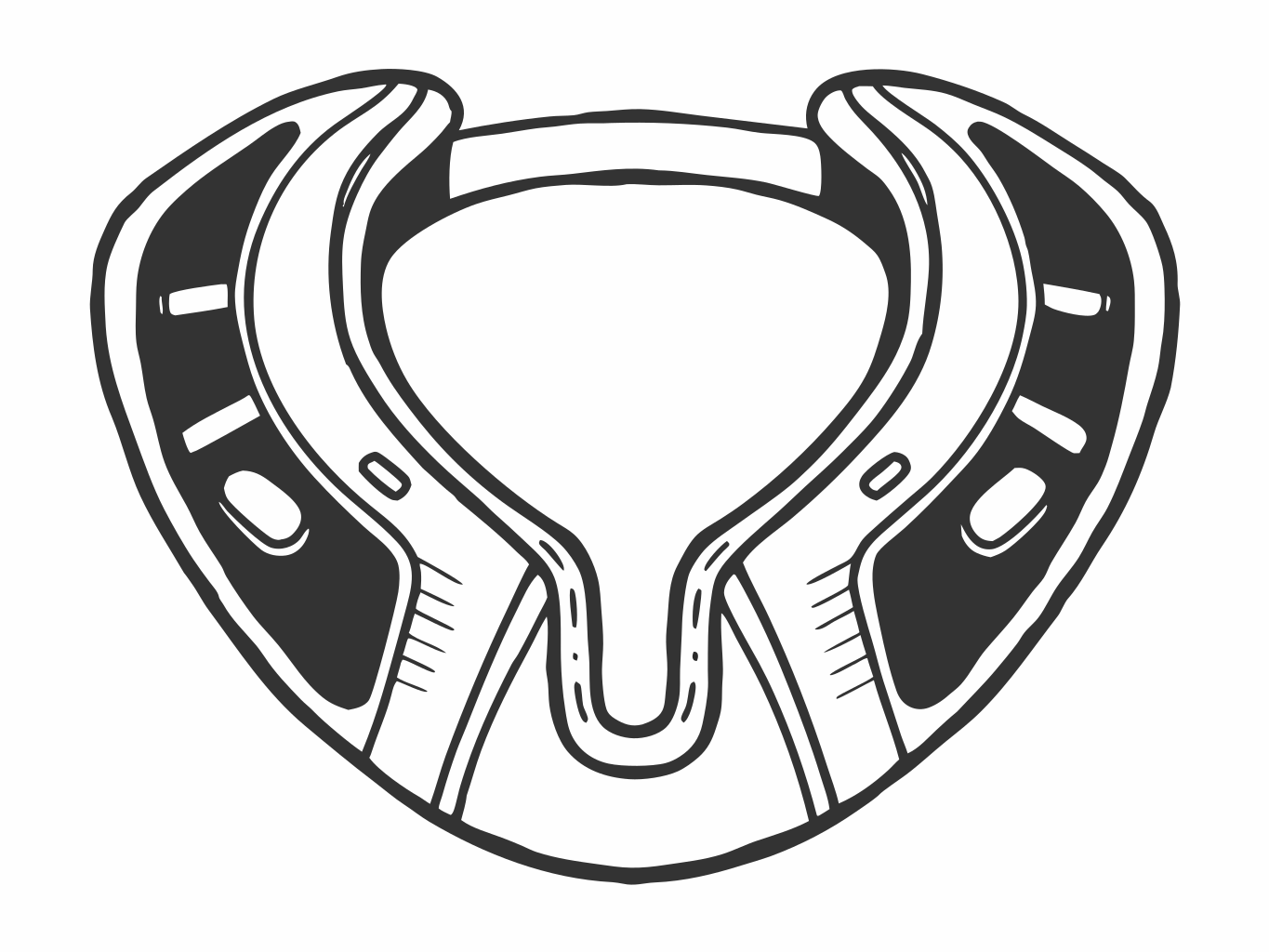
A neck brace gives the helmet rim something solid to land on, so part of a head-first impact goes into your shoulders and back instead of your neck. The makers document the mechanism well, but the independent evidence is thin, and there is no EN standard for neck braces. This guide sets out what is known, what is not, and how to fit one if you ride with it.
On this page
What a neck brace does, and what it cannot do
A neck brace sits on the shoulders, chest and upper back. It works only when the helmet touches it.
Alpinestars' BNS manual spells out the mechanism. Catastrophic neck injuries are most likely when a rider lands upside down on the top of the head and the body's weight over-bends or compresses the neck. The brace offers "an alternative load path": the underside of the helmet rim hits the brace, and part of the load goes into the brace and the torso.
The same manual is blunt about the limits:
- A gap must stay. You need to move your head to ride. Alpinestars says a minimum gap of about 40 mm is preferable, so the risk of a neck fracture "will ALWAYS remain", even with the brace.
- Contact must happen first. If the head is hit before the helmet touches the brace, "the outcome may be the same as wearing nothing at all". The manual shows a Hybrid III dummy test at 573 joules with no helmet-to-brace contact and essentially no difference.
- Gap size matters. In a computer simulation of a 573-joule frontal impact, gaps of 55 mm and 30 mm made no difference. At 20 mm and 10 mm, the compressive neck load fell from 2,300 N to 1,700 N.
- The force goes somewhere. Diverting large forces away from the neck means they can damage other parts of the body, "particularly the collar bone".
Leatt's FAQ adds one more limit. Pure axial loading, a straight compression through the top of the head, "cannot be prevented by any currently available brace". Leatt says its brace reduces axial forces when they combine with bending and shear, as in hyperflexion or hyperextension.
Certification: CE as PPE, but no EN standard
Chest and back protectors have EN 1621-3 and EN 1621-2. Neck braces have no equivalent. The EN 1621 series has four parts: limb joints, back, chest and inflatable protectors. None covers the neck.
What the makers of the picks here claim:
| Maker | Claim, as stated |
|---|---|
| Leatt (5.5 and 6.5) | "CE tested and certified to the PPE Regulation (EU) 2016/425" |
| Alpinestars (BNS Tech 2) | "Category 2 PPE - CE Certified Under EU Regulation 2016/425" |
The BNS manual adds detail. The BNS Tech 2 and Pro were subject to an EU type-examination by notified body #0498, Ricotest in Italy, and are Category II PPE.
What that means
Under Regulation (EU) 2016/425, Category II covers risks other than the minimal (Category I) and very serious (Category III) lists. Category II products need an EU type-examination by a notified body. The maker's information must cite the harmonised standards used "or references to the other technical specifications used". With no harmonised neck brace standard, the examination rests on those other specifications.
The research community has pointed at the gap. A 2019 finite-element study from the University of Padua and Imperial College London opens: "there is no standard method to evaluate their performance". Leatt's own lab page says that in the early days, Dr. Chris Leatt "had no standard against which to test". In 2024, a team from Stellenbosch University, with Chris Leatt as co-author, published two SAE papers proposing test methods for these braces.
How to read the brace label
The BNS manual explains its markings:
| Marking | Meaning |
|---|---|
| CE | Conformity under Regulation (EU) 2016/425 |
| CAT 2 - Regulation (EU) 2016/425 | Certified as Category II by a notified body |
| Year (e.g. 2018) | Year of manufacture |
| BNS 4 or 5 | Certification code for BNS Pro or Tech 2 |
| Off-road motorcycle pictogram | Suggested for off-road motorcycle use only |
| Size reference | Marked on the size adapters |
Treat CE on a neck brace as proof of a notified-body examination, not as a comparable performance grade. We say that because of the regulation text above, and because no EN test with levels exists, unlike the 18 kN and 9 kN limits for back protectors on our chest protector page.
What the research found
The largest field dataset: Action Sports EMS, 2009–2018
Great Lakes EMS / Action Sports EMS is an ambulance service that covers mainly amateur motocross events in the US Midwest. It published patient data from January 2009 to October 2018. Of 8,529 patients with a recorded yes/no for neck brace use, 4,726 wore no brace and 3,803 wore one.
| Outcome | No brace (4,726) | Brace (3,803) |
|---|---|---|
| Critical cervical spine injury | 239 | 26 |
| Death from cervical spine injury | 4 | 1 |
| Clavicle (collarbone) fracture | 443 | 291 |
The one death with a brace involved a rider with a previous full cervical spine fusion and a blunt blow from part of the motorcycle to the back of the neck.
Leatt's product pages quote this study as "up to 89% reduction in critical cervical spine injuries". Leatt's white paper converts the counts into rates: 5.06% of non-wearers and 0.68% of wearers had a critical cervical injury.
Limits you should know. The report was published by the ambulance company on its own website, not in a peer-reviewed journal. It covers only riders who needed EMS care, so it cannot show how many riders in each group crashed. It does not adjust for age, speed, skill or other kit. It comes mainly from amateur motocross events, not hard enduro. The headline percentages compare raw counts from groups of different size.
Simulations and lab work
| Study | Who | Finding |
|---|---|---|
| Khosroshahi, Ghajari, Galvanetto (2019), International Journal of Crashworthiness | University of Padua, Imperial College London; funded by the EU FP7 Marie Skłodowska-Curie programme | Finite-element model of hyperflexion, hyperextension and lateral bending. The brace type studied "can in some cases increase the risk of neck injury" |
| Meyer, Deck, Willinger (2018), Sports Engineering | University of Strasbourg; Leatt lists FEA collaboration with Strasbourg on its lab page | Modeled the Leatt GPX 5.5. As summarized in Leatt's white paper: lower neck loads and lower serious-injury risk for head impacts below 6.5 m/s; smaller risk reduction above that |
| de Jongh, Basson, Knox, Leatt (2024), SAE Int. J. of Transportation Safety | Stellenbosch University; co-authored by Chris Leatt | "Unless almost touching the helmet", braces likely have a negligible effect on axial neck load in the first 20 ms, but can affect neck bending |
Riding studies
- Gorasso and Petrone (2013) measured riders on a motocross track. The brace did not reduce rotational range of motion, and the authors saw a fatigue-support effect.
- Thiele et al. (2015, 2016) compared brace designs on track. Depending on design, neck muscle activity went up or down. In the 2016 study of one rider, the helmet touched the brace for almost one fifth of riding time.
- Lecoublet et al. (2021) measured four braces on 12 volunteers. Neck mobility was significantly reduced, but only flexion and extension were reduced by every brace. The authors conclude these designs do not protect against all loading directions.
Our view: the evidence says a correctly fitted brace can reduce some neck loads in some head-first crashes, and it is weakest for a straight hit on the top of the head. We base this on the studies above. Most are simulations or small samples, and several are linked to a maker. There is also one large field dataset, without a peer review.
Collarbone concerns
The oldest worry about neck braces is that they break collarbones. Both makers address it directly.
- Alpinestars says diverting force from the neck can damage "particularly the collar bone". It adds that foam on the underside of the BNS spreads the load, and that the risk can be reduced but never eliminated.
- Leatt's white paper names three ways riders break a clavicle: a fall on an outstretched arm, a direct fall on the shoulder, or the helmet rim striking the clavicle. The brace's "clavicle relief area" targets only the third. The paper states that, in the experience of motocross and supercross riders, clavicle fractures are about 50 times more likely than cervical spine fractures.
- Leatt's product pages say "Collarbone injuries up to 45% MORE likely WITHOUT a neck brace", citing the Action Sports EMS data. In that dataset's table, as reproduced in Leatt's white paper, clavicle fractures were 9.37% of non-wearers and 7.65% of wearers.
The field data does not show braces causing more collarbone fractures, but it does not show a large reduction either. That reading comes from the 9.37% vs 7.65% rates above and from the same data limits described in the research section.
Fit & integration
A brace that sits wrong, or leaves a big gap to the helmet, does little. The BNS manual gives the most complete fitting procedure.
- Fit it in your real kit. Wear your helmet and normal riding clothing when fitting.
- Size it. Alpinestars sizes the BNS by chest circumference and swaps size adapters to set the fit. Leatt's 5.5 and 6.5 come in S/M and L/XL, with sliding SureFit adjusters front and rear.
- Check it does not rock. Alpinestars' fitting chart asks whether the brace rocks left and right or back and forth on the body. If it does, change the adapter size.
- Check the helmet. Alpinestars says the helmet brand does not change the brace fit but can change head movement and the helmet-to-brace gap. Helmets that sit low at the back can restrict head movement. A helmet that is too big or too small changes the gap. See our helmet guide.
- Seat the shoulder pads on your shoulders. The BNS shoulder pads must sit directly on top of the shoulders, not on top of shoulder protectors.
- Layer it correctly. Alpinestars says roost protectors go on after the BNS, and so does any protection jacket. The brace may sit on a chest and back protector only if the shoulder pads still sit on the shoulders. Leatt says the thoracic strut is best placed against the body, under the chest protector, and that Leatt chest protectors with BraceOn allow the brace over or under.
- Know the release. Both Leatt and Alpinestars braces have an emergency opening mechanism. Show your riding partners how it works. Our first aid basics cover what to do before touching an injured rider's neck.
Alpinestars does not recommend pairing the BNS with third-party protection, and Leatt gives no assurances on third-party gear. Given those two statements, buy the brace and chest protector from the same maker. Our chest protector guide covers Leatt BraceOn and Alpinestars BNS tabs.
Do hard enduro riders need one?
Our view: most hard enduro riders do not need a neck brace, and a certified chest and back protector is the better use of the money. We base this on four points:
- The crash type. Braces work in head-first landings with helmet contact. In the Erzbergrodeo study, most crashes happened when the front tire slid in a curve and mostly injured arms and legs.
- The speed. Hard enduro is ridden at walking pace over rock and roots for much of the day. The Action Sports EMS data comes from motocross, with jumps and higher speed.
- The evidence. The strongest data is observational and unreviewed. The simulations disagree on the size of the benefit, and one independent study found cases of increased risk.
- The cost. The picks here list at $394.95 to $609.00 (USD). That is more than any of our chest protector picks.
Riders who might choose differently: those racing fast enduro or motocross-style sections with jumps, and those who have had a neck injury. Leatt says riders with a previous neck or spine injury should ask a physician, and that it cannot advise on pre-existing conditions.
Heat and comfort
A brace adds a rigid collar under the helmet on long, hot days, and riding studies found mixed effects on neck muscles. Try one on a long ride before committing, because those mixed muscle results depended on brace design.
If you practice steep hill climbs, check that you can still look up the hill with the brace on. Lecoublet et al. found that every brace in their study reduced flexion and extension.
Care, inspection and replacement
Cleaning
- Alpinestars: remove dirt after each use with a damp cloth or cold running water. Do not use a pressure washer or strong solvent-based cleaners, which can damage the foam.
- Leatt: remove the padding and hand-wash it in mild detergent. Leatt's FAQ points to the brace's user manual for full care instructions.
After a crash
Alpinestars says to check the BNS after any accident, whether or not your head hit the ground:
- no cracks or missing pieces in the main frame or plastic parts;
- the brace opens and closes normally;
- no large pieces of foam missing.
If any of these fail, replace the brace or the damaged part. The BNS attachment plate is engineered to fail in moderate to severe crashes. If nothing else is damaged, the brace is reusable once that plate is replaced. Leatt's 5.5 and 6.5 use a CoreFlex rear thoracic strut designed to break away before applying excessive pressure to the back.
Age
Alpinestars strongly recommends replacing the BNS every 5 years under normal use, and no later than 8 years from the date of manufacture, which is on the internal label. Leatt says neck braces are made from polymers that deteriorate over time, and that heat and UV light cause material changes. Leatt runs a replacement program for its braces made between 2006 and 2018.
Alpinestars recommends storing the brace in a cool, dry place and repeating the after-crash checks every few months.
Common mistakes
- Treating the brace as crash-proof. Both makers say a neck fracture remains possible, and Leatt says no brace prevents pure axial loading.
- Setting the gap by guesswork. Alpinestars prefers a minimum gap of about 40 mm so you can move your head, and its simulation showed no difference between 55 mm and 30 mm gaps. Set the gap with your helmet on, to the maker's instructions.
- Fitting it without your helmet and riding kit. The helmet changes the gap and head movement.
- Riding a cracked or old brace. Check after every crash. Alpinestars sets 5 years of normal use as the replacement point.
- Reading the headline numbers as risk. The "89%" and "45%" claims come from counts in one ambulance dataset. The rates are in the research section above.
For the full kit priorities, see our hard enduro gear guide and the maker profiles for Leatt and Alpinestars.
Priority: ★★☆☆☆. Suggested share of a full kit's budget: 5%.
What the rating rests on: Two stars and about 5% of the kit budget. Neck braces target a rare but catastrophic injury: a head-first landing that compresses or over-bends the neck. In a three-year study of Erzbergrodeo starters, most crashes injured arms and legs and more than 80% of counted injuries were superficial. The best field data in favor of braces comes from amateur motocross, not hard enduro. The lab work is mostly simulation, much of it linked to makers. No harmonised EN standard sets a performance test for neck braces, so a buyer cannot compare them on a lab number the way they can compare chest or back protectors.
Our suggested picks for hard enduro Neck Brace
Grouped by the maker's list price. No paid placements, no affiliate links. Every fact on a card links to the maker's own page.
Alpinestars BNS Tech 2 Neck Support
- Alpinestars
- US$394.95 list price (US)
Alpinestars describes the BNS Tech 2 as an MX neck protector that helps redirect crash forces away from the neck and spine when the helmet contacts the support frame.
Certification declared by the maker
- Category 2 PPE - CE Certified Under EU Regulation 2016/425
Materials: Carbon polymer compound, EVA foam, Lycra-laminated foam padding
Features: Progressive Force Relief (PFR), Size Adapter System, Quick-release locking system
The BNS Tech 2 Neck Support is built from a carbon polymer compound. Alpinestars lists a rear stabilizer with Progressive Force Relief that spreads load across the back and shoulders, a raised chest area to help reduce hyperflexion, compressed EVA foam padding, Lycra-laminated foam padding kits, and a quick-release locking system. Its integrated Size Adapter System covers the XS/M and L/XL size ranges. The straps can be worn over or under the jersey. Alpinestars states it keeps performing below 0 °C.
Alpinestars states "Category 2 PPE - CE Certified Under EU Regulation 2016/425". The BNS manual says the Tech 2 and Pro had an EU type-examination by notified body #0498 (Ricotest, Italy). The manual recommends replacement every 5 years under normal use, and at least 8 years from manufacture.
Why it is listed: it has a named notified-body type-examination, a size adapter system and a replaceable attachment plate designed to fail in bigger crashes. At a $394.95 list price it is the lowest of the three, which makes it the budget tier.
Leatt Neck Brace 5.5
- Leatt
- 600 g
- US$474 list price (International (int.leatt.com))
Leatt's 5.5 neck brace is made from composite polyamide with three-way adjustability, a collarbone cut-out and a breakaway rear strut.
Certification declared by the maker
- CE tested and certified to the PPE Regulation (EU) 2016/425
Materials: Composite polyamide, Injected foam padding
Features: CoreFlex split rear folding thoracic strut, SureFit adjusters, Emergency release mechanism
Leatt builds the Neck Brace 5.5 from composite polyamide. It has an engineered collarbone cut-out to keep the helmet rim away from the collarbones, a helmet rim striking platform, a CoreFlex split rear folding thoracic strut designed to break away before applying excessive pressure to the back, sliding front and rear SureFit adjusters for three-way adjustment, a push-button closure, an emergency release mechanism and injected foam padding.
Leatt states it is "CE tested and certified to the PPE Regulation (EU) 2016/425". Weight is listed as from 600 g (1.32 lb). Sizes are S/M and L/XL. Leatt chest protectors with the BraceOn system accept the brace over or under the protector.
Why it is listed: it has the same CE claim, adjustment system and emergency release as Leatt's 6.5 in composite polyamide instead of carbon fiber, at a $474.00 list price. That sits between the other two picks, so it is the value tier.
Leatt Neck Brace 6.5
- Leatt
- 600 g
- US$609 list price (International (int.leatt.com))
Leatt's 6.5 neck brace is made from carbon fiber with three-way adjustability, a collarbone cut-out and a breakaway rear strut.
Certification declared by the maker
- CE tested and certified to the PPE Regulation (EU) 2016/425
Materials: Carbon fiber, Injected foam padding
Features: CoreFlex split rear folding thoracic strut, SureFit adjusters, Emergency release mechanism
Leatt builds the Neck Brace 6.5 from carbon fiber, with a carbon matrix platform. It shares the 5.5's features: an engineered collarbone cut-out, a helmet rim striking platform, a CoreFlex split rear folding thoracic strut designed to break away before applying excessive pressure to the back, sliding front and rear SureFit adjusters, a push-button closure, an emergency release mechanism and injected foam padding.
Leatt states it is "CE tested and certified to the PPE Regulation (EU) 2016/425". Weight is listed as from 600 g (1.32 lb). Sizes are S/M and L/XL.
Why it is listed: it is Leatt's carbon fiber brace with the same certification claim and adjustment system as the 5.5, at a $609.00 list price, the highest of the three. That makes it the premium tier.
Budget tiers explained
Where a category has picks, they sit in three tiers. The tier follows the maker's list price within the category. A higher tier does not mean a higher certification level: check the label.
- Budget:
- Entry price. The essentials without the extras: a sound start for new riders or occasional use.
- Value:
- More for the money. More enduro-specific features, better adjustment and ventilation, at a mid-range list price.
- Premium:
- Top tier, fewer compromises. Lighter materials, more adjustment or more coverage, often with diminishing returns unless you ride a lot.
Explore other Top Hard Enduro Gear Categories
Gear lowers the cost of a fall. Control lowers how often you fall. Train it in Controls 101.