Top Hard Enduro Helmet
Critical protection for the head and brain. Look for ECE 22.06 approval, a fit that stays put, and ventilation that works at walking pace on long technical days.
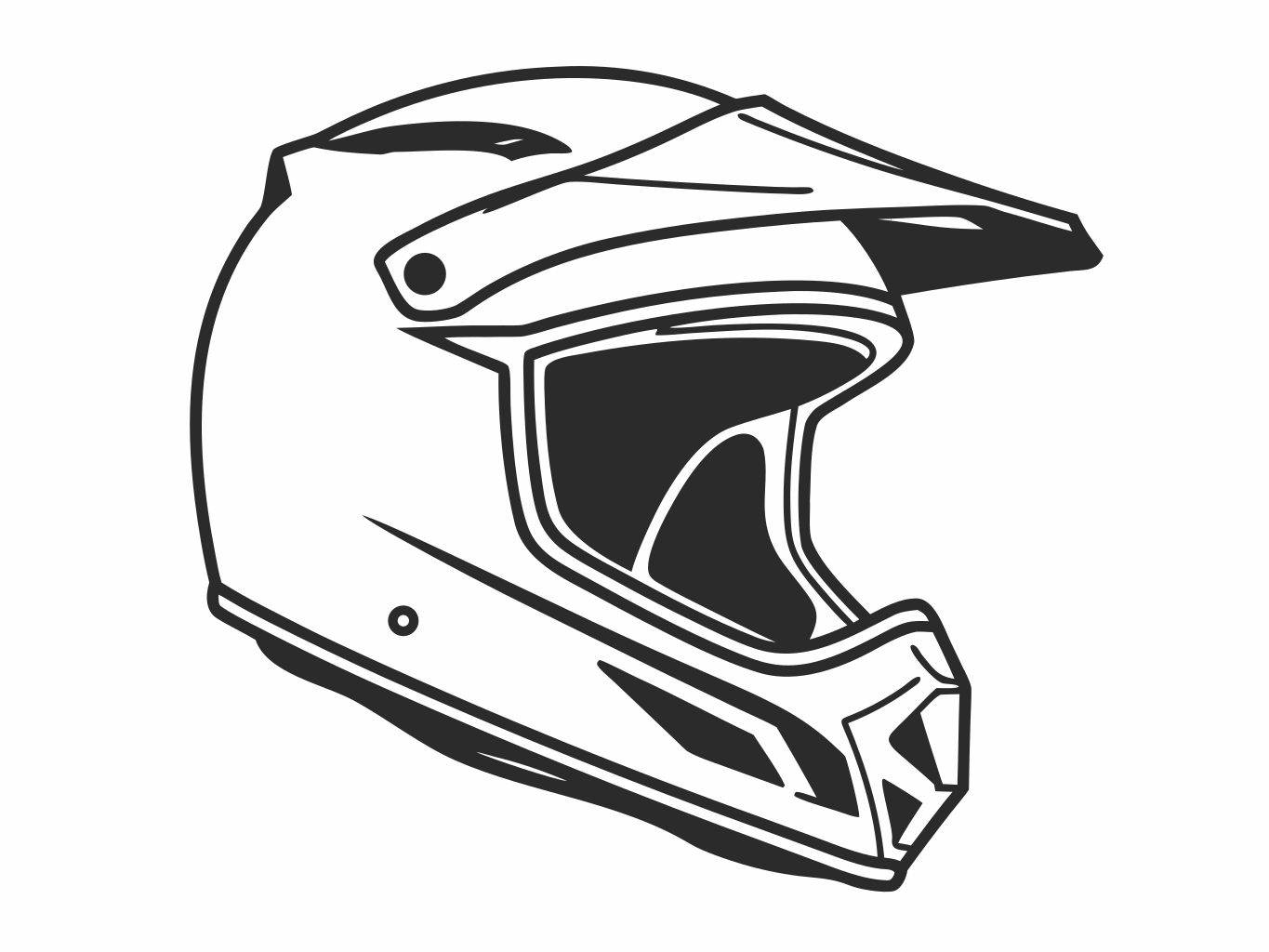
In Europe and the other countries that apply UN Regulation No. 22, your helmet is the one piece of kit that needs type approval under it before it can be sold for road use. Boots, armour and other protection are certified under the EU PPE Regulation instead. The US works differently: there is no approval before sale, makers certify their own helmets to FMVSS No. 218, and NHTSA checks compliance afterwards. This guide explains what ECE 22.06, DOT FMVSS No. 218 and Snell M2025 actually test, how to read the approval label, and how to fit, care for and replace a helmet. It then lists current Airoh off-road helmets with the maker's own specs.
On this page
- What a helmet does in hard enduro
- ECE 22.06 explained: what the lab tests
- When did ECE 22.05 end? The exact dates
- How to read an ECE 22.06 helmet label
- ECE 22.06 vs DOT FMVSS No. 218 vs Snell M2025
- What a certification does not tell you
- How to fit a hard enduro helmet
- Goggles, peak, neck brace and hydration
- Heat and ventilation
- How to choose a helmet for hard enduro
- Care, inspection and when to replace a helmet
- Common helmet mistakes
What a helmet does in hard enduro
A helmet has one job. It manages the energy of a blow to the head so less of it reaches the brain. The shell spreads the load. The foam liner crushes and slows the head down.
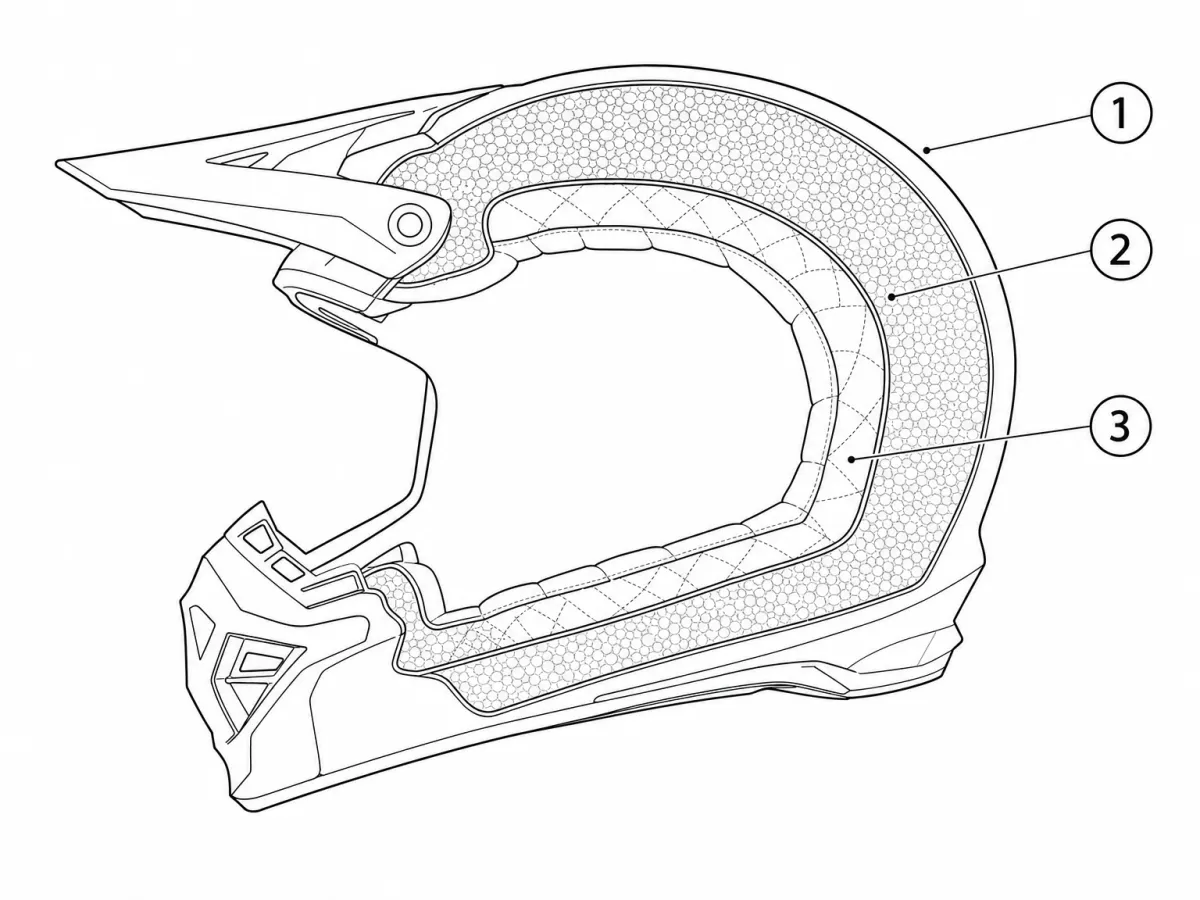
The evidence that this works is strong. A Cochrane review of 61 observational studies found that helmets reduce the risk of death and head injury in motorcyclists who crashed. Its higher-quality studies put the reductions at about 42% for death and 69% for head injury (Liu et al., Cochrane Database of Systematic Reviews, 2008). The same review found too little evidence to measure the effect on neck injuries. A helmet is not neck protection. That is the job of a neck brace.
Why hard enduro asks different things of a helmet
- You fall often, at low speed. Hard enduro is ridden at walking pace over rock, roots and logs. Many small falls mean many small knocks. That makes inspection and replacement more important than on the road.
- You land on edges, not just flat ground. Rock steps and logs have corners. ECE 22.06 drops helmets onto a flat anvil and onto a kerbstone-shaped edge anvil (details below).
- You work hard in it. You climb, push and lift the bike, often for hours. Heat and sweat decide whether you keep the helmet on and fastened properly. See endurance training.
- Mud and water get in. A liner that comes out and goes in the washing machine is not a luxury after a water crossing.
- You wear goggles, not a visor. Off-road helmets have a peak and an open eye port. How the helmet and goggles fit together decides what you see.
ECE 22.06 explained: what the lab tests
"ECE 22.06" is shorthand for UN Regulation No. 22, 06 series of amendments: "Uniform provisions concerning the approval of protective helmets and of their visors for drivers and passengers of motor cycles and mopeds". It is published by the UN Economic Commission for Europe (UNECE) under the 1958 Agreement. The 06 series entered into force on 3 January 2021.
A national type-approval authority grants the approval after a technical service tests the helmet. The regulation also sets rules for production qualification, conformity of production and routine tests on batches, so the approval is not a one-off lab result.
What changed from 22.05
The UNECE working group that drafted the 06 series listed its main changes as a new rotational test, high- and low-energy impacts, more impact points, new visor tests, and rules for modular helmets, sun shields and accessories (GRSP-66-22).
The main tests, in numbers
| Test | What happens | Pass limit |
|---|---|---|
| Linear impact | Helmet on a metal headform, dropped at 7.5 m/s onto a flat anvil and a kerbstone (edge) anvil at points front, side, crown and rear | Peak ≤ 275 g, HIC ≤ 2,400 |
| Chin bar | Full-face helmets take an extra impact on the chin bar at 6.0 m/s, flat anvil only | Linear impact limits (paragraph 7.3.6) |
| Extra points | At least three more impacts, chosen by the lab from 12 defined points | Peak ≤ 275 g, HIC ≤ 2,400 |
| High energy | 8.2 m/s onto the flat anvil | Peak ≤ 275 g, HIC ≤ 2,880 |
| Low energy | 6.0 m/s | Peak ≤ 180 g, HIC ≤ 1,300 |
| Oblique (rotational) | 8.0 m/s onto an anvil cut at 45° and faced with P80 abrasive paper; five impact sites across two helmets | Peak rotational acceleration ≤ 10,400 rad/s², BrIC ≤ 0.78 |
| Chin strap (dynamic) | A 10 kg mass drops 750 mm and loads the strap | Stretch ≤ 35 mm during the drop, ≤ 25 mm after |
| Roll-off | A 10 kg mass drops 0.5 m on a line hooked to the back of the shell | Helmet may not rotate more than 30° off the headform |
For hard enduro, the low-energy test is the line to read first. Most falls in this sport happen at low speed, and 6.0 m/s is the slowest drop in the standard. It also carries the strictest limit, 180 g.
Conditioning
Before impact testing, helmets are soaked at room temperature (25 °C ± 5 °C), in heat (50 °C ± 2 °C), in cold (−10 °C ± 2 °C), or under 48 hours of UV light followed by 4 to 8 hours of water spray. Test helmets are split across these conditions. The regulation's core test set is 15 helmets, plus more for smaller sizes.
Other requirements
- Rigidity. The shell is squeezed to 630 N. It may deform no more than 40 mm, and must recover to within 15 mm.
- Projections and friction. Screws, vents and peaks are checked so they do not snag and twist the head in a slide.
- Retention system. The chin strap must be at least 20 mm wide. A double-D ring must have a red pull tab at least 10 × 20 mm.
- Goggle clearance. Where a helmet has no visor mounts, "the profile at the front edge shall not prevent the wearing of goggles" (paragraph 6.5).
- Visors. Visors take a high-speed particle test: a 6 mm steel ball fired at 60 m/s. Off-road helmets that take goggles have no visor, so this applies to goggles only through their own standard. See goggles.
- Accessories. "Only accessories tested during the type approval procedure of the helmet keep the type approval valid" (paragraph 7.3.1.3.5). That covers camera mounts and intercoms.
The regulation itself notes that "protective helmets for wear in competitions may have to comply with stricter provisions". If you race, read your event's rulebook.
When did ECE 22.05 end? The exact dates
The dates come from paragraph 15 of UN Regulation No. 22. Each one counts from the 06 series' entry into force on 3 January 2021.
| Date | Rule (paragraph) |
|---|---|
| 3 January 2021 | 06 series in force. Authorities may not refuse a 22.06 approval (15.1.1) |
| 3 July 2022 | 18 months: no new approvals or extensions unless the helmet meets 22.06 (15.1.2) |
| 3 July 2023 | 30 months: approval marks from the 05 series may no longer be applied to helmets (15.1.3) |
| 3 January 2024 | 36 months: countries applying the regulation may prohibit the sale of helmets that do not meet 22.06 (15.1.4) |
Two things follow from the wording.
- 3 January 2024 was not an automatic sales ban. The regulation says countries "may prohibit" the sale. Each country decided for itself.
- The regulation says nothing about helmets already in use. Whether you may ride on public roads in a 22.05 helmet is a matter for national road law.
If you still ride in a 22.05 helmet, plan its replacement now, and check its production date. The dates above and Snell's guidance explain why. No 22.05 marks could be applied after 3 July 2023, so any 22.05 helmet is now more than three years old, and many are older than five. The Snell Foundation recommends replacing motorcycle helmets after five years, or sooner if the maker says so (Snell M2025R).
How to read an ECE 22.06 helmet label
Under ECE 22.06 the approval label must be sewn to the retention system, or secured another way that meets the same rules (paragraph 5.1.10). Look on the chin strap. The regulation's own example reads E4 061406/J-1952.
| Marking | What it means |
|---|---|
| E in a circle, with a number | The country whose authority granted the approval. It is not where the helmet was made. In the regulation's example, E 4 is the Netherlands. |
| Approval number starting 06 | The first two digits give the series of amendments. 06 means the helmet was approved to 22.06. 05 means the older 22.05. |
| /P | Full-face helmet with a protective chin guard. Off-road helmets with a fixed chin bar fall here. |
| /J | Open-face helmet with no lower face cover. |
| /NP | Lower face cover that does not protect the chin. The cover must also carry a "Does not protect chin from impacts" marking or symbol. |
| /P/J | Modular helmet approved both with and without the chin guard. Chin protection only applies with the guard in place. |
| Dash and serial number | Production serial number. It runs in sequence for that approved type, and the authority keeps a register. |
| QR or bar code | Optional extra for digital reading. It cannot replace the approval mark. |
The helmet must also show the maker's name or mark, the size in letters and centimeters, and the year of production. Each helmet must carry its size and maximum weight to the nearest 50 g, and a label that says: "For adequate protection, this helmet must fit closely and be securely attached. Any helmet that has sustained a violent impact should be replaced."
What to check before you buy
- Find the sewn-in label. No label, no approval.
- Read the first two digits of the approval number. You want 06.
- Check the code after the slash. An off-road helmet should read P.
- Check the size and year of production on the helmet.
- If you plan to fit a camera mount or intercom, check the maker lists it for that helmet. Only accessories covered by the approval keep it valid.
ECE 22.06 vs DOT FMVSS No. 218 vs Snell M2025
Three labels matter for off-road helmets. They are different kinds of promise.
DOT means the maker certifies the helmet meets Federal Motor Vehicle Safety Standard No. 218, the US rule for motorcycle helmets. NHTSA "does not approve helmets", and relies on self-certification. It tests some helmets, can force a recall, and publishes the results (NHTSA).
Snell is voluntary. Makers submit helmets to the Snell Foundation. Certified makers must also take part in random sample testing, where Snell buys helmets "from the same supply as those sold in stores" (Snell M2025R). Snell M2020 has been replaced by M2025. Snell's transition plan made 1 August 2024 the first day M2025 helmets could be sold and set 1 April 2025 for M2020 production to stop. M2025D applies mostly to helmets that must also meet DOT and JIS. M2025R applies to helmets that must also meet ECE 22.06 as well as DOT and JIS (Snell explanatory cover, current Snell standards).
| ECE 22.06 | DOT FMVSS No. 218 | Snell M2025R | |
|---|---|---|---|
| Who confirms it | Government type approval, plus conformity of production | Maker self-certifies; NHTSA spot-checks | Snell certifies, then buys and checks samples |
| Linear impact speed | 7.5 m/s standard; 8.2 m/s high; 6.0 m/s low | Flat anvil 5.8–6.2 m/s; hemispherical anvil 5.0–5.4 m/s; two hits per site | Flat 8.20 m/s; edge 7.75 m/s; hemispherical 7.70 m/s then a second hit |
| Linear limit | ≤ 275 g, HIC ≤ 2,400 (≤ 2,880 high energy); ≤ 180 g, HIC ≤ 1,300 at 6.0 m/s | ≤ 400 g; above 200 g for no more than 2.0 ms; above 150 g for no more than 4.0 ms | ≤ 275 g (257 g on the largest headform), HIC ≤ 2,880 |
| Rotational test | Yes: 8.0 m/s on a 45° abrasive anvil | None | Yes: 8.0 m/s on a 45° anvil with 80 grit paper; ≤ 10,000 rad/s², BrIC ≤ 0.78 |
| Penetration | No | A 2.95–3.06 kg pointed striker dropped 3 m must not touch the headform | A metal cone dropped on the shell must not reach the headform |
| Label | Sewn-in approval label, E-number, 06 approval number | "DOT / FMVSS No. 218 / CERTIFIED" and model name on the outside back of the shell | Snell certification decal |
DOT labels on helmets made before 13 May 2013 simply read "DOT" (NHTSA).
Both standards include a drop at about 6 m/s. The difference is what they let through. At 6.0 m/s, ECE 22.06 allows a peak of 180 g and a HIC of 1,300. At 5.8–6.2 m/s, FMVSS No. 218 allows a peak of 400 g, with time limits above 200 g and 150 g. A lower limit at the same speed means a softer landing for your head in the slow falls that hard enduro is full of. 22.06 also adds a rotational test, which FMVSS No. 218 does not have.
Our view: for a rider who is not bound by US road law, ECE 22.06 is the label to insist on, for those two reasons from the texts above. A helmet that also carries DOT or Snell is not worse for it.
What a certification does not tell you
A label is a pass. It is not a score.
- No margin. ECE 22.06 is pass or fail at each limit. The label does not say whether a helmet passed with room to spare or only just.
- No fit. Every lab test uses a metal headform of a fixed size. None of it tells you whether the helmet fits your head.
- No neck protection. The Cochrane review found too little evidence on neck injuries. A certified helmet is still only a helmet.
- No heat rating. ECE 22.06 only says temperature under the shell "shall not rise inordinately" and allows vents (paragraph 6.5). There is no ventilation number to compare.
- No lifespan. The label shows the year of production, not an expiry date. Snell sets five years as its guidance.
- Nothing after a crash. An approval covers a new helmet. It says nothing about a helmet that has been dropped or crashed.
- Nothing about added parts. Unapproved accessories can void the approval, as covered above.
- Maker claims are not the standard. Rotational systems such as Airoh's AMS² or ASN are the maker's own designs. The standard's oblique test is the part every 22.06 helmet must pass. Anything beyond that is the maker's claim.
How to fit a hard enduro helmet
A helmet can only work if it stays in place. Airoh's own fitting guidance and NHTSA's guidance agree on the basics.
Measure
Use a cloth tape. Start just above the eyebrows and go around the widest point at the back of the head (NHTSA). Airoh sizes by head circumference: XS 53–54 cm, S 55–56 cm, M 57–58 cm, L 59–60 cm, XL 61–62 cm on the Aviator 3.
Check shape
NHTSA lists three head shapes: round oval, intermediate oval (the most common) and long oval. Pressure on the forehead means the helmet is too round for you. Pressure on the sides means it is too oval.
Try it on properly
These steps come from Airoh's warning booklet (Airoh) unless marked.
- Wear it for 5 to 10 minutes. Look for spots of pressure that cause pain or headache. NHTSA suggests wearing a new helmet for 30 to 45 minutes before a ride, because hot spots can take time to show.
- Gently rotate the helmet. The skin on your brow should move with it.
- Fasten the strap so one finger passes easily between strap and neck.
- With the strap fastened, try to pull the helmet off. It should not rotate or move. If it does, adjust the strap again or change size.
- Airoh's booklet says not to wear scarves or caps under the helmet.
A correctly sized helmet "will be a little tight", with even pressure and no hot spots, and it should not move when you shake your head (NHTSA). Makers may offer different cheek pads and liners to tune fit. NHTSA warns that other changes to the interior risk the helmet's integrity.
Shell sizes
More shell sizes means less padding needed to fill the gap in each size. Airoh makes the Aviator 3 in four shell sizes and the Twist 3 in two.
Goggles, peak, neck brace and hydration
Goggles
ECE 22.06 requires that a helmet without visor mounts does not prevent the wearing of goggles. That is the minimum. The real check is your goggle in your helmet. The goggle should seal around the eye port with no gap at the nose and no pressure on the bridge. The strap should sit flat and not push the helmet up at the back. The full goggle guide is on our goggles page.
Peak
The regulation allows a detachable peak (paragraph 6.2.1). Airoh ships the Aviator 3 with a peak extension and publishes videos on fitting and removing the peak. Check the peak screws as part of every inspection.
Neck brace
If you wear a brace, bring it when you choose the helmet. Check that the helmet's lower edge clears the brace when you look up and turn your head. The neck brace guide covers fit in detail.
Emergency release
Airoh's AEFR system has a red strap at the bottom of each cheek pad. It lets medical staff pull the cheek pads out while the helmet is still on, so the helmet comes off with less head movement (Airoh technologies). Tell your riding partners it is there. See first aid basics.
Hydration
Airoh builds its AHS hydration system into the EPS of the Aviator 3. If you ride with a hydration pack, check how its tube routes to the helmet before you buy. See hydration.
Heat and ventilation
Hard enduro is slow. Slow means little airflow through the vents. Your head produces heat whether or not air is moving.
What the makers and the standard give you:
- Vents. ECE 22.06 allows ventilation holes to stop heat building under the shell. Airoh lists 8 vents plus a spoiler with extractors on the Aviator 3.
- Washable liners. All four Airoh helmets below have removable, washable liners.
- Heat limits. Airoh's booklet warns: "Do not uselessly expose to temperature over 50°C." The standard's heat conditioning also runs at 50 °C. Do not leave a helmet on a dashboard or in a closed van in the sun.
Our view: for hard enduro, choose ventilation and low weight over extra features. The sport is ridden at walking pace for hours, with the rider doing heavy work. And every helmet here passes the same 22.06 impact limits. A helmet that stays on and stays fastened all day does more than a heavier one you loosen at the first stop.
How to choose a helmet for hard enduro
- Prefer ECE 22.06 certification. Read the sewn-in label. The approval number should start 06 and end /P.
- Get the fit right first. Measure, try several sizes and shapes, and do the roll-off check. A helmet that does not fit fails every other test.
- Balance weight and ventilation for long technical days. Makers state weights with a tolerance (Airoh gives ±50 g). Compare vent count and liner, not just grams.
- Understand rotational systems. Every 22.06 helmet passes the oblique impact test. Maker systems such as Airoh AMS² (a two-layer liner with silicone elements that allow relative motion) and ASN (a sliding 3D fabric layer) are claimed to reduce rotational forces further. Those are the maker's claims, not part of the approval.
- Ensure stable goggle fit and hydration compatibility if needed. Try your own goggles in the helmet. If you use a drink tube, check for a hydration channel.
- Check the neck brace. Try the helmet with your brace on.
- Check what comes in the box. Spare peak extensions, vent covers and nose pieces save money later. Only fit accessories the maker lists for that helmet.
- If you race FIM events, you need an FIM helmet. The FIM's 2026 technical rules for EnduroGP, the ISDE, SuperEnduro and HardEnduro make FRHPhe-02 helmets, with a valid FIM homologation label, mandatory from 1 January 2026. All other standards are forbidden in those championships (FIM technical rules 2026). Airoh says its Aviator 3 Evo carries FRHPhe-02 as well as 22.06.
Spend the money here before you spend it on anything else. See how we build this gear list and the gear setup guide.
Care, inspection and when to replace a helmet
Cleaning
Airoh's instructions (Airoh warning booklet):
- Clean the helmet with water and a few drops of mild soap only.
- Dry it away from direct sun and heat.
- For matt paint, use only demineralized water and a microfiber cloth, with light pressure.
- Do not paint the helmet or apply stickers, petrol or other solvents.
- Store it in a safe, dry place.
- Use only original Airoh spare parts.
ECE 22.06 requires a warning label where solvents or stickers can harm the shell material (paragraph 14.2). The US standard requires the maker to list which cleaning agents, paints and adhesives are safe, because "helmet can be seriously damaged by some common substances without damage being visible to the user" (FMVSS No. 218, S5.6.1).
Inspection after every ride
- Label still present and readable.
- Chin strap: no fraying, no cuts. Double-D rings free of rust. Red pull tab intact.
- Shell: no cracks, deep gouges or soft spots. Check around the vents and peak screws.
- Liner: no crushed or cracked foam under the comfort padding.
- Cheek pads and AEFR straps in place.
When to replace
- After a crash or a hard knock. Airoh: "in case of accident, we always suggest replacing the helmet, even when the damage is not clearly visible." Snell: return it to the maker for inspection, or destroy and replace it. The ECE 22.06 label itself says a helmet that has sustained a violent impact should be replaced.
- After a drop. Airoh's booklet refers to falls, "even accidental ones, that may provoke dents and/or abrasion". A helmet dropped onto rock or concrete is a helmet with a possible impact.
- With age. Snell recommends replacement after five years, or sooner if the maker recommends it.
- When it no longer fits. A liner that has packed down lets the helmet move.
In hard enduro, treat "had a crash" broadly. The makers themselves say the damage may not be visible, and riders in this sport fall often. If your head hit rock hard enough that you remember it, replace the helmet.
Common helmet mistakes
- Trusting a sticker, not the label. The ECE approval is the sewn-in label with an E-number and a 06 approval number. Paragraph 5.1.10 of the regulation sets this.
- Buying by letter size, not head size. Measure your head in centimeters and use the maker's own chart. Airoh's chart, for example, puts M at 57–58 cm.
- Wearing it loose for comfort. Airoh's guidance is one finger under the strap and no rotation on the head. Airoh warns that for maximum protection the helmet "must always fit properly and not move loosely about on your head".
- Keeping a crashed helmet because it "looks fine". Airoh, Snell and the ECE label all say the damage may not be visible.
- Cleaning with solvents or degreaser. Makers call for water and mild soap. Solvents can harm the shell without visible signs.
- Wearing a cap under it. Airoh's booklet says not to wear scarves or caps under the helmet, and to let air circulate freely inside.
- Assuming "DOT" equals "22.06". FMVSS No. 218 has no rotational test. Its flat-anvil drop runs at about the speed of the 22.06 low-energy test, but it lets through up to 400 g, against 180 g under 22.06. Check which label your helmet carries.
Priority: ★★★★★. Suggested share of a full kit's budget: 25%.
What the rating rests on: Five stars and 25% of the budget, for three reasons. A Cochrane review found helmets cut the risk of death by about 42% and of head injury by about 69% in motorcyclists who crashed. The helmet is also the only item in your kit that needs UN Regulation No. 22 type approval before it can be sold for road use; other protection is certified under the EU PPE Regulation. And a certified off-road helmet is the most expensive single item in most kits: Airoh's list prices for the helmets on this page run from 209.99 EUR to 859.00 EUR.
Our suggested picks for hard enduro Helmet
Grouped by the maker's list price. No paid placements, no affiliate links. Every fact on a card links to the maker's own page.
Airoh Twist 3
- Airoh
- 1,330 g
- €209.99 list price (EU, airoh.com store, plain Color version)
Off-road helmet with a thermoplastic HRT shell in two shell sizes, listed by Airoh as ECE 22.06 approved.
Certification declared by the maker
- ECE 22.06
Materials: Thermoplastic HRT shell
Features: ASN (Airoh Sliding Net), AEFR (Airoh Emergency Fast Release), Double-D ring retention, Removable, washable liner
Airoh builds the Twist 3 with a double shell in thermoplastic HRT and makes it in two shell sizes (XS–S–M and L–XL–XXL). Airoh lists it as ECE 22.06 approved and gives its weight as from 1330 g (±50 g), without naming the size. It closes with a double-D ring. The liner is removable, washable and hypoallergenic. It uses Airoh's ASN sliding-net system and AEFR emergency cheek pad release, and Airoh says its ventilation was optimized in the wind tunnel. It is ready for Airoh's AWC4 and AWC2 communication units, sold separately.
Airoh's size chart runs from XS (53–54 cm) to XXL (63 cm).
Why it is listed: it is the lowest-priced ECE 22.06 helmet on this page, at 209.99 EUR for the plain Color version on Airoh's store (graphic versions list at 249.99 EUR). It carries on Airoh's Twist line; the Twist 2.0 no longer appears in Airoh's helmet range.
Airoh Aviator Ace 2
- Airoh
- 1,250 g
- €399.99 list price (EU, airoh.com store, plain Color version)
Off-road helmet with a composite carbon double shell, listed by Airoh as ECE 22.06 approved at 1250 g ± 50 g.
Certification declared by the maker
- ECE 22.06
Materials: Composite carbon shell
Features: ASN (Airoh Sliding Net), AEFR (Airoh Emergency Fast Release), Double-D ring retention, Removable, washable liner
Airoh builds the Aviator Ace 2 with a double shell in composite carbon, in two shell sizes (XS–S–M and L–XL). Airoh lists it as ECE 22.06 approved and gives its weight as 1250 g ± 50 g, without naming the size. It closes with a double-D ring. The liner uses high-performance textiles and is removable, washable and hypoallergenic. It uses Airoh's ASN and AEFR systems, comes with a removable nose cover, and is ready for Airoh's AWC4 and AWC2 communication units.
Airoh's size chart runs from XS (53–54 cm) to XL (61 cm).
Why it is listed: it moves from thermoplastic to a composite carbon shell and is the lightest weight Airoh states among the helmets here, at 399.99 EUR for the plain Color version (graphic versions 469.99 EUR). It replaces the original Aviator Ace, which no longer appears in Airoh's range.
Airoh Aviator 3
- Airoh
- 1,330 g
- €639.99 list price (EU, airoh.com store, plain Color version)
Airoh's HPC carbon off-road helmet in four shell sizes, with a hydration channel in the EPS, listed as ECE 22.06 approved.
Certification declared by the maker
- ECE 22.06
Materials: HPC carbon shell, 3K carbon shell (Carbon graphic), EPS
Features: AMS² Plus (Airoh Multiaction Safety System), AEFR (Airoh Emergency Fast Release), AMLS (Airoh Magnetic Lining System), AHS hydration system, Double-D ring retention
Airoh builds the Aviator 3 shell in HPC carbon (3K carbon on the Carbon graphic) in four shell sizes: XS–S, M, L and XL–XXL. Airoh lists it as ECE 22.06 approved and gives its weight as from 1330 g (±50 g). It has 8 vents and a spoiler with integrated extractors, and Airoh's AHS hydration system built into the EPS. Safety and comfort systems are AMS² Plus (two overlapping liner shells of different densities with silicone elements that allow relative motion, per Airoh), AEFR emergency cheek pad release and AMLS magnetic liner. The box includes an action camera mount, side bumpers, a peak extension, summer and winter nose pieces, vent covers and filters.
Airoh's size chart runs from XS (53–54 cm) to XL (61–62 cm), with XXL on a wide base.
Why it is listed: four shell sizes, a hydration channel and the most spare parts in the box of the helmets here. Airoh lists the Color version at 639.99 EUR.
Airoh Aviator 3 Evo
- Airoh
- 1,330 g
- €859 list price (EU (airoh.com store))
Updated Aviator 3 with double homologation to ECE 22.06 and FIM Racing (FRHPhe-02), per Airoh.
Certification declared by the maker
- ECE 22.06
- FIM FRHPhe-02
Materials: HPC carbon shell
Features: AMS² EVO (Airoh Multiaction Safety System), AEFR (Airoh Emergency Fast Release), AMLS (Airoh Magnetic Lining System), Hydra System, Double-D ring retention
Airoh describes the Aviator 3 Evo as an update of the Aviator 3, with double homologation: ECE 22.06 and FIM Racing FRHPhe-02. Airoh says this homologation lets riders of motocross, enduro, rally and other disciplines compete in FIM racing. The shell is HPC carbon in four shell sizes (XS–S, M, L, XL–XXL), with a weight from 1330 g ± 50 g. It uses Airoh's AMS² EVO system, which Airoh says improves absorption of rotational impacts and low-speed linear impacts, plus AMLS, AEFR and the Hydra System. The box includes an action camera mount that Airoh describes as FIM competition approved, side bumpers, a peak extension, two nose pieces and vent covers.
Why it is listed: it is the only helmet here with a racing homologation on top of ECE 22.06, and FIM enduro and hard enduro championships require FRHPhe-02 from 2026. It is the highest-priced, at 859.00 EUR on Airoh's store.
Budget tiers explained
Where a category has picks, they sit in three tiers. The tier follows the maker's list price within the category. A higher tier does not mean a higher certification level: check the label.
- Budget:
- Entry price. The essentials without the extras: a sound start for new riders or occasional use.
- Value:
- More for the money. More enduro-specific features, better adjustment and ventilation, at a mid-range list price.
- Premium:
- Top tier, fewer compromises. Lighter materials, more adjustment or more coverage, often with diminishing returns unless you ride a lot.
Explore other Top Hard Enduro Gear Categories
Gear lowers the cost of a fall. Control lowers how often you fall. Train it in Controls 101.