Top Hard Enduro Gloves
Grip and protection that wear out fast. Prioritize comfort, bar feel, and reasonable durability over a single brand pick.
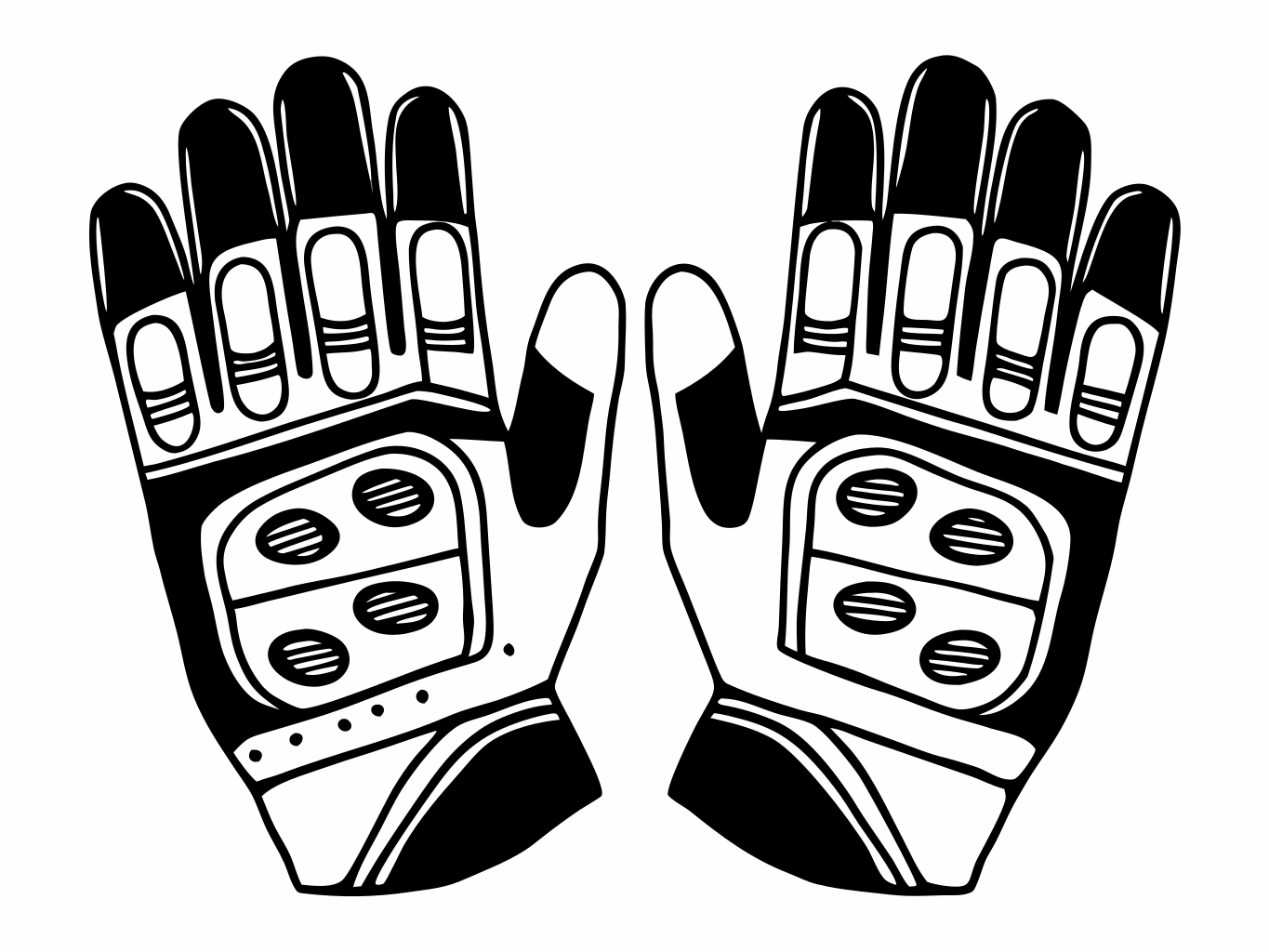
Your hands work the clutch, brake and throttle for every minute of a hard enduro day. Most off-road gloves carry no protection rating, a few are certified to EN 13594:2015, and the label tells you which is which. This guide explains the standard, how a glove should fit, and what matters on wet rock and roots.
On this page
What gloves do in hard enduro
Hard enduro is slow, technical riding. You feather the clutch on climbs, drag the front brake down rock steps and restart after stalls. At Erzberg, the Red Bull Hare Scramble gives 500 starters 4 hours on one mountain, per the organizer. That is four hours of grip.
A glove has three jobs:
- Grip. It holds the bars and levers when your hands are sweaty, muddy or soaked from a water crossing. Clean clutch feathering needs a glove you can feel the lever through.
- Skin protection. It keeps rock, bark and branches off your palm and the back of your hand.
- Impact protection. Knuckle armor takes the hit when your hand meets a rock, a tree or your own lever.
Our view: in hard enduro the first two jobs matter every minute, and the third matters a few times a day. That comes from the kind of falls the sport produces. Most are low-speed tip-overs on logs and rocks, not slides down tarmac at speed. Keep that in mind when you read the standard below.
EN 13594:2015 explained
EN 13594:2015, "Protective gloves for motorcycle riders – Requirements and test methods", is the European standard for motorcycle gloves. The Estonian Centre for Standardisation catalogue entry lists it as valid, published on 6 October 2015, and replacing the 2002 edition. Its scope reads: "This European Standard applies to protective gloves for motorcycle on-road use." Note the words on-road.
Where the law comes in
In the EU, protective gloves are personal protective equipment under Regulation (EU) 2016/425. Per the European Commission, the CE mark is the evidence of compliance, and meeting a harmonised standard gives a presumption of conformity. Annex I sets three risk categories. Category II covers "risks other than those listed in Categories I and III". Leatt's certificate for its Moto 4.5 Lite shows how that lands for a glove: "Category of PPE: II: 'medium' risks", examined by notified body RICOTEST (0498).
Two levels
SATRA, a notified body and test lab, describes Level 1 as protection "while having low ergonomic penalties" and Level 2 as "greater protection than level 1", with possible weight and restriction penalties.
| Test | What the lab does | Level 1 | Level 2 |
|---|---|---|---|
| Cuff length | Measures the cuff past the wrist line on a correctly sized wearer | At least 5 mm | At least 50 mm |
| Restraint | Pulls a test cone out of the fastened glove by the fingers | Must hold to 25 N | Must hold to 50 N |
| Cut resistance | EN 388 blade test on all layers together | Palm materials only | All materials except the fourchettes |
| Impact abrasion | Palm area abraded on the Cambridge machine with a P120 grit belt, after washing if applicable | Required | Required |
| Knuckle impact | One impact on each of the four knuckles, four glove sizes | Optional | Mandatory |
| Seam and tear strength | Every seam type forming the protective layer; tear per EN 388 | Required | Required |
The glove must also pass chemical safety checks (such as chromium VI in leather and nickel on metal parts) and an ergonomics check where an assessor performs set movements.
The numbers behind the knuckle test
SATRA's guide to EN 388 describes the impact method, which EN 388 borrows from clause 6.9 of EN 13594:2015. The protected area is cut out, laid over a domed anvil and hit by a 2.5 kg flat-faced striker at 5 J. A load cell under the anvil records the peak force that gets through. SATRA gives the EN 13594:2015 Level 1 limit as a mean transmitted force of no more than 7.0 kN, with no single result above 9.0 kN.
What the standard does not cover
- Grip and bar feel. No test measures how well the palm holds a wet grip.
- Wear life. Abrasion is a one-off crash test, not a measure of how many rides the palm survives.
- Off-road crashes. SATRA notes the impact abrasion test models a rider sliding along the road, and was developed from studies of real accidents. That is not what a low-speed fall onto a boulder looks like.
How off-road gloves relate to EN 13594
Most off-road gloves are built for feel first and carry no certification claim. A few are certified to EN 13594:2015. Some carry a CE mark earned by a different route. Here is what each maker states.
| Glove | What the maker states |
|---|---|
| Fox Bomber CE | "CE Level 1 certified - EN 13594:2015" |
| REV'IT! Massif (DIRT Series) | "Level 1 certified according to standard EN 13594:2015" |
| Leatt Moto 4.5 Lite | "CE certified (EU) 2016/425, EN 13594:2015" |
| Fox Airline | No certification stated |
| Leatt Moto 1.5 GripR | No certification stated |
Read past the product page
The Leatt line shows why the paperwork matters. Leatt's EU declaration of conformity for the Moto 4.5 Lite says compliance "has been assessed against an internal method partially based on the applicable parts" of EN ISO 21420:2020 and EN 13594:2015. The EU type-examination certificate lists the tests it assessed (seam strength, tear strength, restraint, palm abrasion, knuckle protection) and gives an "overall PASS level". It describes the protection as limited, against "minor bruises, lifted stones and debris", and says the glove is "NOT to be used on tarmac". Leatt's own glove user information says the knuckle attenuation was assessed with an EN 13594:2015 method "adapted to off-road use", and calls it "less robust" but "sufficient for use in the Motocross environment".
So a CE mark on an off-road glove can mean full EN 13594 Level 1 certification, or a notified-body pass against an off-road method built from parts of the standard. Both routes end in a CE mark. They are not the same claim.
What that means for you
For rocky hard enduro, certified knuckle protection is worth its extra weight. For tight woods and mud, a light uncertified glove is a fair choice. The reason is what the standard tests. The knuckle impact test maps onto a rock strike. The palm abrasion test models a slide on tarmac, which hard enduro, ridden at walking pace, rarely produces.
How to read a glove label and declaration
| Marking | What it means |
|---|---|
| CE mark | The maker declares the glove complies with the PPE Regulation (EU) 2016/425 |
| EN 13594:2015 | The standard used. Check whether the documents say "applicable parts" or "partial application" |
| Level 1 / Level 2 | The performance level passed (see the table above) |
| KP | The glove passed the knuckle impact test. Makers print it after the level, as in Alpinestars' "EN 13594 2015, Level 1 KP" or REV'IT!'s "Level 1 KP certified" |
| Notified body number | The lab that examined the design, e.g. RICOTEST 0498 on Leatt's documents |
Knuckle hardware alone does not earn the KP mark. REV'IT!'s Massif has a "flexible TPR knuckle protector" yet is listed as Level 1 without KP.
The declaration of conformity
Under the PPE Regulation's Annex II, point 1.4, the maker's instructions must name the standards applied and the notified body, and say where to find the declaration of conformity. Leatt, for example, posts it under the DOCUMENTS tab on each product page. In the declaration, check:
- The exact product name matches the glove in your hand.
- The regulation is (EU) 2016/425.
- The standard, and whether it is applied in full or "partially".
- The notified body's name and four-digit number.
- Any stated limits on use, such as "not for tarmac".
How a glove should fit
Makers size by different measurements, so take both. REV'IT! measures hand circumference around the palm just below the knuckles, thumb excluded, and hand length from the tip of the longest finger to the crease under the palm. Fox sizes by hand length (7.1–7.3" for S). Leatt sizes by circumference (19–21.5 cm for M, 21–23 cm for L).
Leatt's fitting steps, in short:
- Fasten the cuff snugly, but not so tight it restricts movement or blood flow.
- Grip a handlebar or similar cylinder.
- The glove should be as close fitting as is comfortable, with minimal bunching in the palm and no pressure on the fingertips.
- Check that the cuff strap stops the glove from being pulled off.
MotoCAP, Australia's gear rating program, adds a fist test: make a fist and check that the material does not bunch or pinch. It also warns that a glove that is too tight can make your hands go numb, and one that is too bulky makes the controls harder to use.
Fit at the bars, not in the air, because bunching only shows up when your hand closes around a grip, and bunching is what makes you squeeze harder.
What matters specifically in hard enduro
Bar feel versus protection
Every layer between palm and grip costs feel. The Fox Airline uses a "single-layer perforated Clarino palm" for "reliable bar feel". The Fox Bomber CE uses a "padded double-layer palm" plus knuckle and finger armor. Our view: pick by terrain, because the fall pattern differs. Rock gardens put your knuckles at risk, while roots and mud mostly test your grip.
Grip when wet
Leatt claims wet and dry grip for both its gloves here. Fox adds silicone fingertip print to the Airline for lever grip. No standard tests wet grip, so these stay maker claims. The only sure fix for a soaked glove on a soaked grip is a dry pair. We say that because of how often the sport crosses water and mud.
Blisters and arm pump
Blisters come from the glove moving over your skin. A glove will not cure arm pump, but a bad one adds to it. A thin palm that fits tight at the bars helps with both. This follows from the fit checks above and the grip mechanics in our arm pump guide: less slip means less squeeze. Pair it with grip and forearm training.
Spares and wear rate
On a long or wet day, carry a second pair in your hydration pack, and treat light off-road gloves as consumables. There are two reasons: the wet-grip point above, and construction. Makers use thin palms to maximize feel, and a thin palm has less material to wear through.
Picking gloves
- Prioritize bar feel and comfort. Expect faster wear. Try the glove on a real grip before you buy.
- For rocky terrain, get knuckle protection. Look for EN 13594:2015 with the KP mark, or read the declaration of conformity to see how the knuckle armor was assessed.
- On wet days, carry a second pair. Tacky palms help, but a dry pair beats any palm on a soaked grip.
- Check the cuff. EN 13594 requires an adjustable restraint at the wrist or cuff. A slip-on cuff, like the Fox Airline's, trades that for an unrestricted fit.
- Read the documents behind any CE claim. Look for the level, the KP mark and whether the standard was applied in full.
- Buy for your terrain. Our view: a light pair for mud and woods and an armored pair for rock covers most hard enduro. That split matches the terrain points above: rock gardens put your knuckles at risk, while roots and mud mostly test your grip.
Care, inspection and replacement
Washing and storage
Fox's care instructions for the Airline and the Bomber CE: machine wash cold and gentle, close the hook-and-loop closure first, line dry, and do not bleach, iron or dry clean. Leatt's user information points to the care label in each glove. For storage, Leatt says to wash and dry the gloves thoroughly, keep them in a ventilated place away from direct sunlight and UV, avoid airtight boxes and bags, and keep heavy objects off them, which can permanently compress the impact material.
Inspection and replacement
Leatt says to inspect the protector before each use. Stop using it if any part is damaged, worn, cracked or deformed, or if the padding has deteriorated. Leatt recommends replacing it every three years under normal use, and after a crash either having the seller inspect it or replacing it.
Replace any glove when the palm wears through, a seam splits, the knuckle armor cracks or the cuff closure no longer holds. SATRA calls seam strength one of the more difficult EN 13594 requirements to meet, and notes that a failed seam can split open and expose the hand to abrasion.
Common glove mistakes
- Reading "CE" as "Level 1". A CE mark can sit on a glove examined against an internal off-road method built from parts of EN 13594. Leatt's own declaration for the Moto 4.5 Lite says exactly that.
- Sizing up for comfort. A loose palm bunches, rubs and makes you grip harder. See the fit checks from Leatt and MotoCAP above.
- Drying gloves on a hot pipe or heater. Fox says line dry, and Leatt warns against heating its protectors.
- Trusting knuckle plastic you cannot trace. Armor without a KP result or documented assessment has no number behind it. REV'IT!'s Massif is a case in point: it has a TPR knuckle protector, yet it is listed without KP.
For the rest of your kit, see the gear overview and the gear guide in our training section. Leatt's brand profile covers the company behind two of the gloves listed here.
Priority: ★★★☆☆. Suggested share of a full kit's budget: 5%.
What the rating rests on: Gloves get three stars because they are the contact point for every control input and the first thing to meet rock in a tip-over, but the lab protection on offer is modest: the EN 13594 impact method delivers 5 J, and the standard's scope is on-road riding. They get 5% of the budget because the gloves listed here run $29.99 to $84.99 at list, and because thin off-road palms wear out, so you buy several pairs rather than one expensive pair.
Our suggested picks for hard enduro Gloves
Grouped by the maker's list price. No paid placements, no affiliate links. Every fact on a card links to the maker's own page.
Moto 1.5 GripR Glove
- Leatt
- US$29.99 list price (International (int.leatt.com))
A lightweight, minimalist moto glove with a mesh upper and a super-slim MicronGrip palm for handlebar feel and grip in the wet or dry.
Materials: Mesh upper, Stretch Lycra sides, MicronGrip palm
Features: 3D Concave Palm cut, FormFit finger construction, Hook-and-loop Hypalon cuff adjustment
Leatt describes the Moto 1.5 GripR as a lightweight, minimalist glove for warm-weather riders. It pairs a mesh upper and stretch Lycra sides with a super-slim MicronGrip palm in a 3D Concave Palm cut and a seamless palm. The cuff is a low-profile stretch fit with hook-and-loop Hypalon adjustment. It is touch-screen compatible and comes in sizes S to XXL. Leatt states no certification for it.
Why it is listed: it is the lowest list price on this page ($29.99) and a moto glove rather than a mountain-bike glove. It has an adjustable cuff but no knuckle armor, so it suits mud and woods riding where feel matters more than impact protection.
Sources
Airline Gloves
- Fox Racing
- US$34.95 list price (US)
Minimalist motocross gloves with a neoprene slip-on cuff and a single-layer perforated Clarino palm.
Materials: 63% polyamide nylon, 15% neoprene, 12% polyurethane, 6% elastane, 4% silicone
Features: Single-layer perforated Clarino palm, Slip-on neoprene cuff, Silicone fingertip print
Fox describes the Airline as ultra-minimalist motocross gloves. They use a compression-molded, slip-on neoprene cuff, a single-layer perforated Clarino palm, an ultra-light stretch top of hand, stretch nylon finger gussets and silicone print at the fingertips for lever grip. Fox lists the materials as 63% polyamide nylon, 15% neoprene, 12% polyurethane, 6% elastane and 4% silicone. Sizes run S to 2XL. Fox states no certification for them.
Why it is listed: it sits between the budget and premium picks on list price ($34.95) and is built for bar feel, with a single-layer palm. It has no knuckle armor and no adjustable cuff restraint, which EN 13594 requires, so it is a feel-first glove for mud and woods, not rock gardens.
Sources
Bomber CE Gloves
- Fox Racing
- US$84.95 list price (US)
An off-road motocross glove with molded plastic knuckle and finger armor, a padded double-layer palm and CE Level 1 certification to EN 13594:2015.
Certification declared by the maker
- CE Level 1 certified - EN 13594:2015
Coverage: Knuckle and finger armor; extended cuff
Materials: Perforated goatskin leather top, Padded double-layer palm, Molded plastic knuckle and finger armor
Features: Extended compression-molded cuff with hook-and-loop closure, Touch screen compatible
Fox describes the Bomber CE as an off-road motocross glove with coverage from the fingers to the cuff. It has molded plastic knuckle and finger armor, a padded double-layer palm, a perforated goatskin leather top and a compression-molded, extended cuff with a hook-and-loop closure. It is touch-screen compatible. Fox lists the materials as 30% polyamide nylon, 27% polyester, 14% polyurethane, 8% goat leather, 6% PVC, 6% neoprene, 5% polycarbonate and 4% elastane. Sizes run S to 4XL.
Why it is listed: it carries a full EN 13594:2015 Level 1 claim from the maker, the clearest certification on this page, together with hard knuckle and finger armor and an adjustable cuff. At $84.95 it is the premium pick. Expect less bar feel than a single-layer glove.
Sources
Moto 4.5 Lite Glove
- Leatt
- US$84.99 list price (International (int.leatt.com))
A ventilated moto glove with an ultra-thin NanoGrip palm and 3D molded ReaFlex impact gel over the knuckles and third and fourth fingers.
Certification declared by the maker
- CE certified (EU) 2016/425, EN 13594:2015
- EN 13594:2015 (applicable parts only)
Coverage: Knuckles and third/fourth fingers
Materials: NanoGrip palm, Mesh upper, ReaFlex impact gel
Features: FormFit finger stitching, Hook-and-loop closure, Touch screen compatible
Leatt describes the Moto 4.5 Lite as combining an ultra-thin, durable NanoGrip palm with slim, 3D molded ReaFlex impact gel over the knuckles and the third and fourth fingers. It has a ventilated mesh upper, FormFit finger stitching, a pre-curved fit with a seamless palm and concealed reinforcement, and a hook-and-loop closure. Sizes run S to 2XL.
Leatt's product page states "CE certified (EU) 2016/425, EN 13594:2015". Its EU declaration of conformity says compliance was assessed by notified body RICOTEST (0498) against an internal method partially based on the applicable parts of EN ISO 21420:2020 and EN 13594:2015. The EU type-examination certificate describes limited protection against minor bruises, lifted stones and debris, and says the glove is not to be used on tarmac.
Why it is listed: it is the lightest route on this page to notified-body-examined knuckle protection, and Leatt publishes the full declaration and certificate. At $84.99 it sits at the premium price point. Read it as an off-road CE glove, not as an EN 13594 Level 1 glove.
Budget tiers explained
Where a category has picks, they sit in three tiers. The tier follows the maker's list price within the category. A higher tier does not mean a higher certification level: check the label.
- Budget:
- Entry price. The essentials without the extras: a sound start for new riders or occasional use.
- Value:
- More for the money. More enduro-specific features, better adjustment and ventilation, at a mid-range list price.
- Premium:
- Top tier, fewer compromises. Lighter materials, more adjustment or more coverage, often with diminishing returns unless you ride a lot.
Explore other Top Hard Enduro Gear Categories
Gear lowers the cost of a fall. Control lowers how often you fall. Train it in Controls 101.