Lesson 4 of 5 in Advanced Techniques
Water Crossings
Cross water by reading it first: depth, current and what's on the bottom. If you're not sure, walk it or don't cross. Pick the shallowest, smoothest line, enter at a steady speed in second or third, stand with your weight back so the front floats over hidden rocks, and hold a smooth, steady throttle all the way to the far bank. Deep water needs just enough speed to push a small bow wave, never a splash over the engine. If the engine does drown, stop it straight away and pump the water out before you try to start it.
Updated September 2026. Sources are listed below. How we work
On this page
- Why water crossings matter
- Read the crossing from the bank
- Depth and what to do about it
- How to ride a water crossing
- Deep water and the bow wave
- Protect the engine before you get wet
- If the engine drowns
- Safety: current and unknown depth
- How to train water crossings
- Water crossing mistakes and fixes
- You're ready to move on when…
- Water crossing questions
Why water crossings matter
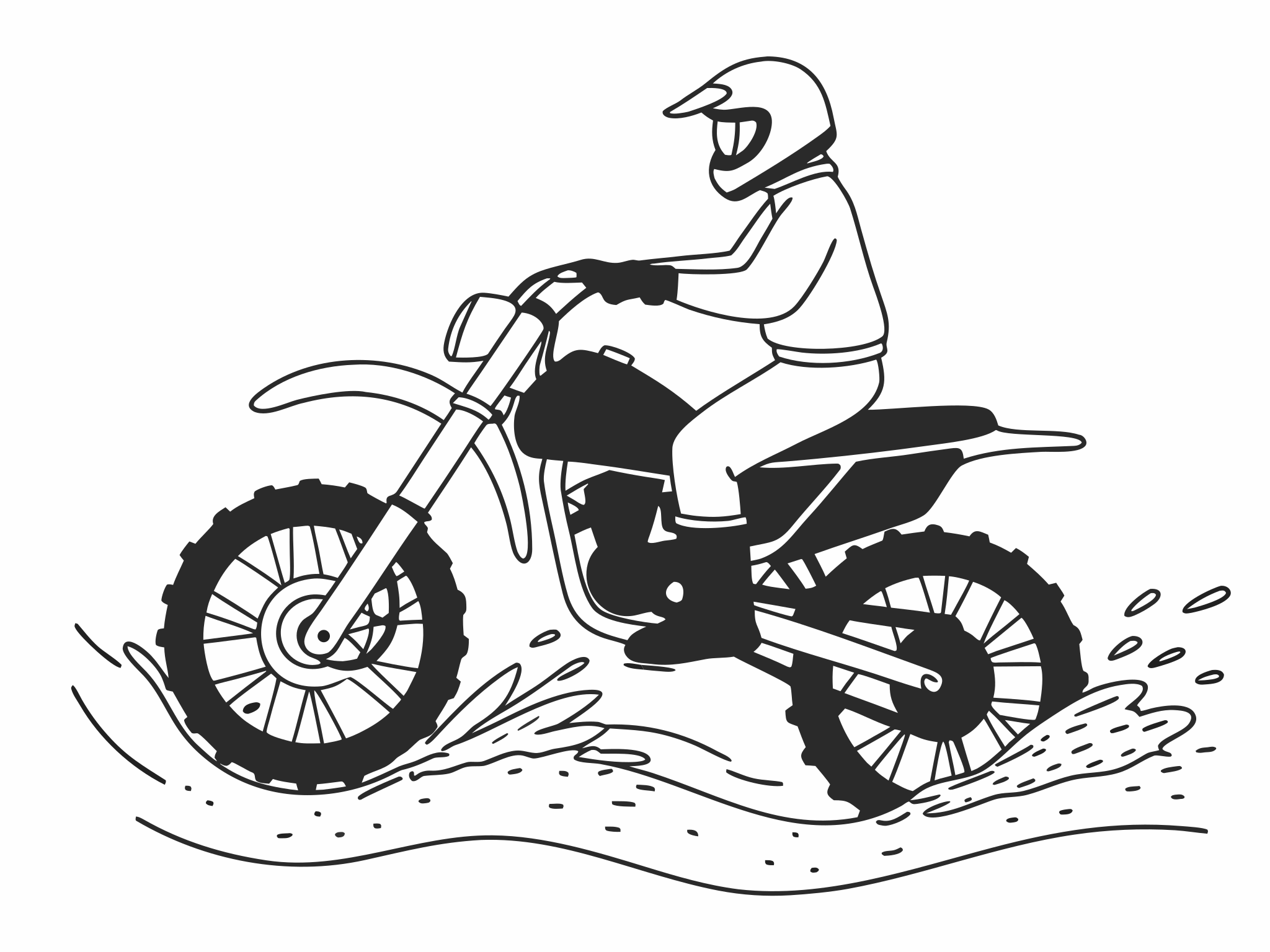
Water hides things. A clear stream can have a boulder, a hole or a sunken log under the surface. A brown one can hide all three. The current can be stronger than it looks, and the far bank can be a slippery, rutted climb.
The costs are high. A rider who falls in a river can be hurt, cold or carried downstream. A bike that sucks water into its engine can be out for the day, or for good. In a race, Ricky Russell's summary to Dirt Rider applies to everyone: "You might save a second or two by blasting through a creek, but you lose it if you suck water into the filter."
A calm approach protects you and the engine. Most of this lesson is about judgement. The riding itself is throttle control and body position you already have.
Read the crossing from the bank
Stop before the water. Look at four things:
- Depth. Russell: "if you see little ripples, it's usually caused by little rocks just under the water, so that's a sign it's not very deep." Smooth, dark water is usually deeper. Watch another rider cross, or throw a stick in to see how fast the water moves.
- Current. New Zealand's Department of Conservation lists warning signs for anyone crossing a river: the water is "flowing faster than walking pace", it's murky, or you can hear "roaring water or rocks moving".
- The bottom. Gravel is good. Big round boulders deflect the front. Mud and sand can bog the rear. Bedrock can be as slippery as ice.
- The exit. A steep, muddy or rutted far bank needs momentum and a plan. Work out where you'll climb out before you go in.
If a slow crossing is new to you, walk it. It tells you the depth, the bottom and the current, and shows you the line. If the current is too strong to walk comfortably, it's too strong to ride. DOC's rule is simple: "If you are not sure a river is safe, do not cross. Wait, turn back, or use another route."
Depth and what to do about it
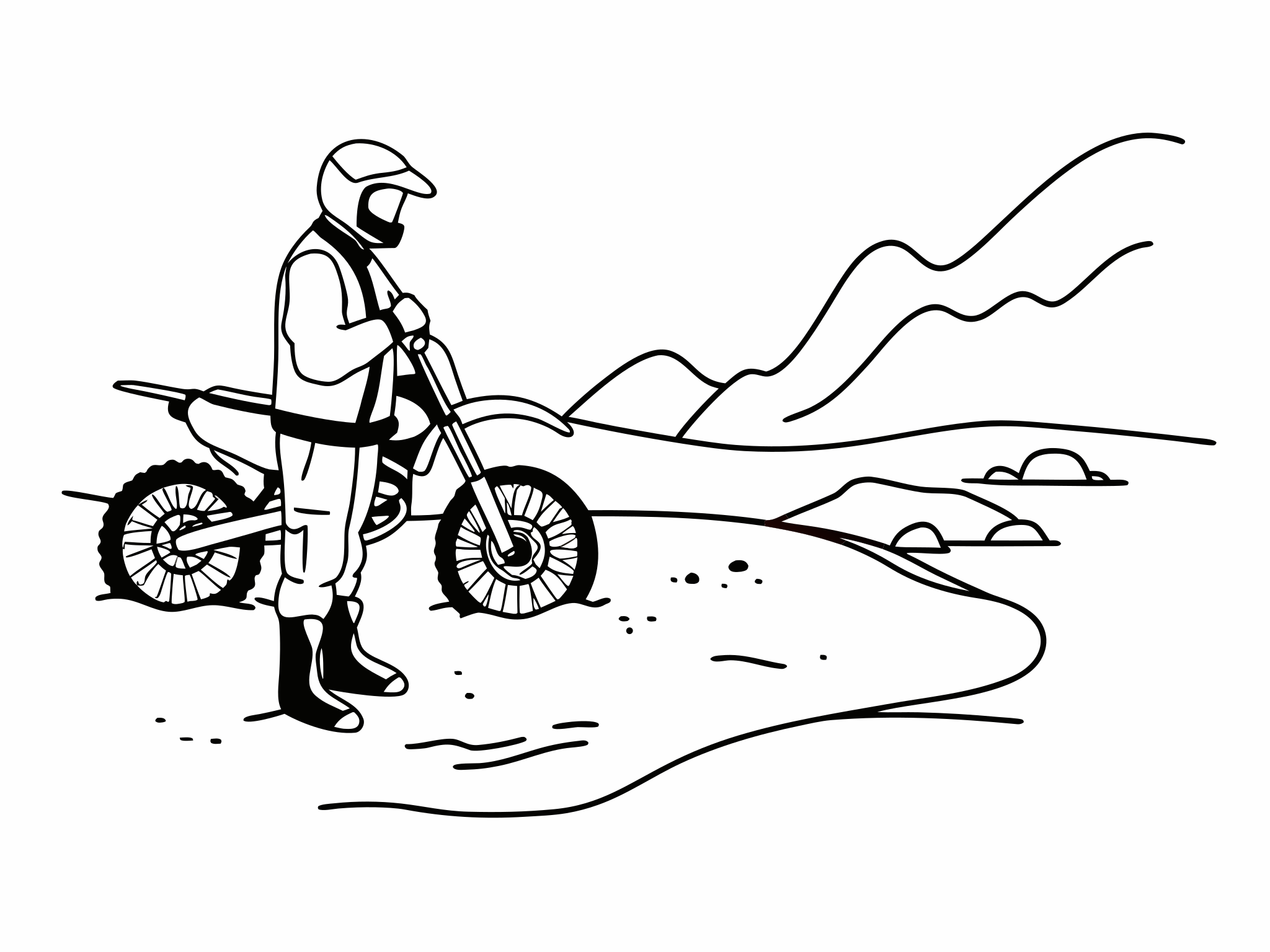
A rough guide for a standard enduro bike with the airbox under the seat. Current changes everything: moving water at any of these depths is far more dangerous than still water.
| Depth | What it means | How to ride it |
|---|---|---|
| Below the axles | Low risk to the engine | Steady speed, standing, weight back. Watch for hidden rocks. |
| Axles to the bottom of the engine | Spray can reach the air intake | Slow down to a small bow wave. Steady throttle, no gear changes. |
| Over the engine, near the airbox | Real risk of drowning the engine | Walk it first. Cross only if still and known, at walking pace with a bow wave, or don't cross. |
| Deeper, or fast-moving | Dangerous to rider and bike | Don't ride it. Find another line, wait or turn back. |
Swipe the table sideways to see every column.
How to ride a water crossing
These principles hold from a shallow creek to a knee-deep river.
1Pick one line and commit to it
Choose the shallowest, smoothest line, usually where the water ripples over gravel. Then commit. Changing your mind halfway across is how riders end up in the deep bit.
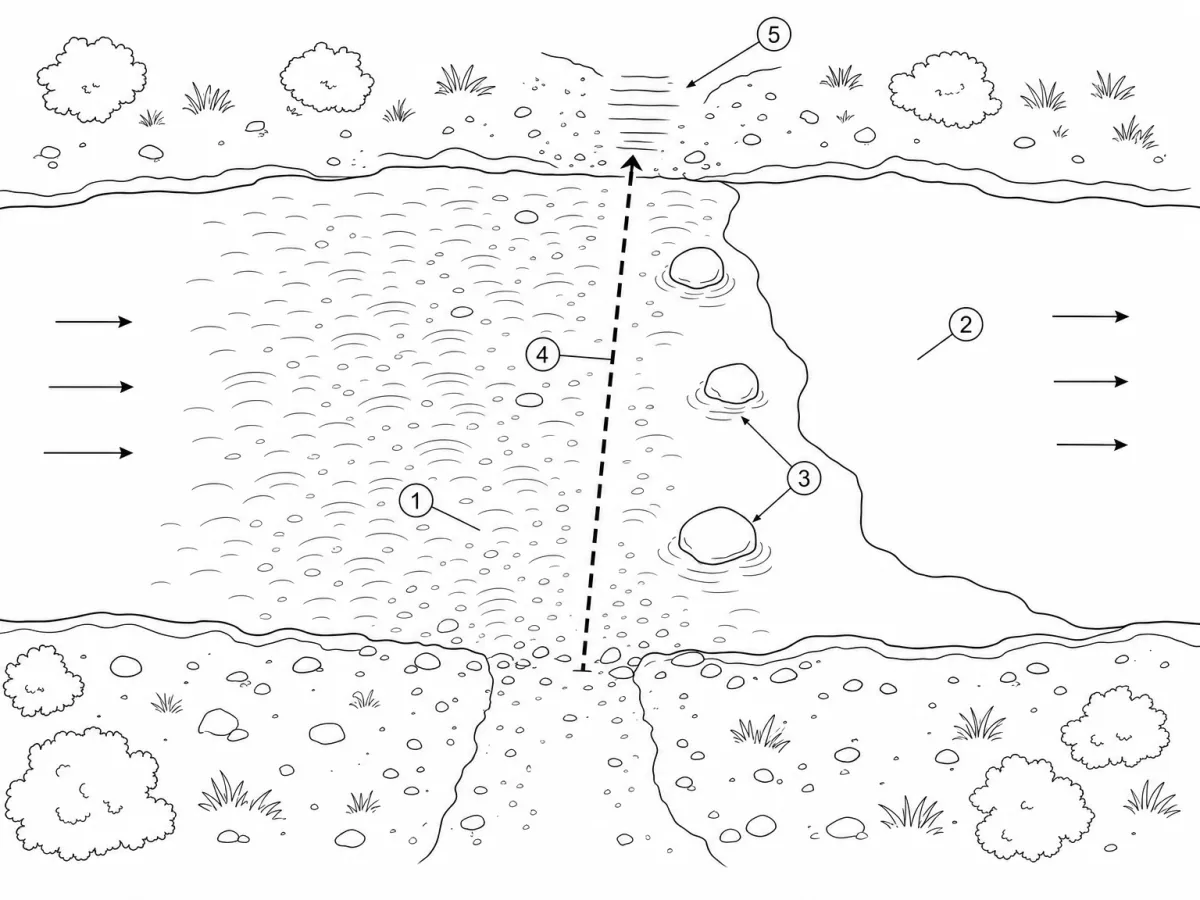
Picking the line from the bank. 1 Ripples over gravel: usually shallow · 2 Smooth water: usually deeper · 3 Big round boulders deflect the front · 4 One line, straight across · 5 The exit, chosen before you go in. 2Enter steady, in a gear that pulls
Second or third, chosen before the water. Chris Hollis told Transmoto: "You need to come into the section with some momentum and then be steady on the throttle throughout." Don't shift in the water; it cuts drive when you most need it.
3Stand, weight back, front light
Russell keeps "my weight back and try to just float the front tire because you don't know what it's going to hit". A light front rides over a hidden rock instead of stopping against it. Grip the bike with your knees and keep your elbows soft.
4Smooth, lugging throttle
Wet rock is slippery. Russell's advice: "You want to be super smooth with the throttle because your traction is not going to be the best. So if you can, try to lug the engine a little bit." Hollis adds: "Don't look to build speed during the crossing." Keep a finger on the clutch for when the front hits something.
5Eyes on the far bank, and just ahead
Russell looks across to the far bank to find his target, then back at the water just in front, scanning for "any big boulders or anything like that". Switch between the two all the way across.
6Dry the brakes
After the crossing, wet discs and pads grab weakly. KTM's manual: "Brake carefully several times to dry out and remove dirt from the brake linings and the brake discs." The UK Highway Code says the same for any vehicle: "gently apply light pressure while driving slowly".
Deep water and the bow wave
In deep water, speed pushes water up and over the bike. Too slow and the front wheel stops against a rock. Too fast and a wall of spray goes straight into the air intake.
The answer is a small, steady bow wave in front of the front wheel. Russell: "For deep water, you want to go just fast enough that you're splashing the water but not getting it over the engine and into the air filter." He also leans back so "my toes are pointing up and in a way the bottom of my boots are keeping water from going over the engine."
If the water is deep enough to reach the seat, you're into the kind of crossing where riders push their bikes across with the engine off, in pairs, and only in still water. That's a group decision, not a technique.
Protect the engine before you get wet
- Air filter. Oiled, seated properly and sealed around the rim. A filter that's dry or badly fitted lets water straight through.
- Airbox. Know where your bike breathes. On most enduro bikes the intake is under the seat. Some riders fit a waterproof cover over the filter for wet races.
- Vent hoses. Carburettor, fuel tank and gearbox vents should be routed high and clear.
- Spare plug and plug spanner. Carry both. A drowned engine often needs a fresh plug.
- Kill switch. Know where it is without looking. Cycle World's advice for a bike going under: "flick off the kill switch before it goes completely under."
If the engine drowns
Water can't be compressed. Cycle World warns that if the engine is running when it takes in water, "you risk bending the connecting rod, since the water in the cylinder can't be compressed." So the first rule is: don't keep trying to start it. The steps below follow Cycle World's procedure.
1Stop the engine and get out
Hit the stop button, pull the bike to dry ground and stand it up. Don't press the starter.
2Filter and plug out
Cycle World: "remove the air cleaner and spark plug. Drain the airbox and exhaust pipe." To get the water out, Cycle World says to "lay the bike over on its side if you have to; with a light two-stroke trail bike you can even turn the whole thing upside down." Wring out and dry the filter, or fit a spare.
3Pump the water out
With the plug out, "Put the bike in gear, lift the rear wheel off the ground, and give it a spin." Keep turning the engine over until no more water sprays from the plug hole. Dry the plug, or fit your spare.
4Fuel system
On a carburetted bike, drain the float bowl, as Cycle World describes: "remove the float bowl or the bowl's drain screw, drain the gas, and reinstall." Then refit everything and try to start it.
5Change the oil as soon as you can
Cycle World: "As soon as possible, change the oil in the engine and gearbox." If the oil looks milky, water has got in. Don't ride the bike hard until it's changed.
Safety: current and unknown depth
Moving water is stronger than it looks. The US National Weather Service warns that "a mere 6 inches of fast-moving flood water can knock over an adult" and "12 inches of rushing water" can carry away most cars. The UK Environment Agency puts it as "30cm of water to make a car float". A dirt bike weighs a fraction of a car.
- Avoid fast current and unknown depth. If you can't see the bottom and can't walk it, don't ride it.
- Rivers rise. Rain upstream can raise a river in hours. DOC notes that "even small side streams can flood and become too dangerous to cross". A crossing that was easy in the morning may not be in the afternoon.
- Cross one at a time. The next rider waits until the one in front is out. A rider who stops midstream blocks the line for everyone.
- If the bike goes over, stay upstream of it. A bike pushed by the current can pin a rider against a rock.
- Cold. Wet riders get cold quickly, even in summer. Carry a dry layer on long rides with crossings, and use the trail first-aid basics.
How to train water crossings
Start with shallow, slow, clear creeks you have walked. Focus on committing to one clean line and resisting panic inputs.
1Shallow creek, same line, ten times
Choose a crossing below your axles with a gravel bottom and easy banks. Ride it ten times on the same line, standing, one gear, steady throttle. Then the other way.
2Change the line
Ride a different line through the same creek, with a few rocks in it. Practise keeping the front light and the throttle steady when the front is deflected.
3A deeper, still crossing
Walk a crossing around engine height with no current. Ride it at walking pace with a small bow wave. Stop on the far side and check the airbox: it should be dry.
4A muddy exit
Add a crossing with a steep or muddy far bank. Practise carrying steady speed out of the water and up the bank, as in the hill climbs lesson.
Water crossing mistakes and fixes
Blasting in to get it over with.
Fix: A wall of spray goes into the airbox. Enter at a steady speed with a small bow wave.
Gassing it when the front hits a rock.
Fix: The rear spins on the slippery bottom and the bike goes down. Keep the throttle steady and use a flick of clutch to keep moving.
Sitting with your weight forward.
Fix: The front digs into holes and stops against rocks. Stand, weight back, front light.
Changing line halfway across.
Fix: Walk or read the crossing first, then commit to one line.
Pressing the starter on a drowned engine.
Fix: Water doesn't compress. Plug out, pump the water out, then start it.
Forgetting the brakes afterwards.
Fix: Brake gently several times to dry the discs before the next descent.
You're ready to move on when…
- You can read a crossing's depth, current, bottom and exit from the bank before you ride.
- You can ride a shallow, rocky creek ten times on one line without a dab.
- You can cross engine-deep still water at walking pace and arrive with a dry airbox.
- You dry your brakes after every crossing without being reminded.
- You carry a spare plug and know the drowned-engine procedure.
- You turn back when the current or depth is wrong.
Water crossing questions
How deep can a dirt bike go through water?
It depends on the bike, but the limit is the air intake, usually under the seat. Water over the engine is where the risk of drowning it starts. In moving water, depth matters less than current: even shallow fast water can knock a rider over.
Should I go fast or slow through water?
Steady. Enter with some momentum and hold a smooth throttle. In deep water, go just fast enough to push a small bow wave.
What gear should I use for a water crossing?
Second or third, chosen before you enter. Low enough to pull, high enough to keep the throttle smooth, and no shifting in the water.
What do I do if water gets in the engine?
Stop it immediately. Take out the air filter and spark plug, drain the airbox and exhaust, turn the engine over until the water is out, then refit and start. Change the oil as soon as you can.