Lesson 5 of 5 in Safety & Setup
First‑Aid Basics (Trail)
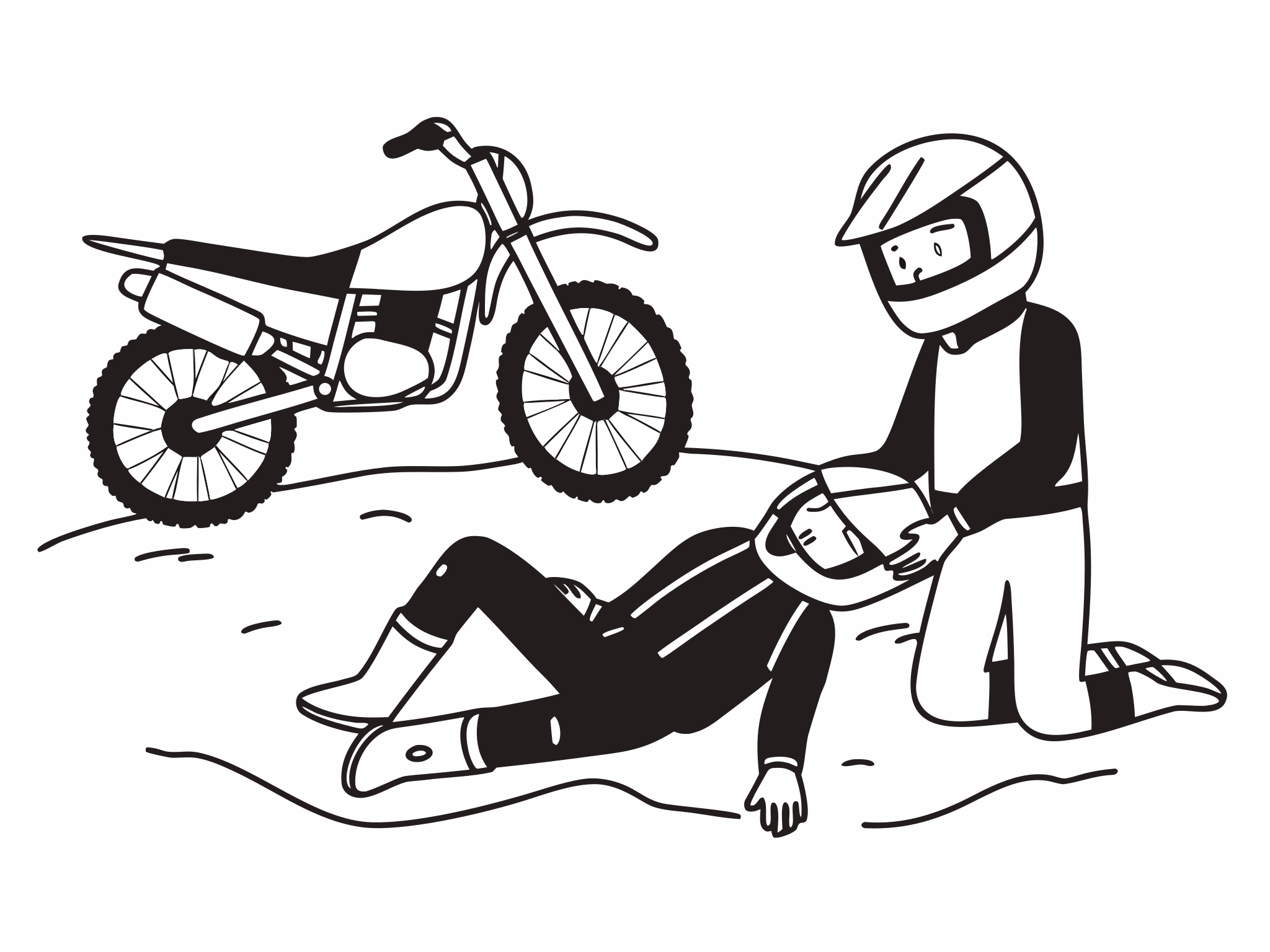
After a crash, make the scene safe, check for a response and call 112 or 999 as soon as you know it's serious. Stop life-threatening bleeding with firm direct pressure, then check the airway and breathing. Leave the helmet on unless the airway is at risk and you can't manage it any other way. Keep the rider still if the neck or back could be hurt, support broken limbs as you find them, and keep them warm. Then do a proper first-aid course: every hard enduro rider should.
Updated September 2026. Sources are listed below. How we work
On this page
Goals
You are not a paramedic. Your job is to keep the injured rider alive and stable, stop things getting worse, and get help moving early. In hard enduro that gap can be long: AdventureSmart UK warns that mountain rescue "may take several hours to reach you".
This page follows the European Resuscitation Council (ERC), Resuscitation Council UK, St John Ambulance, the British Red Cross, the NHS and the FIM.
The first minutes after a crash
Work through these in order. The order keeps you calm.
1Make the scene safe
St John Ambulance's first rule: "Before approaching the casualty, always make sure the area is safe." On the trail that means stopping the next rider coming down the same line, switching off the crashed bike's engine, and watching for a bike that could slide or roll. Hot exhausts burn.
2Check for a response
Talk to the rider before you touch them. St John Ambulance's spinal injury advice is "do not move them and do not tell them to move, unless they are in immediate danger".
3Call for help early
If the rider is unresponsive, has hit their head hard, can't move a limb, is bleeding heavily or has neck or back pain, call now. Don't wait to be sure. 112 works across the EU; in the UK, dial 999 or 112. In the hills, Mountain Rescue England and Wales says to ask for "Police" then "Mountain Rescue", and to "STAY WHERE YOU ARE until contacted by the rescue team". Give an exact location (grid reference or GPS coordinates), what happened, and how the rider is. The safety overview covers satellite SOS for places without signal.
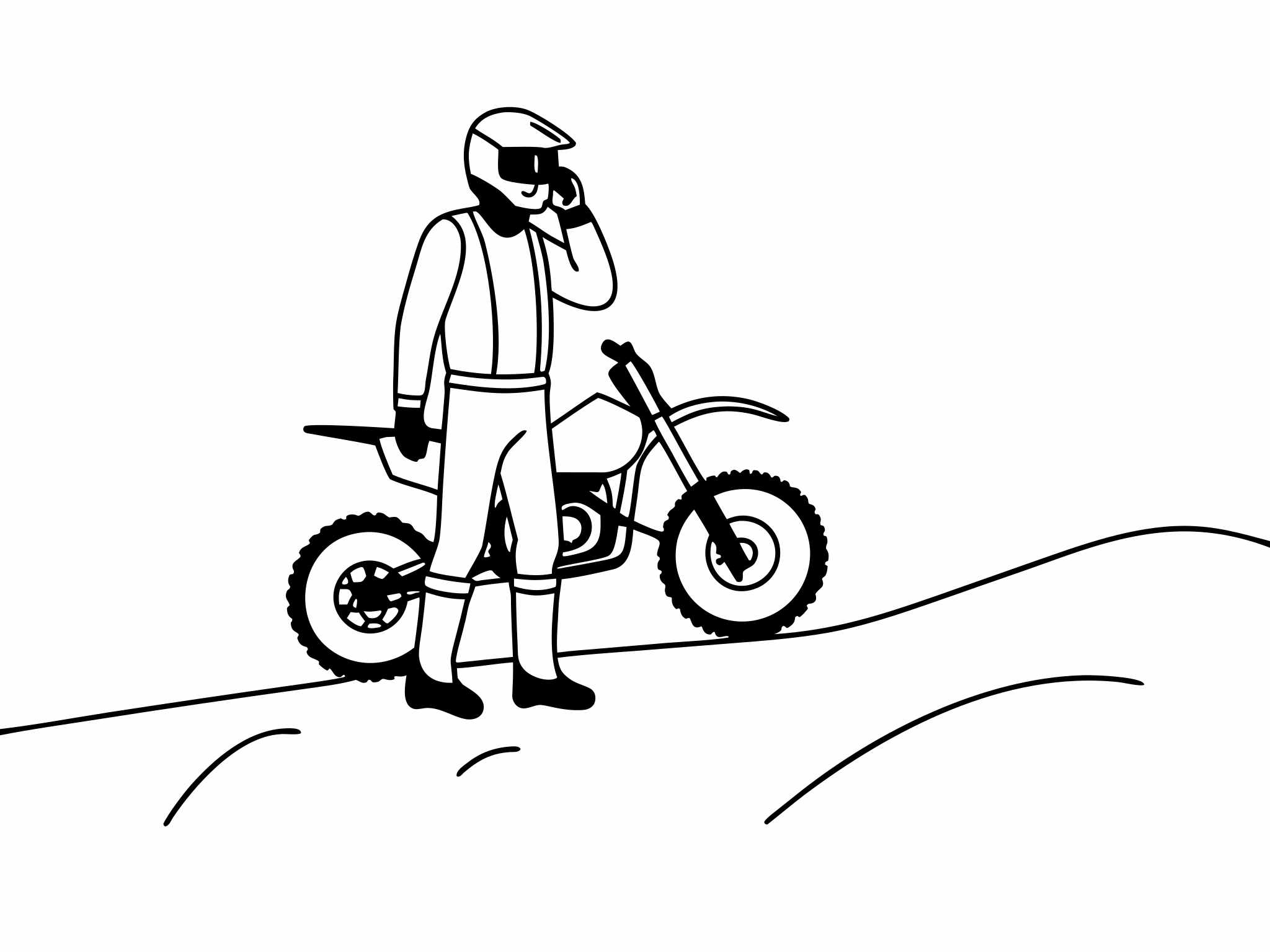
Call as soon as you know it's serious. Rescuers can always be stood down. 4Stop life-threatening bleeding
St John Ambulance says life-threatening bleeding "must be dealt with before moving on to the airway". Press hard, directly on the wound, and keep pressing. See the bleeding section below.
5Check the airway and breathing
Look, listen and feel for normal breathing for up to 10 seconds. St John Ambulance: "Ignore occasional, irregular gasps - these are common in the early stages of cardiac arrest." Not breathing normally means CPR (below). Breathing means you keep the head still and keep watching.
6Check the rest of the body, keep them warm, and monitor
Ask where it hurts and look for injuries without moving the rider. Put an emergency blanket or spare layer over them and something between them and cold ground. The Highway Code's first-aid annex says to "try to keep casualties warm, dry and as comfortable as you can", and "DO NOT give them anything to eat or drink". While you wait, St John Ambulance says to "monitor the casualties and record their breathing, pulse, and level of response". Write it down with the time.
Helmet on or off?
Leave it on. The UK Highway Code's first-aid guidance, compiled with St John Ambulance and the British Red Cross, says: "DO NOT remove a motorcyclist's helmet unless it's essential." The FIM's concussion guidelines for motorcycle sport say: "Do not remove a helmet or any other equipment unless trained to do so safely, or for reasons of immediate risk to the injured e.g. airway management." The same applies to a neck brace and body armour.
Take the goggles off. With an off-road helmet on, you can still see the eyes, talk to the rider and watch their breathing. Removal becomes essential only when the airway is at immediate risk and you can't open or clear it with the helmet on. The same basis applies to a chest protector when CPR needs the chest.
Safe helmet removal is a hands-on skill. Learn it before you need it. UK fire and rescue services run Biker Down courses covering "crash helmet removal – when and how".
Unresponsive rider: airway first
If they are on their back and breathing normally, keep them there. The ERC's 2025 guidelines say: "Persons with a known trauma should be kept in supine position." Resuscitation Council UK puts it as: "In cases of agonal breathing or trauma, do NOT move the person into the recovery position." Kneel behind the head and hold it still with a hand on each side. If the airway needs opening, use a jaw thrust. St John Ambulance describes it as putting "your fingertips at the angles of the jaw" and gently lifting, without tilting the neck. Resuscitation Council UK is clear on the priority: "Airway opening, if required, always has priority over in-line immobilisation."
If you can't keep the airway open, for example because they're vomiting, St John Ambulance says to put them in the recovery position even with a suspected spinal injury, keeping the head, neck and spine in line. Use every helper you have.
If they're face down, Resuscitation Council UK says to check the airway and hold the neck steady. If you need to open the airway, roll them "as a unit onto their back, while keeping their neck in line with their body".
If they are not breathing normally, start CPR. St John Ambulance: call 999 or 112, push in the centre of the chest "to a depth of about 5-6cm" at "a rate of 100 to 120" compressions a minute, and give rescue breaths at 30 compressions to 2 breaths if you're trained. Follow the call handler's instructions. Resuscitation Council UK says to continue until professional help takes over, the person "becomes responsive", or "the rescuer becomes exhausted".
Bleeding
Direct pressure first. The ERC says to "apply firm direct manual pressure to the bleeding injury". Use a dressing, a clean cloth or a gloved hand. Press hard and keep pressing. Don't keep lifting it to look. The ERC advises "against the use of pressure points".
Leave embedded objects in. The British Red Cross says not to remove an object stuck in a wound: "it's helping plug the hole". Press around it.
Life-threatening limb bleeding. If pressure doesn't control heavy bleeding from an arm or leg, the ERC recommends a tourniquet "as soon as possible". Resuscitation Council UK says to place it "5-7cm above the injury, but not over a joint" and tighten it until the bleeding stops, warning: "This may be painful for the person." Write down the time and never release it. The ERC also recommends haemostatic (clotting) dressings for first-aiders. Training makes both far more effective, and the British Red Cross notes that "the 999 operator will be able to tell you what to do".
Shock. Heavy bleeding, or a broken thigh or pelvis, can cause shock: pale, cool or clammy skin, dizziness or confusion. Keep the rider lying flat and warm, call for help, and monitor. St John Ambulance says "do not raise the legs if either are suspected to be broken or there is injury to the pelvis or a hip".
Broken bones, dislocations and spinal injury
Limb injuries are the most common injuries in enduro, as the safety overview shows.
- Don't move a suspected fracture. St John Ambulance: "Do not move the casualty until the injured part is secured, unless they are in immediate danger." The British Red Cross says to "support the limb above and below the injury". Pad around it with spare clothing. Don't try to straighten it.
- Don't put a dislocation back. St John Ambulance: "Do not try to put the dislocated bone back into its socket, as this may cause further injury." Support an arm in a sling, and check the circulation beyond any bandage "every 10 minutes".
- Open fractures (bone through the skin): cover the wound with a clean dressing. St John Ambulance says to "apply pressure around the wound, but not over the protruding bone". Call 999 or 112.
- Suspect a spinal injury after any big crash. The ERC lists "a sporting accident" among the events that should make you suspect a neck injury. Keep the rider still and hold the head in line. Don't make a collar out of anything: the ERC advises against routinely applying cervical collars because they "may impair respiration and swallowing". And "never force an uncooperative person into any position".
Riding needs both hands and both feet. A rider with a suspected fracture or dislocation shouldn't ride out. Walk them to a track with a partner, or wait for a pick-up.
Head injury and concussion
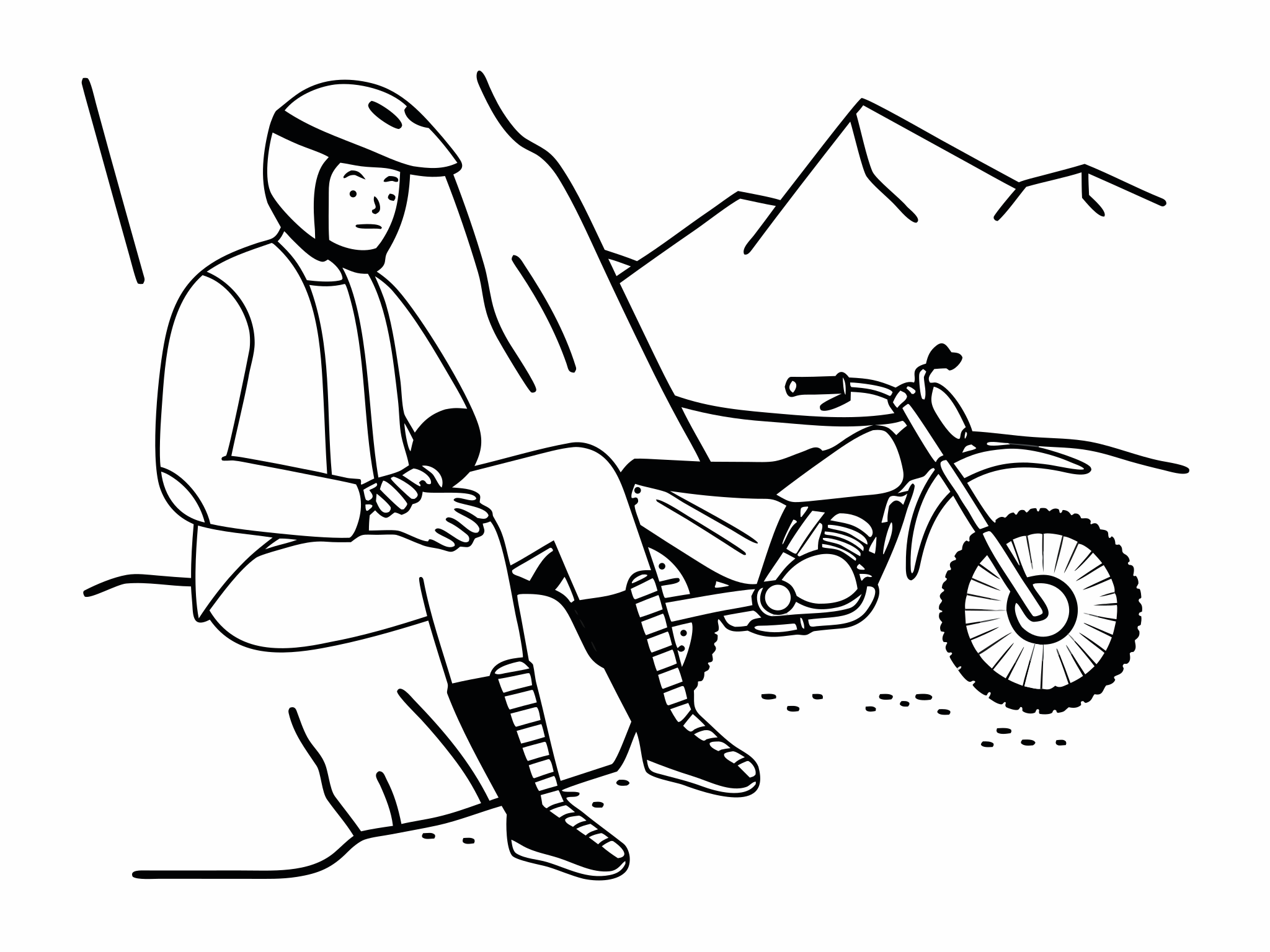
Treat any hard knock to the head as a possible concussion, even with a good helmet. The NHS says to call 999 if someone has hit their head at "high speed, such as in a road accident", has "been knocked out and has not woken up", has a seizure, "has fallen from a height of more than 1 metre", has "clear fluid coming from their ears or nose", or has "new numbness or weakness in any part of their body". The UK's concussion guidelines add red flags such as deteriorating consciousness, repeated vomiting and severe neck pain.
For a milder knock, the rule is simple: if in doubt, sit them out. The UK guidelines say anyone with a suspected concussion "should NOT drive a motor vehicle (e.g. car or motorcycle)" within 24 hours. So the rider doesn't ride out: they walk out or get a lift, and someone else takes the bike. The NHS adds that an adult should stay with them "for at least the first 24 hours", and not to drive "until you feel you have fully recovered".
Trail riding is a sport with a risk of head injury, so come back to it through a graduated return, as the UK guidelines set out. They allow "no return to competition before 21 days". FIM racing excludes riders for at least 10 days after a diagnosed concussion (20 days for riders aged 17 and under). Replace the helmet after any real impact, as the gear guide explains.
Heat, cold, burns and chest injuries
Not every trail emergency is a crash injury. Here's what the NHS and resuscitation bodies say to do.
| Problem | Signs | What to do |
|---|---|---|
| Heat exhaustion | Tiredness, dizziness, headache, nausea, heavy sweating, cramps, strong thirst (NHS) | Move to shade, open or remove kit, give water, cool the skin with water and fanning. They should improve within 30 minutes (NHS). If not, treat it as heatstroke. |
| Heatstroke | Confusion, agitation, disorientation, seizures or unresponsiveness (Resuscitation Council UK). In hard effort it "can occur at any ambient temperature". | Call 999 or 112. Cool hard: the NHS says wrap them "in a cool, wet sheet", or fan and sponge them with cold water. The ERC's rule is "cool first, transfer second". |
| Hypothermia | Shivering, pale cold skin, slurred speech, slow breathing, tiredness or confusion (NHS) | A medical emergency (NHS): call for help. Get them out of wind and off the ground, remove wet clothing, wrap them up with the head covered. A warm, non-alcoholic drink and sugary food only if fully awake (NHS) and not injured: give a crash casualty nothing to eat or drink (Highway Code). Don't rub their limbs. |
| Exhaust burn | Red, blistering skin on the calf or thigh | Cool under running water for 20 minutes (NHS); drinking water will do. Don't remove anything stuck to the burn or burst blisters. Cover loosely with cling film, not a sticky dressing. Call 999 if it's large or deep. |
| Chest, rib or belly injury | Pain on breathing, worsening breathlessness or chest pain, coughing blood, pain in the tummy or shoulder | The NHS says to call 999 after a serious accident or for any of these signs. Leave an open chest wound uncovered, as Resuscitation Council UK advises. |
Swipe the table sideways to see every column.
Pack you'll actually carry
Resuscitation Council UK says a kit "should be based on the setting, expected risks and the users". The ERC says that for "extreme weather outdoor settings" first-aiders should consider "a compact survival bag, splinting, wound dressings, a flashlight, and a whistle". This list builds on that and the American Red Cross kit guide, cut down to fit a hydration pack.
| Item | Why |
|---|---|
| Disposable gloves and a CPR face shield | Protect you and the rider. |
| Two large trauma or wound dressings | Direct pressure on heavy bleeding. |
| Two triangular bandages | Slings for arm and collarbone injuries, and securing splints. |
| A light mouldable splint | Supporting a broken limb for a long wait or a walk out. |
| Strong tape, a roll of gauze and cling film | Holding dressings in place, and covering burns. |
| Small shears | Cutting clothing away from a wound. |
| Emergency blanket or compact survival bag | Waiting for help gets cold fast, even in summer. |
| Whistle and a small torch | AdventureSmart UK's distress signal is "six blasts on the whistle or six torch flashes repeated every minute". |
| Tourniquet and haemostatic dressing | The ERC recommends both where there's a high risk of life-threatening bleeding. Learn to use them on a course. |
| Personal medication and a note of allergies | Tell your riding partners where it is. |
When to end the ride
Any one of these ends the ride for the injured rider, and usually for the group. Call it early.
- Any knock to the head followed by confusion, headache, dizziness, nausea or "not quite right" behaviour.
- Any loss of consciousness, however short.
- Heavy bleeding, or any wound that needed a dressing and pressure to stop bleeding.
- A suspected fracture or dislocation, or a limb that can't take weight or grip.
- Neck or back pain after a crash.
- Chest or abdominal pain, or breathlessness that isn't settling.
- Heat exhaustion that hasn't clearly improved after 30 minutes in the shade (call 999), or any sign of hypothermia.
Do a proper first-aid course
A hands-on course is what makes you useful at a crash. The Highway Code's advice is to "learn first aid" with "St John Ambulance, St Andrew's First Aid, British Red Cross, or any suitable, qualified body". Choose an outdoor or remote first-aid course if you can, add Biker Down for helmet removal, and get your riding partners to do the same.
Trail first-aid questions
Should I take the boot off a hurt ankle?
Apply the fracture rule: St John Ambulance says not to move the casualty until the injured part is secured. Pulling a tall boot off a broken ankle moves the injury a lot, so leave it on, support the leg as you found it, and check the toes for colour and feeling.
All lessons in Safety & Setup
Related lessons and guides
- Safety and risk managementPlanning, partners and calling for help without signal.
- STOP / GO decision frameworkThe decisions that keep you out of this page.
- Beginner bike and gear guideHelmets, protectors and boots, and the standards behind them.
- Hard enduro helmetsChoosing and replacing a helmet.
- Hydration packsRoom for water, tools and a first-aid kit.
- Arm pump guideThe most common non-crash complaint in hard enduro.