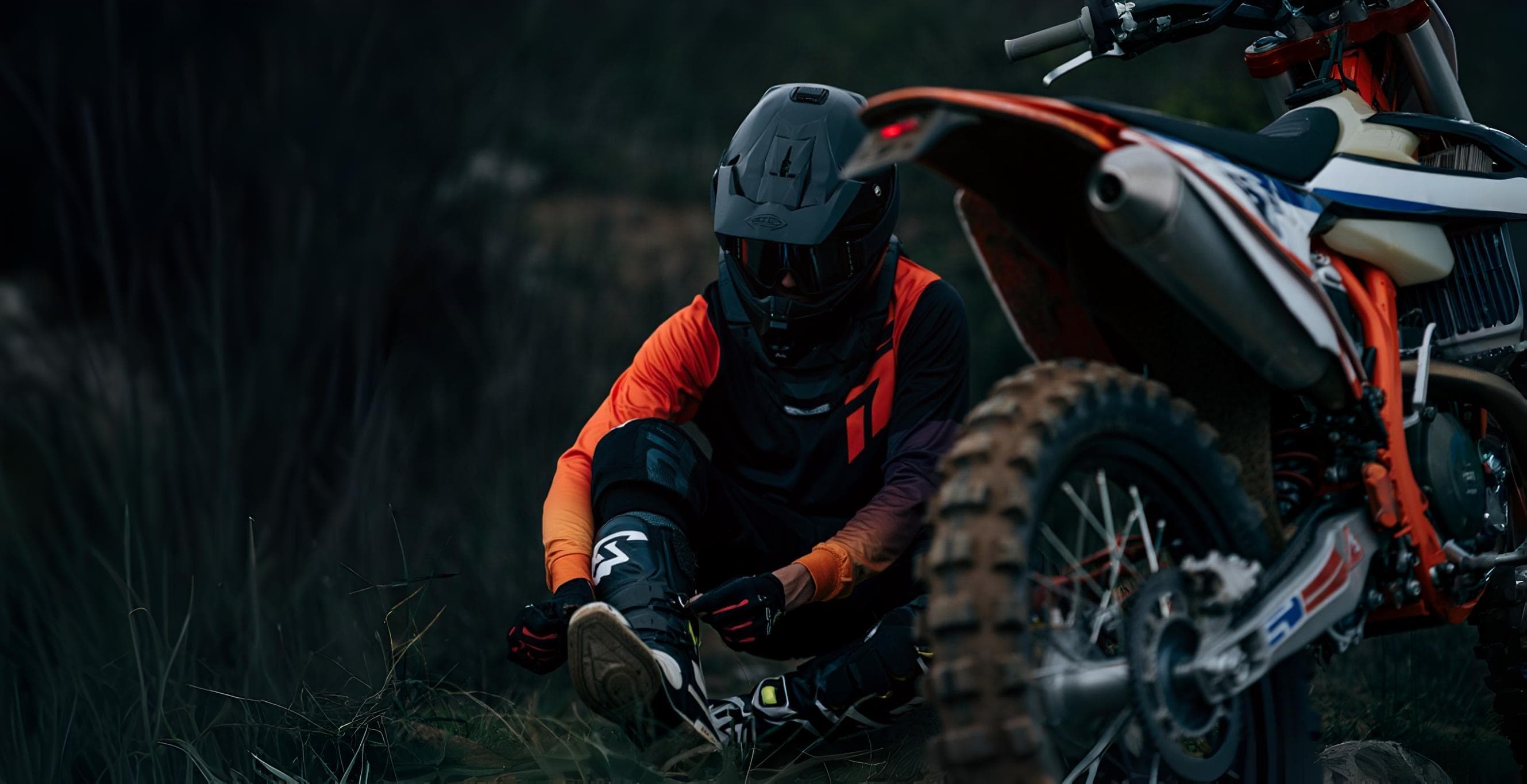
Top Hard Enduro Gear
Get the right gear for hard enduro, spend where it matters, and ride with more confidence. This hub explains what each safety standard means, which protection matters most and why, and how to choose at every budget.
On this page
Protection priorities for hard enduro
This is the order we recommend buying in. We set it by three things: the injury research in the next section, which items have a real safety standard behind them, and what failure costs you far from the truck.
1. Helmet
★★★★★ · 25% of budgetApproved to ECE 22.06 (or DOT FMVSS 218 in the US). Head trauma is a small share of recorded injuries, but the most serious.
2. Boots
★★★★★ · 20% of budgetCertified to EN 13634. Foot and ankle fractures are the most common fractures in the enduro data, and you will walk in these boots for hours.
3. Knee Protection
★★★★★ · 15% of budgetA brace or EN 1621-1 armour. The knee carries the largest share of ligament injuries in the studies below.
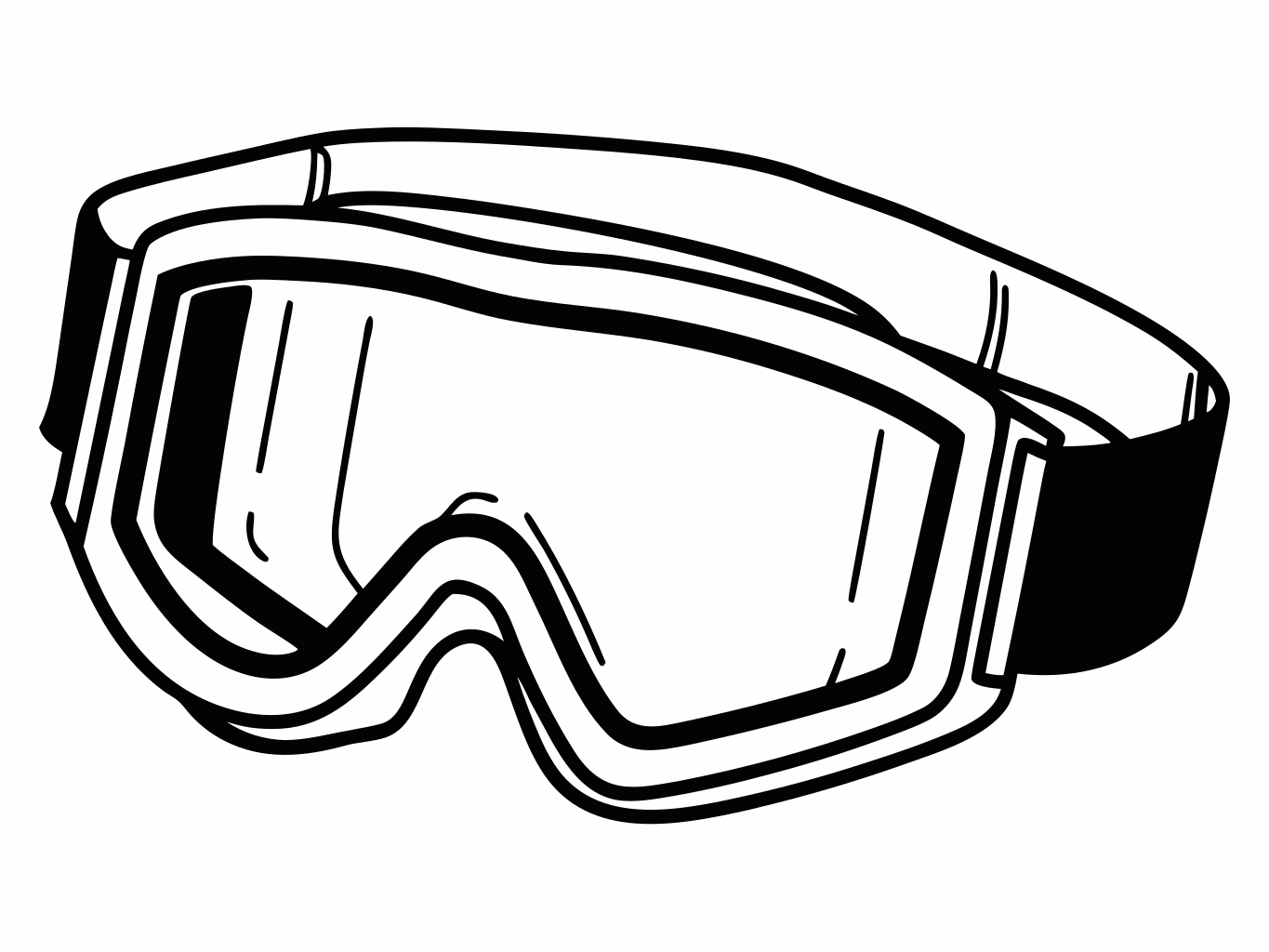
4. Goggles
★★★★★ · 5% of budgetEN 1938 goggles. Roost, branches and mud aimed at your eyes are constant in the woods.
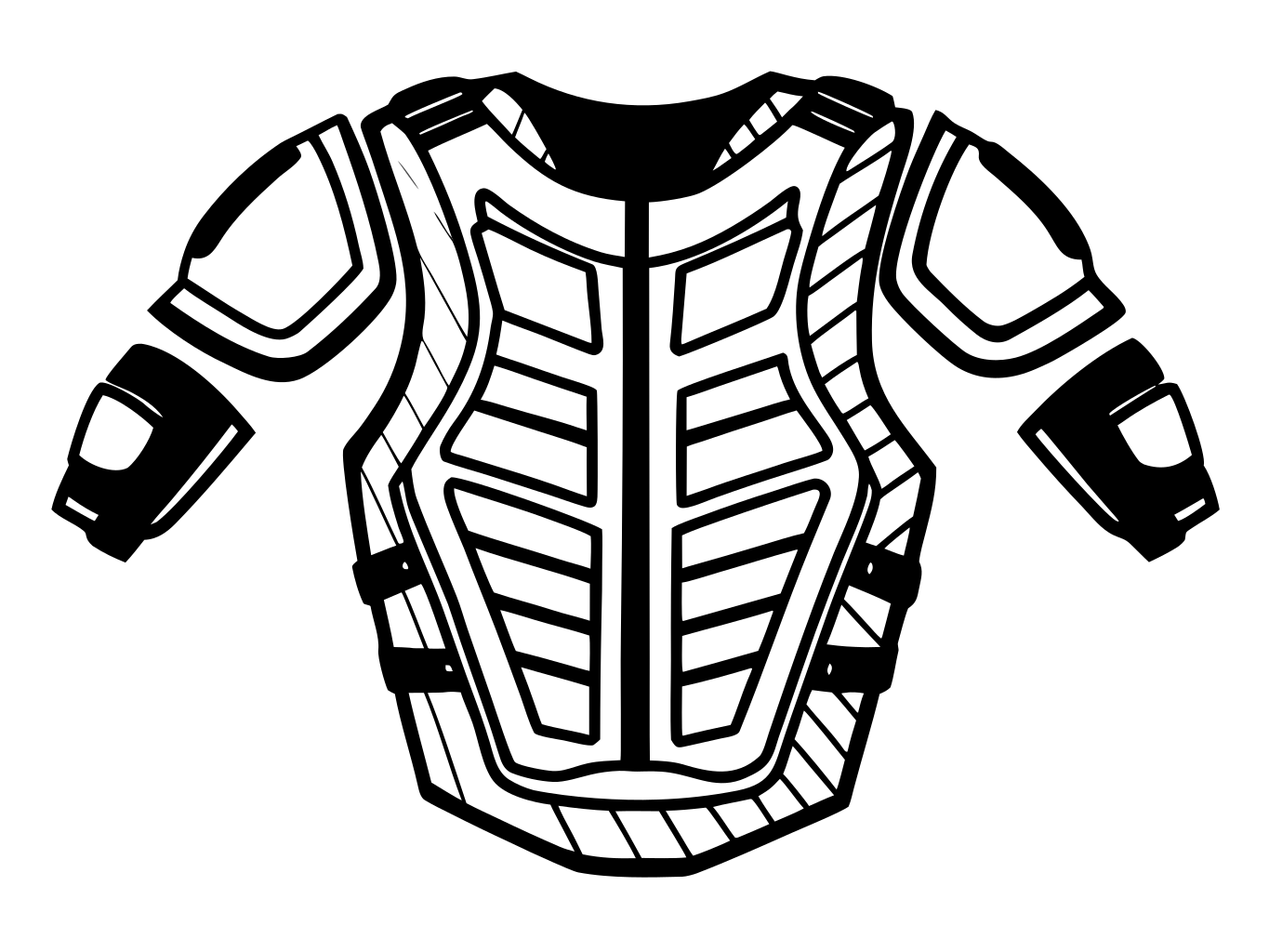
5. Chest Protector
★★★★☆ · 10% of budgetEN 1621-3 chest and EN 1621-2 back protection. A roost guard certified only to EN 14021 stops stones, not impacts, so it is the wrong tool for hard enduro. Handlebar and rock impacts to the ribs are a real risk on steps and climbs.
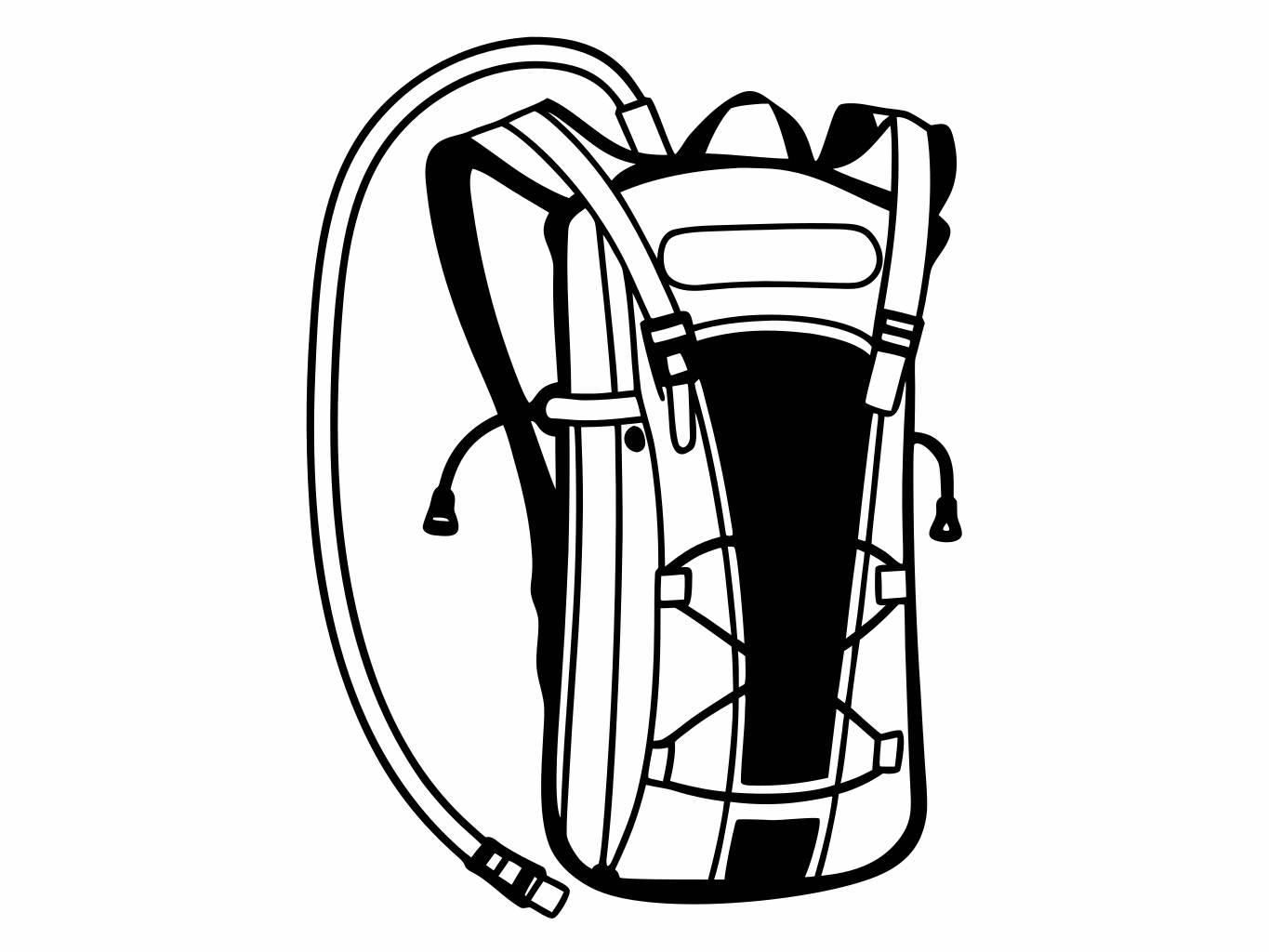
6. Hydration Pack
★★★★☆ · 5% of budgetNot protection, but hard enduro means hours of hard physical work at low speed with little cooling airflow, and a stable pack also carries your tools.
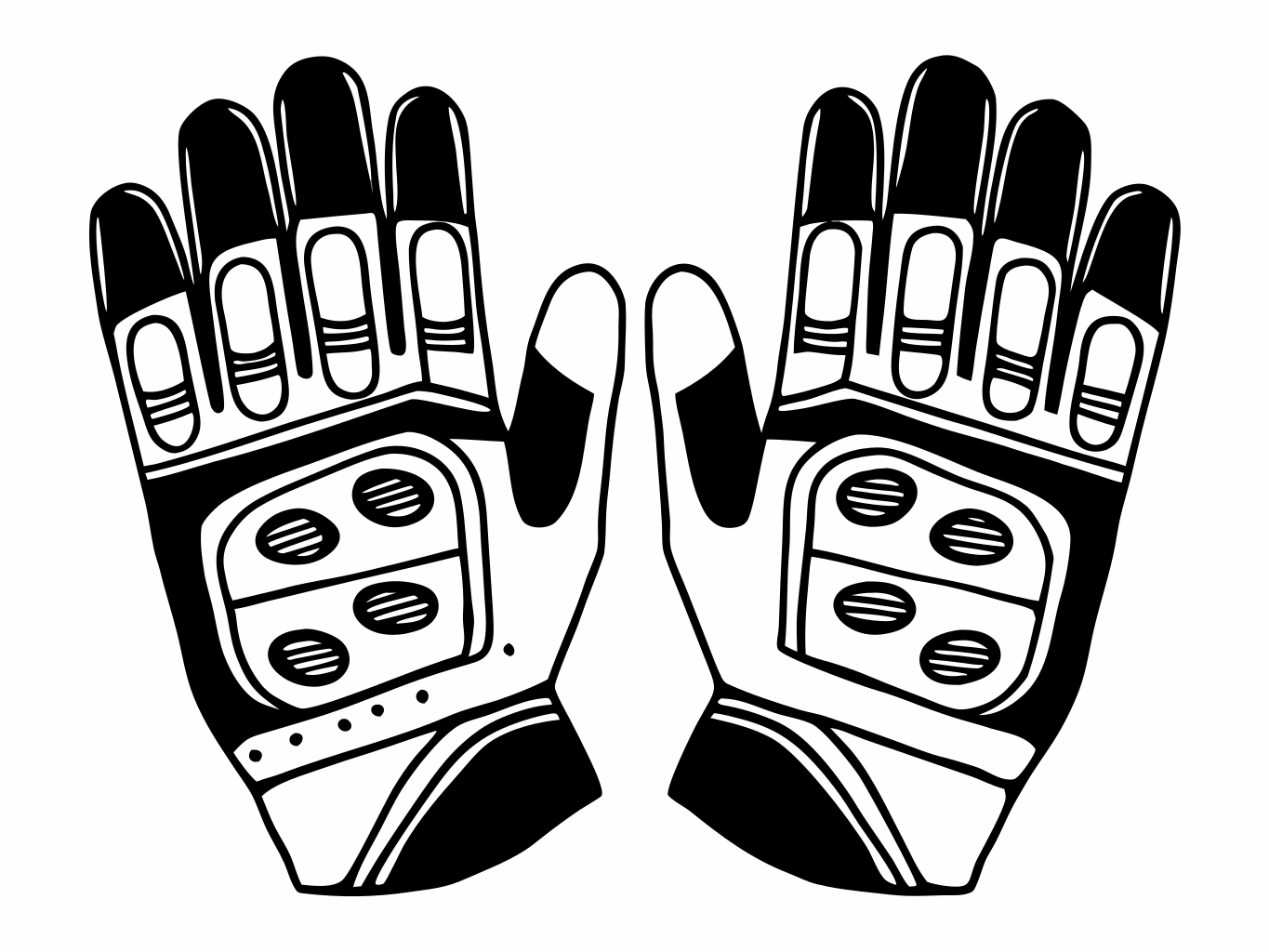
7. Gloves
★★★☆☆ · 5% of budgetGrip, blister prevention and some knuckle protection. They wear out quickly, so buy several.
Lower in the order for most riders:
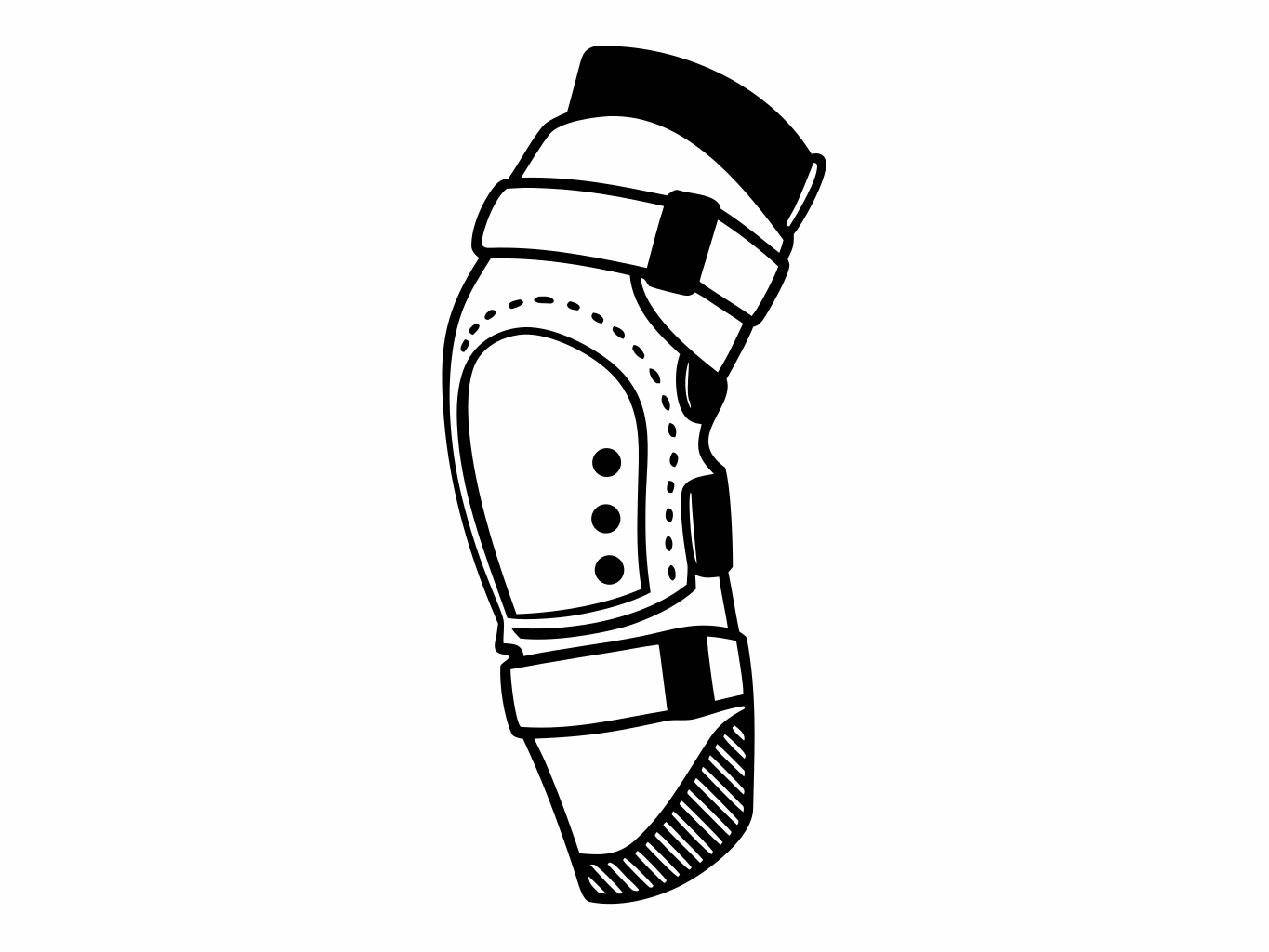
Elbow Guards
★★☆☆☆ · 5% of budgetRocky terrain and frequent tip-overs benefit most. The guide explains when to wear them.
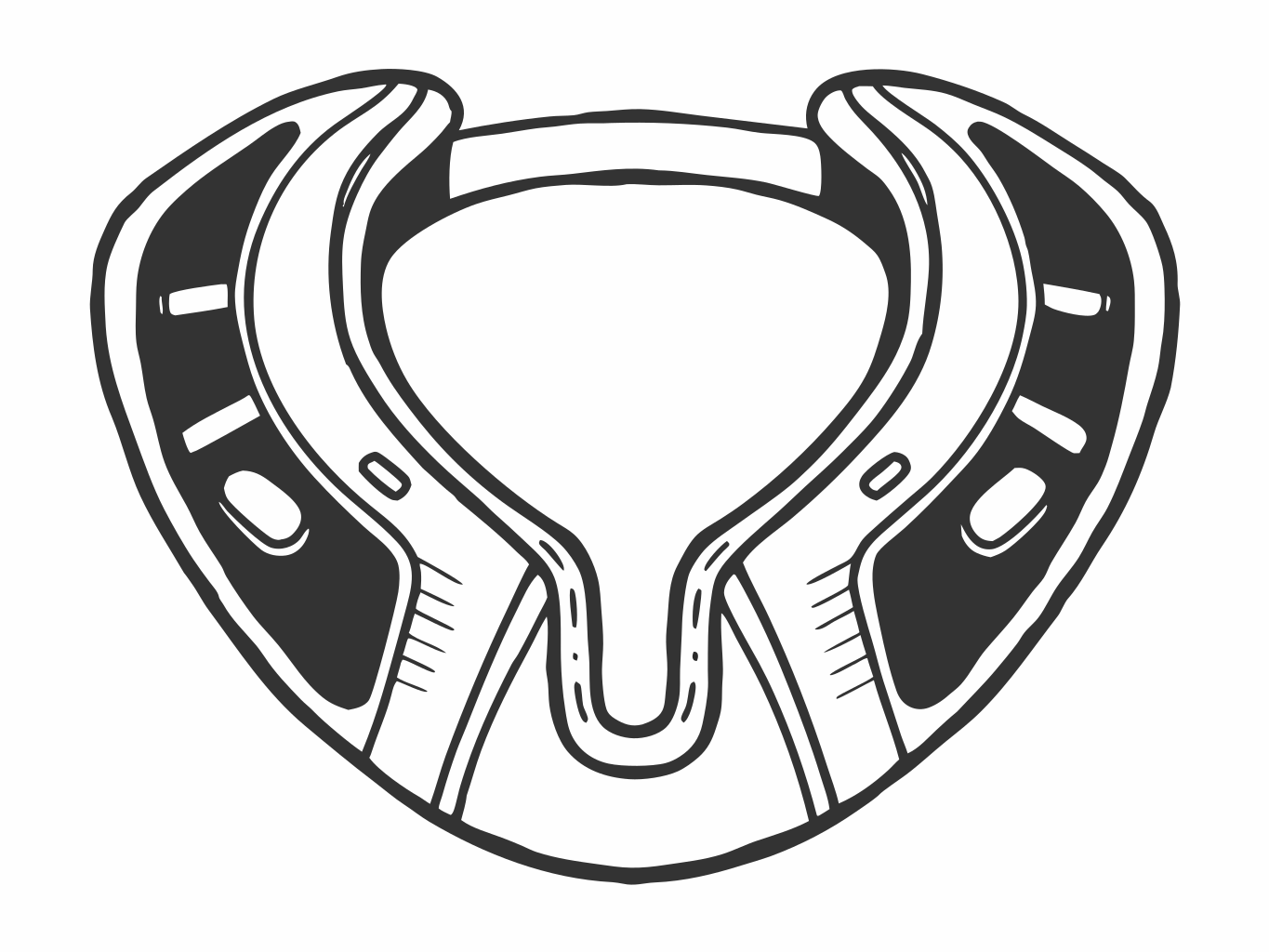
Neck Brace
★★☆☆☆ · 5% of budgetMost hard enduro riders do not need one. The guide explains which riders might choose differently.
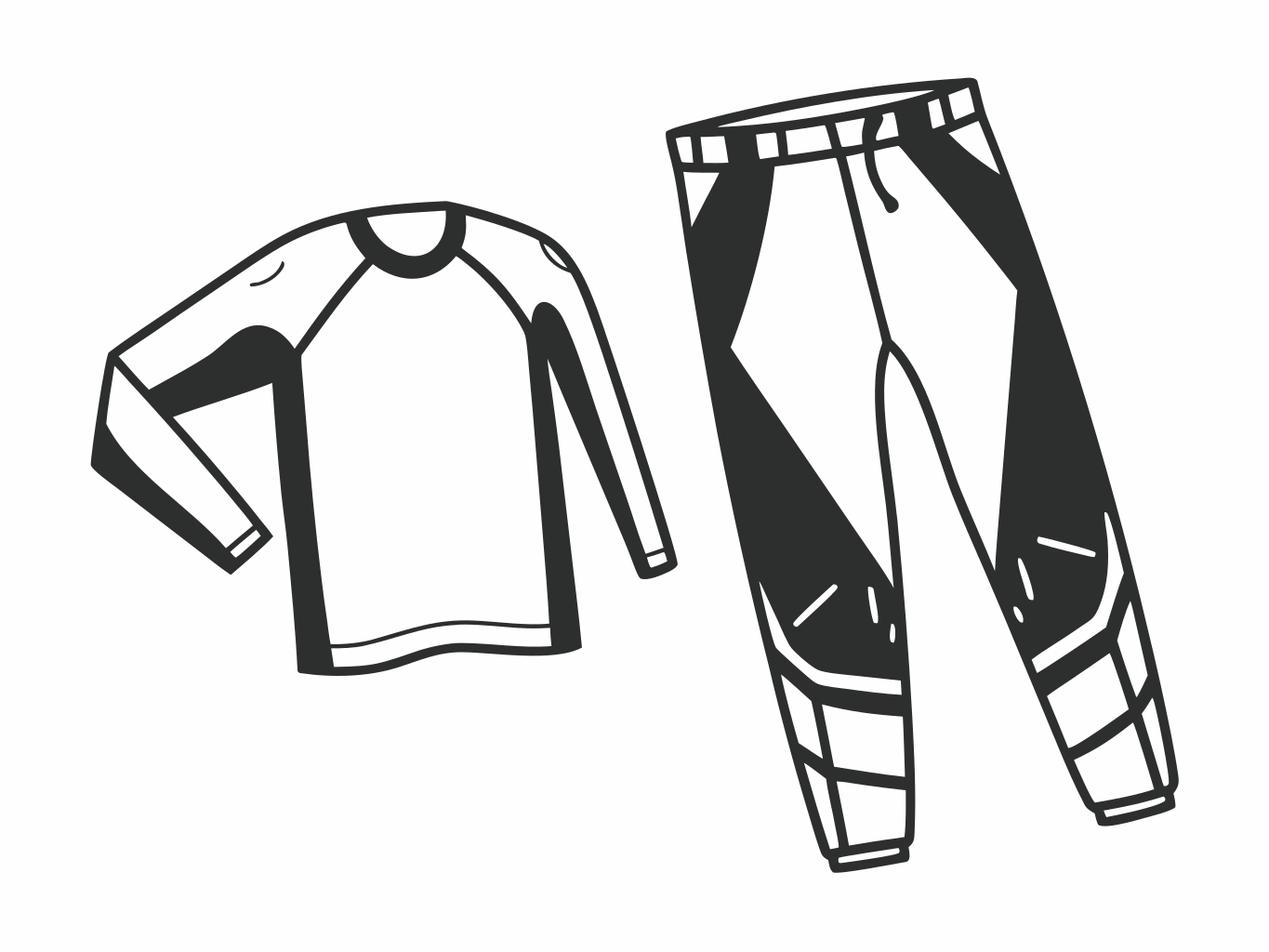
Pants & Jersey
★★☆☆☆ · 5% of budgetNone of the race pants and jerseys we list carries a protective certification. Buy protection first, then pants and a jersey that fit over it.
If you are new to the sport, the Safety & Setup course and the beginner bike and gear guide put this list in context with bike setup and a first-aid kit.
What hard enduro does to your body
Hard enduro crashes are mostly slow. You tip over on a rock step, slide off a root, get pinned under the bike on a climb, or land a foot badly while paddling. The speed is low but the ground is hard, and it happens dozens of times a day. That pattern shapes what protection earns its place.
The research on off-road racing points the same way. It is not a perfect match for hard enduro, so we list what each study covered.
| Study | Who and where | What it found |
|---|---|---|
| Sabeti-Aschraf et al., 2009 | 2,923 starters at the Erzbergrodeo over three years; 94% non-professional | 6% had an accident. More than 80% of injuries were superficial. Most accidents happened in a curve when the front tire slid, "affecting mostly arm and leg". |
| Colburn & Meyer, 2003 | 1,787 riders at four International Six Days Enduro events | About 10% needed medical attention; 85% of those injuries were mild. 80% of accidents happened below 50 km/h. The extremities were the most injured region (57%), ligament injuries were the most common type (50%), and foot and ankle were the most common fractures (36%). |
| Gobbi et al., 2004 | 1,870 injuries from European off-road competition, 1980–1991 | 50.9% of fractures were in the arms and 38% in the legs. 59.9% of ligament injuries were in the legs, "especially on the knee (42.4%)". Head trauma was recorded in 5.7% of accidents. |
| Sanders et al., 2011 | Online survey of 2,115 off-road riders over one year | Riders without knee braces reported 3.675 knee injuries per 1,000 riding hours; braced riders reported 1.587. ACL and MCL injuries were also less frequent in the braced group. |
| Hay, Singh & Hay, 2023 | 615 orthopaedic injuries in UK motocross riders, 2010–2015 | Collarbone fractures were 14% of all injuries; forearm/wrist fractures 9.7% and shoulder injuries 8.9%. |
Three things follow from this, and they drive the order of the guides on this site:
- Arms and legs both take a beating, but the leg injuries are the ones gear can do most about. Arms carry about half of all fractures in the data. On the leg side, ligament injuries cluster at the knee and foot and ankle fractures lead the enduro fracture count, and boots and knee protection are built for exactly those. That is why they sit next to the helmet at the top.
- Most crashes are minor, so comfort decides compliance. Gear that is too hot or too stiff to wear for a full day is gear that comes off at lunch. Fit and ventilation are safety features in hard enduro.
- The head injury you avoid is the one that matters most. Head trauma is a small share of recorded injuries, but it is the injury with the least chance of full recovery. A certified helmet is non-negotiable.
These studies have limits. Most regional figures come from motocross or classic enduro rather than modern hard enduro, and the knee-brace survey is self-reported and not randomised. We use them to set priorities, not to promise outcomes.
The standards behind the labels
A certification tells you the product passed a defined lab test. It does not tell you how it fits or how it will feel after six hours. Here is what applies to each item. Each category guide explains its standard in full.
| Gear | Standard | What it covers | Status in the EU |
|---|---|---|---|
| Helmet | UN Regulation No. 22, 06 series (ECE 22.06) | Impact absorption at three energies, rotational (oblique) impact, retention, rigidity | Type approval under UN R22, outside the PPE Regulation |
| Boots | EN 13634:2017 | Impact abrasion, impact cut, transverse rigidity, boot height | Harmonised under Regulation (EU) 2016/425 |
| Knee & elbow armour | EN 1621-1:2012 | Force transmitted through the protector in an impact test, Level 1 or 2 | Used for certification; not cited as harmonised under 2016/425 |
| Chest & back | EN 1621-3:2018 (chest), EN 1621-2:2014 (back) | Impact force transmitted, Level 1 or 2 | Used for certification; not cited as harmonised under 2016/425 |
| Roost guard | EN 14021:2003 | Stones and debris thrown by other bikes | Harmonised |
| Gloves | EN 13594:2015 | Abrasion, cut, seams, restraint; optional knuckle impact (KP) | Harmonised |
| Pants & jackets | EN 17092-2 to -6 (classes AAA to C) | Abrasion, tear, seams, impact protectors by class | Harmonised |
| Goggles | EN 1938:2010 | Impact, light transmittance, UV, field of vision, marking | Harmonised |
"Harmonised" means the standard is cited in the EU's Official Journal under the PPE Regulation, so meeting it gives a presumption of conformity. The status column follows the Commission's current list, Implementing Decision (EU) 2026/1279, and CEN's own project pages.
CE marking and the declaration of conformity
In the EU, riding gear that claims impact or abrasion protection is personal protective equipment under Regulation (EU) 2016/425, which has applied since 21 April 2018. The Commission's guidance puts motorcyclists' garments, gloves and footwear with added protection (impact protectors, airbags, abrasion or cut protection) in Category II. That means a notified body must carry out an EU type-examination before the maker can apply the CE mark.
What that gives you as a buyer:
- A CE mark on the product and a pictogram with the standard and level. Look for the standard number (for example EN 1621-1:2012) and the level, not just "CE".
- An EU declaration of conformity. Article 8(8) requires the maker either to supply the declaration with the product or to print the web address where you can read it. The declaration names the standard and the notified body. If a label is vague, the declaration settles it.
- Weather-only clothing is not PPE. A jersey or pants with no protection claim do not need certification, and most off-road jerseys have none.
Motorcycle helmets are the exception. Article 2 of the Regulation excludes helmets and visors covered by UN Regulation No. 22. They are approved under that regulation instead, which is why a helmet carries an ECE approval label rather than a PPE declaration.
In Great Britain, the government continues to recognise the CE marking alongside UKCA for PPE. In the US, the federal standard for motorcycle helmets is FMVSS No. 218, shown by the "DOT" symbol on the helmet.
A starter kit, in order
If you are building your first hard enduro kit, buy in this order and do not skip ahead.
- A certified off-road helmet that fits your head shape. Try it on with your goggles.
- Certified boots, sized with the socks and knee protection you will actually wear.
- Knee protection: EN 1621-1 armour at minimum, a brace if your budget or knee history calls for it.
- Goggles with a clear lens and tear-offs.
- A chest protector with EN 1621-3 chest and EN 1621-2 back protection.
- A hydration pack that does not bounce, with a basic tool kit inside.
- Two or three pairs of gloves.
- Pants and jersey that fit over your knee protection.
Then spend on riding skill. The Controls 101 course, clutch feathering and body positioning drills reduce how often you test your gear. If you ride a lot of rocks, add the logs and rocks module. If you are choosing a bike too, start with what makes a hard enduro bike.
Where to spend and where to save
Spend on the items with a real certification and a high cost of failure: helmet, boots and knees. Save on items that wear out quickly or carry no protection claim: gloves, jerseys and pants.
The budget shares in the priority list are the collective's view. They add up to 100% of a full kit. We based them on the injury pattern above and on where a cheaper item gives up the most. A budget helmet and a premium helmet pass the same approval tests. In boots and knee protection, the extra money usually buys structure you can see on the maker's spec sheet: hinged ankle support, a rigid brace frame instead of a pad, more coverage. The Budget, Value and Premium picks on each page follow the maker's own list price.
Do not buy used helmets or used impact protectors. You cannot see whether they have already taken a hit. Airoh, the Snell Foundation and the ECE 22.06 label itself all tell you to replace a helmet after a violent impact, even when the damage is not visible.
Budget tiers explained
Where a category has picks, they sit in three tiers. The tier follows the maker's list price within the category. A higher tier does not mean a higher certification level: check the label.
- Budget:
- Entry price. The essentials without the extras: a sound start for new riders or occasional use.
- Value:
- More for the money. More enduro-specific features, better adjustment and ventilation, at a mid-range list price.
- Premium:
- Top tier, fewer compromises. Lighter materials, more adjustment or more coverage, often with diminishing returns unless you ride a lot.
How we choose gear
- Safety first: certification level, coverage, and what the standard's test measures.
- Fit and mobility: Comfort reduces fatigue and improves control, especially on long, technical days.
- Certification, not opinion: We cite the standard a product is tested against — ECE 22.06, EN 1621, EN 13634 — and link the regulation so you can check it.
- Value at three budgets: Budget / Value / Premium picks follow the maker's list price, and every fact on a card links to the maker's own page.
- Zero fluff: No paid placements, no affiliate links, and no product-testing claims: we do not lab-test or wear-test products.
Full methodology and disclosures
Gear works best when it supports better riding habits. Pair your setup with the Hard Enduro Training Plan and start with Controls 101.