Top Hard Enduro Knee Protection
The knee is a high-risk joint. Braces aim to limit harmful motion; pads protect against impact. Fit and retention are critical.
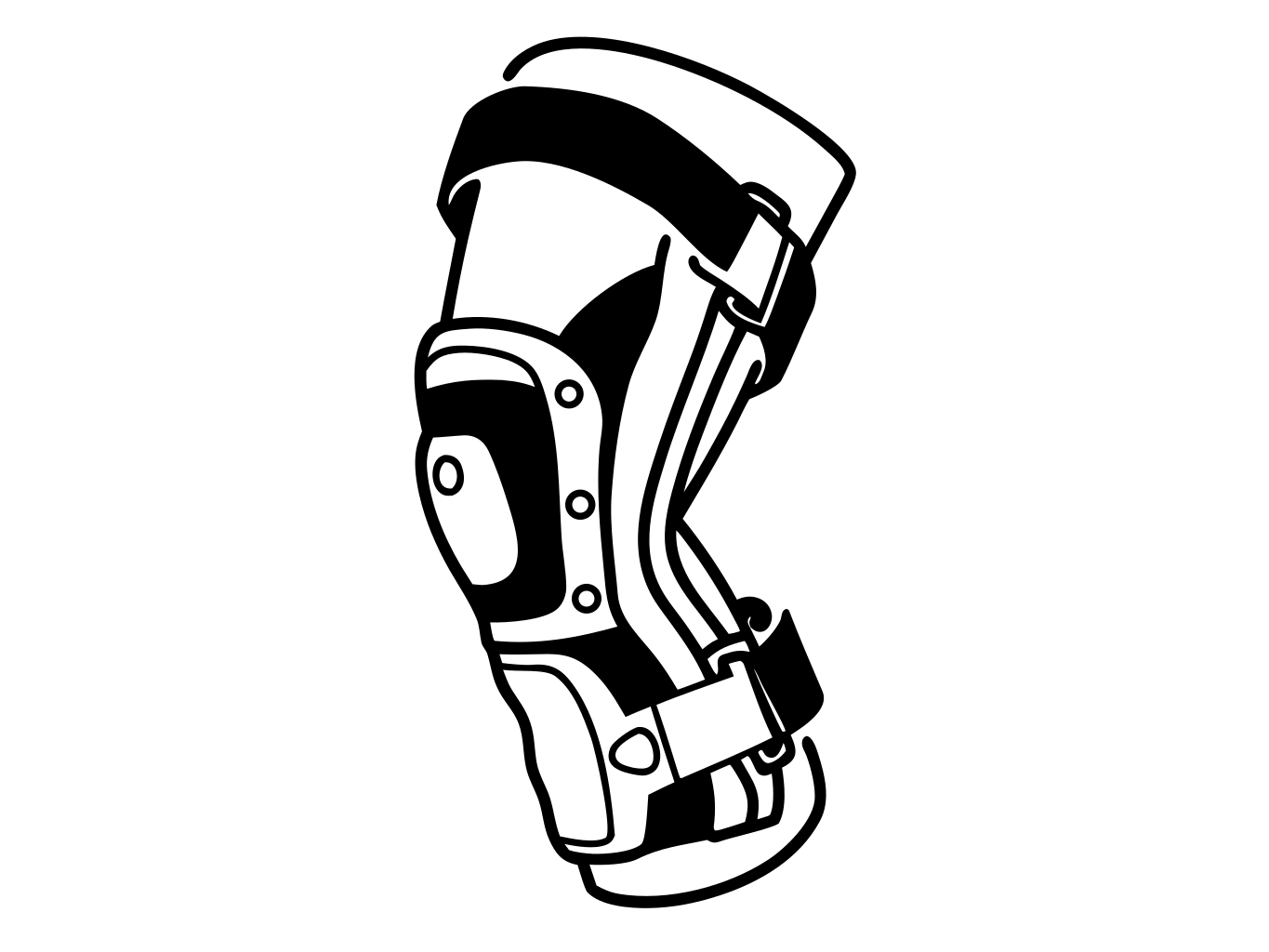
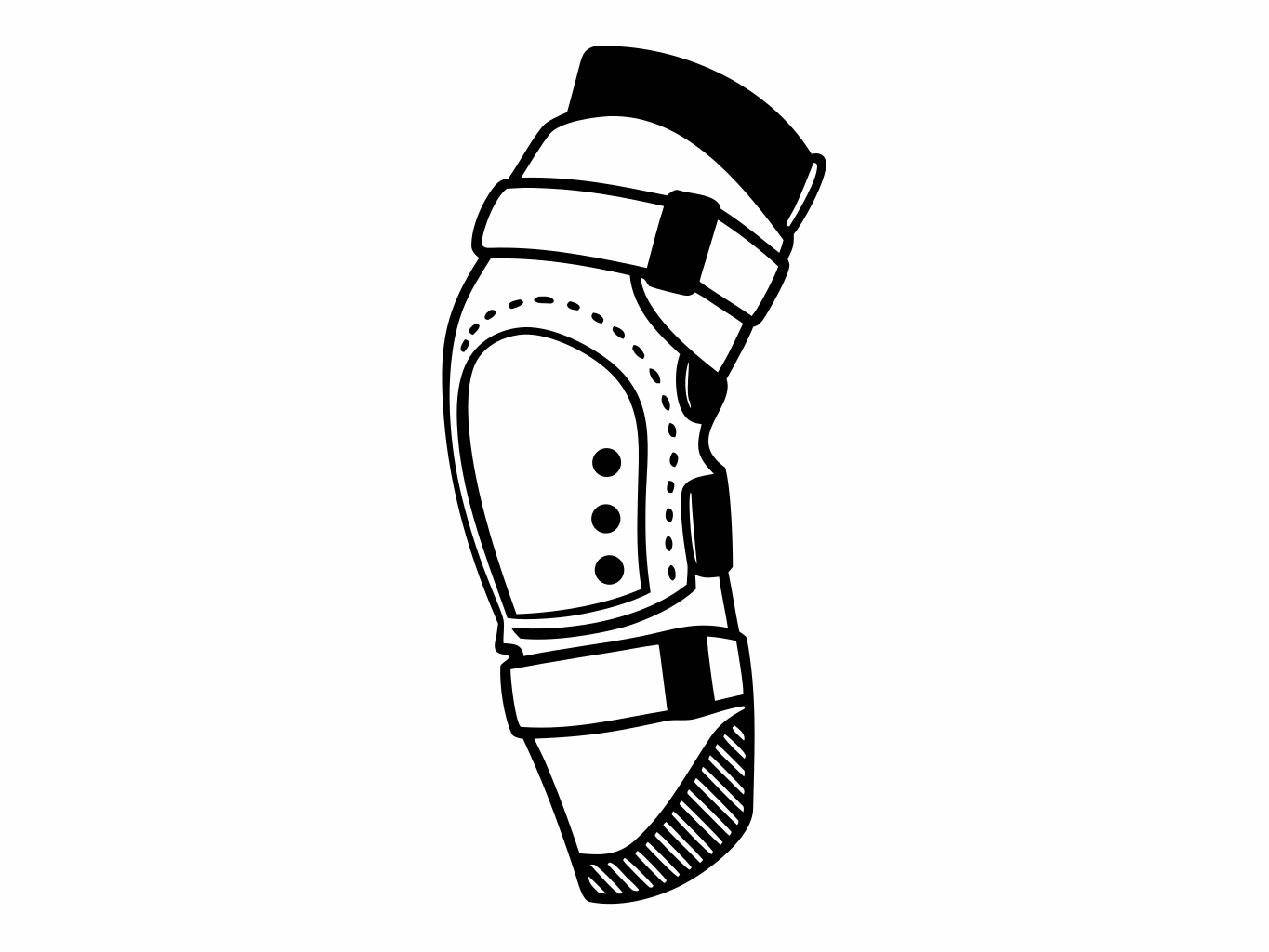
Your knees take two kinds of damage off-road: a blow from a rock or log, and a twist that tears a ligament. A guard is built for the first. A brace is built to limit the second, and many braces also carry an impact rating. This guide explains the EN 1621-1 label, what the research on braces actually found, and how to pick, fit and look after knee protection for hard enduro.
On this page
What knee protection does in hard enduro
Hard enduro is slow. You crawl up rock steps, paddle through roots and stall on climbs. Most falls happen at walking pace. That changes what hurts you.
At speed, the risk is a hard hit. At walking pace, the risk is a foot planted on a rock while the bike and your body keep moving. The knee twists. That is how ligaments go. Then there are the hits: a kneecap into a boulder, a shin into a log, the bike landing on your leg in a rock garden.
The days are long, too. The Red Bull Erzberg Rodeo Hare Scramble is "1 mountain. 500 starters. 27 checkpoints. 4 hours time," per the organizer. You push, lift and walk the bike for part of that. Whatever you strap to your knees has to stay put, breathe, and let you walk.
Knee protection comes in two forms:
| Guard (pad) | Brace | |
|---|---|---|
| Main job | Spread and soften a blow | Limit harmful knee motion, especially straightening too far |
| Structure | Hard shell and foam, or soft armor, held by straps or a sleeve | Rigid frame above and below the knee, joined by hinges |
| Typical rating | EN 1621-1 impact level | Medical device registration, an EN 1621-1 rating for the knee cup, or both |
| Makers' list price here | $114 to $159.95 | $384 to $449.95 per brace |
If you ride hard enduro often, we'd weigh ligament protection heavily, not only impact protection. This follows from the injury data in the next section: ACL, meniscus and MCL injuries are the most common knee injuries reported, and braced riders reported fewer of them.
What the research says about knee braces
The key study of knee braces in off-road motorcycling is often quoted without its limits. Here are both.
Sanders et al., 2011
Sanders and colleagues published "Knee injuries and the use of prophylactic knee bracing in off-road motorcycling" in the American Journal of Sports Medicine. The abstract reports:
- Design: a descriptive epidemiology study. 2,115 off-road riders answered an internet survey over one year. Riders were grouped by whether they wore knee braces.
- Exposure: 39,611 riding hours. 57 riders (2.7%) had at least one knee injury, 89 injuries in total.
- Most common injuries: the anterior cruciate ligament (ACL), the menisci and the medial collateral ligament (MCL).
- Overall rate: 3.675 injuries per 1,000 rider hours without braces, against 1.587 with braces (P < .001).
- ACL rupture: 1.518 against 0.701 per 1,000 rider hours (P = .0274).
- MCL injury: 0.799 against 0.111 per 1,000 rider hours (P = .002).
The authors conclude that bracing "appears to have a beneficial effect" against MCL and ACL injuries and overall knee injury.
Its limits
Our reading of the design, based on the methods in the abstract:
- Riders chose whether to brace. It is not a randomized trial. The two groups may differ in skill, bike or riding style.
- Injuries were self-reported through an online survey, not taken from medical records.
- Small numbers. 57 injured riders carry the whole comparison.
- Off-road in general. It covers off-road motorcycling, not hard enduro specifically.
Within those limits, its results point one way. The paper's own background notes that brace studies in other sports disagree, which is why the topic "remains controversial."
What braces can cause
A 2018 case report by Erwood and colleagues describes two motocross riders who broke the femur (thigh bone) at the top edge of their knee braces, 22 cm and 21.1 cm above the center of the knee. The authors suggest a rigid brace protects the ligaments but may focus force where the frame ends. This is why makers now build in weak points: Leatt says the C-Frame chassis has "built-in fracture points" designed to break before the shin or thigh bone does (Leatt). Two cases say nothing about rates, but they explain the design.
Older race data
A 12-year study of European motocross competition (15,870 riders, 1980 to 1991) counted 344 ligament injuries. 206 of them (59.9%) were in the lower limbs, "especially on the knee." The pattern matches Sanders.
EN 1621-1:2012 explained
EN 1621-1:2012 is the European standard for motorcycle limb joint impact protectors: shoulder, elbow, hip and knee. Its full title is "Motorcyclists' protective clothing against mechanical impact – Part 1: Motorcyclists' limb joint impact protectors – Requirements and test methods." The Estonian Centre for Standardisation catalogue lists it as valid from 4 January 2013, replacing the earlier edition. Its scope covers protectors built into riding clothing or "used as separate items," which includes strap-on guards and the knee cups of braces.
The impact test
REV'IT!, which certifies its own armor to the standard, describes the test: a 5 kg striker falls from about one meter, so the impact energy is at least 50 J. The lab measures how much force passes through the protector, in kilonewtons (kN). Lower is better.
REV'IT! lists two conditionings: 48 hours at 23 °C before the ambient test, and 72 hours at 70 °C above water before the wet test.
Level 1 and Level 2
| Level | Mean transmitted force | What it means |
|---|---|---|
| Level 1 | Below 35 kN | Protection "with low ergonomic penalties" |
| Level 2 | Below 20 kN | "Increased protection," with possible weight and restriction penalties |
The force limits come from Knox. The descriptions come from Alpinestars' EN 1621-1 user leaflet. SATRA, a test lab, adds that no single value should be over 50 kN.
The level is a pass mark, not a score. Alpinestars says its Bionic 10 Carbon and Bionic 7 braces "attained transmitted force values below 26kn" and were awarded Level 1 (manual). Two Level 1 products can sit far apart inside the band.
Type A and Type B
Alpinestars' leaflet: "There are two protector types – Type A and Type B, these refer to the size. Type B protectors are larger than Type A protectors." Type is about the area the protector covers, not how well it absorbs a hit. MET, which sells Type B knee pads, states Type B certification means "39% more coverage on knees" (MET).
T+ and T-
Two optional tests check the protector when hot and cold. SATRA gives the temperatures: +40 °C and −10 °C. A pass adds T+ or T- to the label. Alpinestars warns that heat and cold "may reduce the performance of the protector, even if T+ and/or T- are present."
What the standard does not cover
- Ligaments. The test measures force through the protector. Nothing in it measures twisting or hyperextension. An EN 1621-1 label on a brace describes the knee cup, not the hinges.
- Abrasion and tearing. It is an impact test.
- Retention. A protector that has slid down your shin protects nothing. Fit is on you.
PPE, medical device, or both
Guards and braces are regulated in different ways, so the claims on the box mean different things.
Impact protectors are PPE
In the EU, impact protectors fall under the PPE Regulation (EU) 2016/425. Annex I sorts PPE into three risk categories. Category II "includes risks other than those listed in Categories I and III." Alpinestars states its EN 1621-1 protectors are Category II PPE (leaflet).
For Category II, Article 19 requires an EU type-examination by a notified body (module B), followed by production control (module C). An independent lab checks the design. Alpinestars names its lab for the Bionic braces: "Notified Body #0498, Ricotest" in Italy (manual).
Braces are often medical devices
Many braces are also registered as medical devices. In the EU that means the Medical Device Regulation (EU) 2017/745. Article 52(7) lets makers of Class I devices "declare the conformity of their products by issuing the EU declaration of conformity" after drawing up their own technical documentation. No notified body is involved for a non-sterile brace without a measuring function.
POD's EU declaration for the K8 3.0 shows this plainly: "Class 1 (non-sterile; no measuring function)," declared by POD under Annex IV of the MDR. The stated purpose is "external support, stabilization and protection of the knee."
In the US, a brace is a "limb orthosis," a Class I device exempt from premarket notification (21 CFR 890.3475). FDA registration "does not in any way denote approval of the establishment or its products" (21 CFR 807.39).
What each maker claims
| Product | Maker's claim |
|---|---|
| Leatt C-Frame Pro Carbon | "Certified as medical device: EU CA014741, USA FDA 10048761"; "Knee EN1621-1 Level 1" |
| Alpinestars Bionic-10 Carbon | Armor certified to EN 1621-1:2012, Level 1, Type A, T+ T-; Category II PPE |
| POD K8 3.0 Forged Carbon | Registered medical device "with the FDA and CE"; EU MDR Class I declaration |
| Leatt Knee & Shin Guard Dual Axis | "Knee and shin EN1621-1 Level 1" |
| Fox Titan Pro D3O CE Knee Pads | "CE EN 1621-1 Level 2 certified" |
Our view: a medical device registration tells you the maker has declared a medical purpose. It does not tell you an independent lab has checked anything. An EN 1621-1 certificate does involve a notified body, but only for impact. That reading comes from Article 52(7) of the MDR and Article 19 of the PPE Regulation. Read both claims for what they are.
How to read the label
EN 1621-1 protectors carry a pictogram. Alpinestars' user leaflet and brace manual decode it. A Bionic 10 Carbon knee cup reads "K TYPE A, 1, T+ T-" next to the motorcycle-use symbol.
| Marking | Meaning |
|---|---|
| CE | Meets the EU PPE Regulation. For Category II, no notified-body number follows the CE mark; Article 17 requires one only for Category III |
| EN 1621-1:2012 | The standard and its edition |
| Motorcycle symbol | Intended for motorcycle use |
| K, K+L, E, S, H | Area covered: knee, knee plus leg, elbow, shoulder, hip |
| TYPE A / TYPE B | Protector size. Type B is larger |
| 1 or 2 | Performance level |
| T+ | Passed the optional hot test (+40 °C) |
| T- | Passed the optional cold test (−10 °C) |
| Instructions symbol | Read the instructions before use |
For a knee and shin guard, look for K+L. That code means knee plus leg: the certified zone runs down the leg, not just over the kneecap.
What to check in the paperwork
Annex II, point 1.4 of the PPE Regulation says the instructions must give, among other things: the performance levels, "the significance of any markings," the notified body's name and number, the standard with its date, and the web address of the EU declaration of conformity. If a product claims CE impact protection and none of this is in the box or online, ask the maker.
For a brace sold as a medical device, look for the EU declaration of conformity under the MDR. It should name the device, its class and the maker. POD publishes its declaration on the product page.
How a knee brace or guard should fit
A brace that twists on your leg cannot hold your knee. A guard that slides down cannot cover it.
Sizing a brace
Brace makers size by knee measurements, not by pant size.
| Alpinestars Bionic knee cup width | Brace size |
|---|---|
| 10.6–11.4 cm (4.2–4.5 in) | S |
| 11.4–12.2 cm (4.5–4.8 in) | M |
| 12.2–13.0 cm (4.8–5.2 in) | L |
| 13.0–13.8 cm (5.2–5.5 in) | XL/XXL |
Source: Alpinestars Bionic manual. Alpinestars supplies a measuring tool and still "strongly" recommends trying the brace on. POD sizes the K8 3.0 by knee width and knee circumference.
Fitting steps
Alpinestars' fitting procedure for the Bionic brace, in short:
- Fit it with the undersock, boots and pants you ride in. Pants go on top of the brace.
- Braces are left and right. Put each on the correct leg.
- Straighten your leg fully and place the brace. It should grip the sides of the knee so it stays on, loosely, with no straps closed. If it does not, fit the extra side padding.
- Close the straps in the order the manual gives.
- Bend your leg. The knee cup should stay centered over the knee.
Stopping slip
- Socks and sleeves. Brace makers sell long socks for this. Alpinestars' knee brace socks have "an elasticated upper hem with internal silicon grip to keep the socks in place."
- Straps set once. Fox's Titan Pro D3O guards use three straps and a Posi-Lock buckle with "one-time strap adjustment" (Fox). Set them on the leg, then leave them.
- Walk and kneel before you ride. Ten minutes of walking, squatting and kneeling in full kit shows you more than any size chart. The reason is simple: in hard enduro, you will walk and kneel with it on.
What matters specifically in hard enduro
Hyperextension stops
All three braces here limit how far the knee can straighten. The stop angle is how many degrees short of straight the brace stops you.
- Alpinestars Bionic-10 Carbon: interchangeable stops of 0, 5, 10, 15, 20, 25 and 30 degrees. It ships with the zero-degree stop fitted. Use the same stop in both hinges (manual).
- Leatt C-Frame Pro Carbon: "Hyper extension limitations 10º, 15º, 20º and 25º" (Leatt).
- POD K8 3.0: two extension controls, about 10–20° and 20–30° (POD).
Start with the smallest stop your knee needs, then ride a trail with steps before you race. We say this because of how hard enduro is ridden: you stand, dab and straighten your legs over and over on climbs, and a stop set too tight works against you all day.
Hinge types
| Hinge | Example | How the maker describes it |
|---|---|---|
| Mono-hinge | Leatt C-Frame Pro Carbon | "Super stiff, mono-hinge frame with three-point force distribution" |
| Four-point hinge | Alpinestars Bionic-10 Carbon | Hinge system with interchangeable extension stops |
| Ligament hinge | POD K8 3.0 | "Human Motion® Hinge Technology," using "Synthetic Ligaments™" |
| Guard pivot | Leatt Dual Axis, Fox Titan Pro D3O | Pivots that let the knee cup follow the knee |
Heat and walking
On a hot day of pushing and walking, a vented guard is easier to live with than a brace, and a brace is easier to live with than a torn ACL. That judgement weighs what a brace is, a rigid frame strapped over thigh and calf, against the Sanders injury rates above.
Kneeling on rock
You will kneel on rock to lift the bike, fix a flat or get it up a step. A knee cup rated to EN 1621-1 covers the kneecap. A K+L guard also covers the shin. In rocky races, we'd choose protection certified over the shin as well as the knee. The K+L code shows that: it means knee plus leg.
Boots and pants
Knee protection has to fit between your boots and your pants. Leatt says the C-Frame's shin plate "fits inside all boots" and the Dual Axis has a "slim shin plate for great boot fit." Try your brace with your own boots: the calf strap and the boot top must not fight each other.
Water and mud
Braces get soaked in water crossings and packed with mud. Alpinestars' manual says to check the hinges for foreign objects and clear them with water or compressed air, but never to use a pressure washer on the brace (manual).
Braces vs pads
Braces aim to limit harmful motion. Pads (guards) focus on impact. Fit and retention matter more than brand, because a slipping protector protects nothing. Here is how to choose:
- Decide what you are protecting against. Twisting and hyperextension call for a brace. Blows from rocks and logs call for a guard. A brace with an EN 1621-1 knee cup gives some of each.
- Read the certification. For impact, look for EN 1621-1:2012, the level, and K or K+L. For a brace, look for the medical device claim and the declaration behind it.
- Measure. Knee width and circumference for a brace. The maker's chart for a guard.
- Try it with your boots and pants. Walk, squat and kneel.
- Check spare parts. Alpinestars lists strap, extension stop, calf frame and padding sets for the Bionic brace (manual).
- Budget for a pair. Braces are often priced per knee. Leatt lists the C-Frame Pro Carbon at $384 for one and $709 for a pair (Leatt).
Our view: if you can afford a pair of braces, wear braces in hard enduro. If you cannot, a certified K+L guard beats nothing. Two things decide it: the Sanders rates for braced and unbraced riders, and the price gap: $114 for the Dual Axis guards against $709 or more for a pair of braces at the makers' list prices.
Care, inspection and replacement
Cleaning
- Guards: Fox says to machine wash the Titan Pro D3O cold on a gentle cycle and line dry it (Fox).
- Protector inserts: Alpinestars says use a damp cloth and soapy water, and do not submerge them (leaflet).
- Braces: liners and straps can go in a cold machine wash. Clean the frame with a damp cloth and mild soap, rinse, and dry it before storage. No pressure washer, no tumble dryer (Bionic manual).
Store protection dry, out of direct sun, with nothing heavy on top.
Inspection and replacement
After every crash, bend the brace through its full range and look for cracks, chips, torn straps and grit in the hinges. Alpinestars' rules:
- A brace that is not intact, or has cracks, chips or torn straps, "must be replaced."
- Hinges that do not work correctly mean the brace "must be replaced or repaired." In doubt, ask an authorized dealer.
- Replace a protector after a severe impact, "particularly if the plastic has lightened in colour at the impact point."
- Alpinestars "strongly recommends replacing your protector every 5 years under normal use conditions."
- Do not use a product that "no longer fits correctly," and never modify, paint or sticker it.
Leatt's C-Frame is designed to break at set points before your bones do. Once it has, replace it.
Common mistakes
- Reading "Level 1" on a brace as ligament protection. The EN 1621-1 test measures force through the knee cup, not the hinges.
- Reading "FDA registered" as "FDA approved." Registration "does not in any way denote approval" (21 CFR 807.39).
- Buying a brace by pant size. Braces are sized by knee width and circumference.
- Wearing pants under the brace. Alpinestars' fitting instructions put pants on top.
- Mixing stop angles. Alpinestars says always use the same extension stop in both hinges.
- Ignoring the shin. A K-only guard certifies the knee. In rock, look for K+L.
- Trusting T+ in a heatwave. Alpinestars warns that heat and cold can reduce performance even when T+ or T- is on the label.
For the rest of your kit, see our hard enduro gear guide and first aid basics. For how we build these pages, see our gear methodology.
Priority: ★★★★★. Suggested share of a full kit's budget: 15%.
What the rating rests on: Knee protection gets five stars because the knee is where off-road ligament injuries cluster: a large-scale brace study in off-road motorcycling found ACL, meniscus and MCL injuries were the most common knee injuries, and a 12-year motocross series put most ligament injuries in the lower limbs, especially the knee. It gets 15% of the budget, sized for certified guards or a mid-price brace: the certified guards listed here start at $114, while the braces run $709 to $899.95 a pair at the makers' list prices. If you choose braces, knee protection will take more than 15%, and it is worth it.
Our suggested picks for hard enduro Knee Protection
Grouped by the maker's list price. No paid placements, no affiliate links. Every fact on a card links to the maker's own page.
Knee & Shin Guard Dual Axis
- Leatt
- 850 g
- US$114 list price (International (int.leatt.com))
A CE-certified knee and shin guard with dual pivots, 3DF impact foam under a hard shell, and a slim shin plate for boot fit.
Certification declared by the maker
- Knee and shin EN1621-1 Level 1
Coverage: Knee and shin
Materials: Hard shell, 3DF ventilated impact foam
Features: Dual pivots, Slim shin plate, Vented plates
Leatt describes the Dual Axis as a knee and shin guard with dual pivots that follow the knee's movement. It uses 3DF ventilated impact foam under a hard shell, with vented plates and a slim shin plate designed to fit inside boots. It is certified as impact protection to EN1621-1 Level 1 for the knee and the shin. Leatt lists the weight as from 850 g (1.87 lb) per pair. Sizes are S/M, L/XL and XXL.
Why it is listed: it is the lowest list price in this category ($114) and it is certified over the shin as well as the knee. That makes it the budget pick for rocky riding. It is a guard, not a brace: it has no hinge frame to limit knee motion.
Sources
Knee Brace C-Frame Pro Carbon
- Leatt
- US$709 list price (International (int.leatt.com), pair)
A carbon, mono-hinge knee brace that Leatt certifies as a medical device and as EN1621-1 Level 1 impact protection.
Certification declared by the maker
- Certified as medical device: EU CA014741, USA FDA 10048761
- Knee EN1621-1 Level 1
Materials: Carbon chassis
Features: Mono-hinge frame, Three-point force distribution, Hyperextension limits 10º, 15º, 20º, 25º, Built-in fracture points
Leatt describes the C-Frame Pro Carbon as a premium, medically certified knee brace. It has a carbon chassis and a stiff mono-hinge frame with three-point force distribution, and a very low-profile inner knee for bike feel. Leatt says it reduces forces to limit ACL, meniscus and MCL injuries. Hyperextension limits are 10º, 15º, 20º and 25º. The chassis has engineered, built-in fracture points designed to break before the tibia or femur. The shin plate has a load distribution pad and fits inside boots. Leatt lists it as "Certified as medical device: EU CA014741, USA FDA 10048761" and as impact protection to EN1621-1 Level 1 for the knee. Sizes are S/M, L/XL and XXL, sold as left, right or pair.
Why it is listed: it is the lowest-priced brace on this page ($384 each, $709 a pair) and it carries both a medical device claim and an EN 1621-1 impact rating. That makes it the value brace pick.
K8 3.0 Forged Carbon
- POD
- US$899.95 list price (US price on podactive.com, pair)
POD's forged carbon knee brace with a synthetic-ligament hinge, registered as a medical device with an EU MDR Class I declaration.
Certification declared by the maker
- Registered medical device with the FDA and CE
- EU MDR 2017/745 Class 1 (EU declaration of conformity)
Materials: Forged carbon composite
Features: Human Motion® Hinge, Synthetic Ligaments™, Two extension controls, Adaptive Cuff
The K8 3.0 Forged Carbon is the current K8 brace in POD's range, which also includes the K4 2.0 Impact Modified. Its frame is a forged carbon composite. The Human Motion® Hinge uses Synthetic Ligaments™ for progressive multi-directional motion control, with a flexion range of 118° to 134°. Two extension controls cover about 10–20° (mid gray) and 20–30° (dark gray). POD also lists an Adaptive Cuff, an Adaptive Lower Frame and a Hex Grip comfort liner. POD states its re((SPOᴎSE)) impact system is "CE Level 2 (EN1621-2) certified"; EN 1621-2 is the back protector standard, so ask POD which document covers the knee cup. POD says its K-Series braces are registered medical devices with the FDA and CE. Its EU declaration of conformity lists the K8 3.0 as a Class 1 medical device under Regulation (EU) 2017/745, declared by POD Active Pty Ltd on 3 April 2026. Sizes run SM to 2X, by knee width and circumference.
Why it is listed: it has the highest pair price on this page ($899.95, or $449.95 per brace) and a published EU declaration of conformity. That makes it the premium brace pick.
Titan Pro D3O CE Knee Pads
- Fox Racing
- US$159.95 list price (US)
Dirt bike knee guards with a ventilated polypropylene shell over molded D3O armor, certified to EN 1621-1 Level 2.
Certification declared by the maker
- CE EN 1621-1 Level 2
Materials: Polypropylene, Polyvinyl chloride, D3O
Features: Variable Axis Hinge, Posi-Lock buckle system, Three-strap retention
Fox describes the Titan Pro D3O as dirt bike knee guards with a highly ventilated polypropylene exoskeleton over molded D3O armor. A Variable Axis Hinge lets the knee cap move up and down independently. Three straps hold the pads close to the leg, with a Posi-Lock buckle system for one-time strap adjustment and a replaceable hook-and-loop closure. Fox lists them as CE certified to EN 1621-1 Level 2. Materials are polypropylene and polyvinyl chloride. Sizes are S/M and L/XL. Fox says to machine wash cold on a gentle cycle and line dry.
Why it is listed: it is the only Level 2 knee protector on this page, at $159.95. Level 2 means a mean transmitted force below 20 kN, against below 35 kN for Level 1. It is a guard, not a brace.
Sources
Bionic-10 Carbon Knee Brace
- Alpinestars
- US$449.95 list price (US, per brace)
A carbon polymer knee brace with interchangeable extension stops, sold per knee, with an EN 1621-1:2012 Level 1 knee cup.
Certification declared by the maker
- EN 1621-1:2012 Level 1 (K Type A, T+ T-)
Materials: Carbon polymer compound
Features: Four-point hinge, Extension stops 0–30°, Fluid Tech
Alpinestars describes the Bionic 10 Carbon as a brace built from an advanced carbon polymer compound that helps reduce the risk and severity of injury by preventing excessive hyperextension of the knee. Its manual says the brace contains armor certified to EN 1621-1:2012, marked K Type A, Level 1, T+ and T-, and is Category II PPE, with EU type-examination by Notified Body #0498, Ricotest. Alpinestars says the Bionic 10 Carbon and Bionic 7 braces attained transmitted force values below 26 kN. The four-point hinge takes interchangeable extension stops of 0 to 30 degrees in 5-degree steps. Sizes are S, M, L and XL/2XL, by knee cup width. Left and right braces are sold separately.
Why it is listed: it has the widest stop range on this page and independent impact certification for the knee cup, with the notified body named in the manual. At $449.95 per brace it sits with the POD K8 3.0 at the top of the price range. Alpinestars' product page makes no medical device claim for it.
Budget tiers explained
Where a category has picks, they sit in three tiers. The tier follows the maker's list price within the category. A higher tier does not mean a higher certification level: check the label.
- Budget:
- Entry price. The essentials without the extras: a sound start for new riders or occasional use.
- Value:
- More for the money. More enduro-specific features, better adjustment and ventilation, at a mid-range list price.
- Premium:
- Top tier, fewer compromises. Lighter materials, more adjustment or more coverage, often with diminishing returns unless you ride a lot.
Explore other Top Hard Enduro Gear Categories
Gear lowers the cost of a fall. Control lowers how often you fall. Train it in Controls 101.