Top Hard Enduro Elbow Guards
Useful for rocky terrain; sleeve-style flexible guards balance comfort and protection.
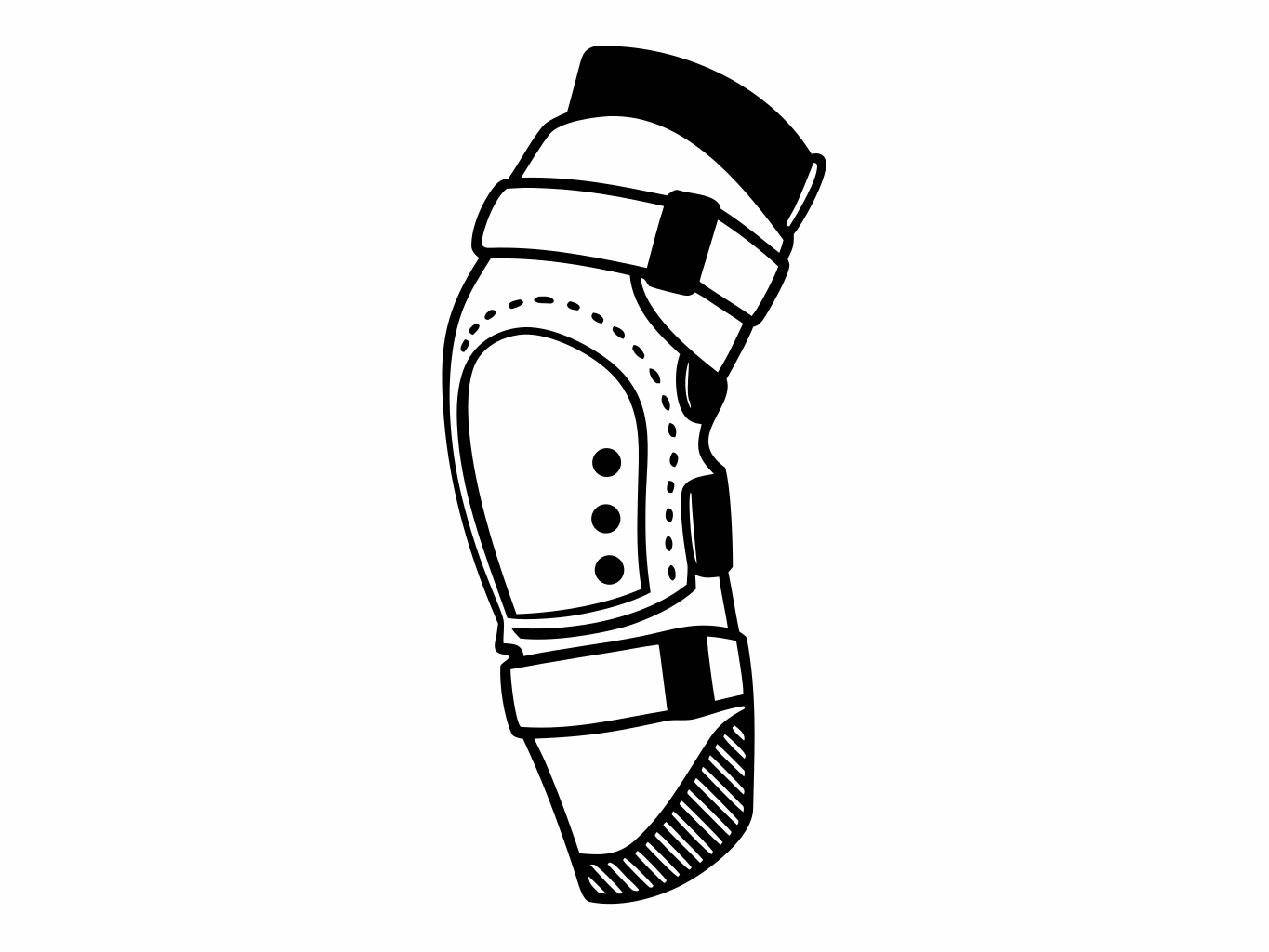
Elbow guards protect the point of the elbow and the forearm when you go down on rock or clip a tree. They are cheap next to a brace or a helmet, and the good ones carry the same EN 1621-1 impact rating as knee armor. This guide covers what the rating means for elbows, which design suits hard enduro, and how to make a guard stay where it belongs.
On this page
What elbow guards do in hard enduro
Hard enduro falls are mostly slow. The bike stalls on a step, the front wheel drops off a rock, or you tip over in a rock garden. You put an arm out, or you land on the side of it. The elbow is the bony point that hits first.
An elbow guard does three things:
- Spreads a blow on the point of the elbow, the olecranon. Alpinestars places the shells of its Bionic Pro Plasma "strategically positioned over the olecranon" (Alpinestars).
- Covers the forearm on longer designs, against rocks, branches and your own handguards.
- Takes the scrape when you slide on rock. Some guards add a hard outer cap for this.
How much it matters
One long-run data set is a 12-year study of European motocross competition (15,870 riders, 1980 to 1991). Of 1,076 bruises, 27.9% were in the upper limbs. Of 450 fractures, 50.9% were in the upper limbs. The authors name wrist and collarbone fractures as still common despite better gear.
Our view: elbow guards are worth wearing, but they are not where your money goes first. The 12-year data above is why. The upper limb takes a large share of injuries, but the fractures the authors single out are at the wrist and collarbone, which an elbow guard does not cover. The same study found ligament injuries mostly in the lower limbs, especially the knee, so fund knee protection first.
EN 1621-1 for elbows, in short
Elbow guards are certified to the same standard as knee guards: EN 1621-1:2012, the European standard for motorcycle limb joint impact protectors. Our knee protection guide explains the full test and label. The short version:
- The test. A 5 kg striker falls from about one meter, for at least 50 J, and the lab measures the force that gets through (REV'IT!).
- Level 1: mean transmitted force below 35 kN. Level 2: below 20 kN (Knox). Lower is better.
- Type A or B: the size of the protector. Type B is larger (Alpinestars leaflet).
- T+ and T-: the protector also passed optional hot and cold tests.
- E on the label means elbow. Alpinestars' leaflet lists the area codes: S shoulder, E elbow, K knee, H hip.
In the EU, these protectors are Category II PPE under Regulation (EU) 2016/425. Article 19 requires an EU type-examination by a notified body for Category II. So an elbow guard labeled EN 1621-1 has had its design checked by an independent lab.
Two things the label will not tell you: how well the guard stays in place, and how it feels after four hours in the heat. That is the rest of this page.
Hard shell vs soft armor
Elbow guards come in three broad builds. The picks on this page cover all three.
| Build | Example | What the maker says |
|---|---|---|
| Hard shell with straps | Alpinestars Bionic Plus | Level 1 protection, dual strap closure, vented panels |
| Hard shell over soft armor | Alpinestars Bionic Pro Plasma; Fox Titan Pro D3O | Thermoplastic shells over Nucleon PLASMA (Level 2); polypropylene shell over D3O with a hinge and forearm sleeve (Level 1) |
| Soft sleeve with gel armor | Leatt Elbow Guard ReaFlex Hybrid | ReaFlex gel in a knitted mesh sleeve, plus a sliding hard shell plate (Level 1) |
What each build does well
- Hard shells slide. A hard outer surface skids on rock instead of gripping it. Leatt says the hard cap on its FlexMesh guard "protects during slides" (Leatt).
- Soft armor bends. Leatt describes its ReaFlex gel as "soft and flexible but extremely tough under impact" (Leatt).
- Sleeves wrap the arm. A sleeve holds the guard along its length. A strap-on guard holds at its straps.
For hard enduro, a slim sleeve with a hard outer plate is the best all-day compromise. The reason is how the sport is ridden. It means long, hot days of low-speed riding and pushing, where comfort decides whether you keep the guard on. It also means rock, where a hard plate slides rather than snags.
Fit that stays put
A guard that has slipped to your forearm protects nothing. Fit it before you ride, and check it again once you are warm and sweaty.
Sizing
Makers size elbow guards differently. Alpinestars sells the Bionic Plus and Bionic Pro Plasma in S/M and L/XL. Leatt sells the ReaFlex Hybrid in S, M, L, XL and XXL, and calls it "single sizing for perfect fit." Fox sells the Titan Pro D3O in S/M and L/XL. Use each maker's own chart.
How it should feel
- The cup sits on the point of the elbow with your arm bent in the riding position, not with your arm straight.
- The top holds on the upper arm. Leatt uses "silicone printed, non-slip cuffs." Fox uses an internal forearm sleeve with a bicep hook-and-loop strap (Fox).
- Straps are snug, not tight. A forearm strap you can feel on the throttle is too tight, given how much work your forearms do on the clutch and throttle all day; see our arm pump guide.
- It works with the rest of your kit. Check the guard under your jersey and with your chest protector. Some body protectors take their own elbow armor: Leatt sells a CE Level 1 elbow insert for its Body Protector AirFit Evo (Leatt).
Test it off the bike
Put the guard on, bend and straighten your arm twenty times, then grip a bar and push your elbows out as you would standing on the pegs. If the cup drifts off the point of the elbow, change the size or the model.
When to use
Rocky terrain and frequent tip-overs benefit most. Sleeve-style flexible guards improve all-day comfort and ventilation. In more detail:
- Rock gardens and boulder sections. This is where elbows meet stone. Wear guards for any event or trail with sections like the ones in our logs and rocks technique guide.
- Tight woods. Our view: a longer guard with forearm coverage suits tight woods, because trunks and branches strike a standing rider on the forearm as well as the elbow.
- Learning new skills. Practicing splatters or hill climbs means more falls. Wear the guards.
- Hot, open trails. On fast, open trails in heat, a slim sleeve or a vented strap guard is easier to keep on than a hard, fully hinged guard. This judgement comes from heat build-up during long days, not from any lab data.
What to trade off
| You want | Choose | You give up |
|---|---|---|
| Lowest transmitted force | Level 2 | Often bulk and weight; Alpinestars says Level 2 can carry "weight and restriction penalties" |
| All-day comfort | Soft sleeve | Some slide protection, unless it has a hard plate |
| Forearm coverage | Longer hinged guard | Heat and weight |
| Low cost | Simple strap-on Level 1 guard | Level 2 performance, and the sleeve or hinged designs |
Care, inspection and replacement
Cleaning
- Fox Titan Pro D3O: machine wash cold on a gentle cycle with gentle detergent, line dry. No bleach, no iron, no dry cleaning (Fox).
- Removable protectors: Alpinestars says clean them with a damp cloth and soapy water, do not submerge them, and never use strong cleaning agents or solvents (leaflet). The Bionic Pro Plasma has a removable protector, so take it out before washing the chassis.
Store guards dry and away from direct heat and sunlight, with nothing heavy on top. Alpinestars says to avoid bending protectors in storage.
When to replace
From Alpinestars' EN 1621-1 leaflet:
- After a severe impact, "particularly if the plastic has lightened in colour at the impact point."
- When degraded, cracked, chipped or delaminated.
- Every 5 years under normal use. Alpinestars "strongly recommends" it.
- When it no longer fits correctly.
After a smaller hit, Alpinestars says to have the protector checked by an authorized dealer before further use. Do not repair it or add paint or stickers.
Common mistakes
- Buying uncertified "pads." Look for EN 1621-1 and an E on the label. Without it, you have no independent impact figure to compare.
- Fitting with a straight arm. You ride with bent arms. Fit the cup in that position.
- Cranking the forearm strap. Snug holds the guard. Tight works against your forearms all day.
- Choosing Level 2 you will not wear. Alpinestars notes Level 2 can bring weight and restriction penalties. A Level 1 guard on your arm beats a Level 2 guard in your bag.
- Ignoring the chest protector. Check the two together before a race. Some body protectors have their own elbow armor.
- Riding a cracked shell. Replace it. Alpinestars lists cracks and chips as replacement triggers.
- Soaking removable protectors. Alpinestars says do not submerge them.
- Skipping elbows and knees to fund one premium item. Certified knee and elbow protection together is worth more than a top-tier version of either. Why: the motocross data above spreads injuries widely, and knees, upper limbs and trunk all take a share.
For the full label guide, see knee protection. For the rest of the kit, see our hard enduro gear guide and gear methodology.
Priority: ★★☆☆☆. Suggested share of a full kit's budget: 5%.
What the rating rests on: Elbow guards get two stars because the elbow is exposed in falls but an elbow guard covers a small area: in a 12-year motocross injury series, the upper limbs took 27.9% of bruises and 50.9% of fractures, and the fractures singled out as still common were the wrist and collarbone, which an elbow guard does not cover. They get 5% of the budget because the certified guards listed here cost $49.95 to $124.95 at the makers' list prices.
Our suggested picks for hard enduro Elbow Guards
Grouped by the maker's list price. No paid placements, no affiliate links. Every fact on a card links to the maker's own page.
Bionic Plus Elbow Protector
- Alpinestars
- US$49.95 list price (US)
A strap-on off-road elbow protector with Level 1 CE-certified protection, a dual strap closure and vented panels.
Certification declared by the maker
- EN 1621-1:2012 Level 1
Features: Dual strap closure, Flexion channel, Vented panels, 3D mesh
Alpinestars describes the Bionic Plus as an elbow protector with ergonomically profiled Level 1 CE-certified protection, held in place by a dual strap closure system. It uses 3D mesh and vented panels to limit heat build-up, an asymmetric lightweight design and a flexion channel so the shell bends with the elbow. Alpinestars lists it as "Elbow Protector - EN 1621-1:2012 LEVEL 1". Sizes are S/M and L/XL.
Why it is listed: it is the lowest list price in this category ($49.95) and it is certified to EN 1621-1:2012. That makes it the budget pick. It is a strap-on design, so fit and strap tension matter more than with a sleeve.
Sources
Bionic Pro Plasma Elbow Protectors
- Alpinestars
- US$99.95 list price (US)
Off-road elbow protectors with a removable Level 2 Nucleon PLASMA protector and two thermoplastic shells over the point of the elbow.
Certification declared by the maker
- EN 1621-1:2012 Level 2
Materials: Nucleon PLASMA, Thermoplastic shells
Features: Removable protector, Slip joint construction, Wide elasticated top strap
Alpinestars describes the Bionic Pro Plasma as anatomically profiled for all forms of off-road riding. A removable Nucleon PLASMA elbow protector sits in a chassis that is abrasion resistant outside and breathable inside. Two independent thermoplastic shells are positioned over the olecranon, with a slip joint for articulation and a wide elasticated top strap. Alpinestars lists it as "Elbow Protector: EN 1621-1:2012 LEVEL 2". Sizes are S/M and L/XL.
Why it is listed: it is the only Level 2 guard on this page and sits mid-range on price ($99.95). Level 2 means a mean transmitted force below 20 kN, against below 35 kN for Level 1. That makes it the value pick.
Titan Pro D3O CE Elbow Pads
- Fox Racing
- US$124.95 list price (US)
Dirt bike elbow and forearm guards with a ventilated polypropylene shell over molded D3O armor and a hinge at the joint.
Certification declared by the maker
- CE certified
- EN 1621-1 Level 1
Coverage: Elbow and forearm
Materials: Polypropylene, Polyvinyl chloride, D3O
Features: Hinge at the joint, Internal forearm sleeve, Bicep hook-and-loop strap
Fox describes the Titan Pro D3O as dirt bike elbow guards with a highly ventilated polypropylene exoskeleton over molded D3O protection. A hinge at the joint and a secure fit system keep the pads in place, with an internal forearm sleeve and a bicep hook-and-loop strap. Multi-layer molded foam sits between the guard and the skin. Fox lists them as CE certified to 1621-1 Level 1. Materials are polypropylene and polyvinyl chloride. Sizes are S/M and L/XL. Fox says to machine wash cold on a gentle cycle and line dry.
Why it is listed: it is the highest list price on this page ($124.95) and the only hinged design, with forearm coverage as well as the elbow. That makes it the premium pick for tight woods and rock.
Sources
Elbow Guard ReaFlex Hybrid
- Leatt
- US$114 list price (International (int.leatt.com))
A slim sleeve-style elbow guard with ReaFlex impact gel, a sliding hard shell elbow plate and EN1621-1 Level 1 certification.
Certification declared by the maker
- Elbow EN1621-1 Level 1
Materials: ReaFlex impact gel, Knitted mesh base layer, MoistureCool and AirMesh fabrics
Features: Sliding hard shell elbow plate, Silicone printed non-slip cuffs, Pre-curved 3D design
Leatt describes the ReaFlex Hybrid as a super slim elbow guard with CE impact certification. ReaFlex impact gel is soft and flexible but tough under impact, and a sliding hard shell elbow plate adds protection. A ventilated knitted mesh base layer adapts to the arm, and silicone printed non-slip cuffs keep the guard in place. It uses MoistureCool and AirMesh wicking fabrics and a pre-curved 3D design. Leatt lists it as certified to "Elbow EN1621-1 Level 1". Sizes are S, M, L, XL and XXL. Leatt tags it for moto, ADV and MTB use.
Why it is listed: it is the sleeve-style option on this page, with a hard outer plate for sliding on rock. At $114 it sits between the value and premium picks on price.
Sources
Budget tiers explained
Where a category has picks, they sit in three tiers. The tier follows the maker's list price within the category. A higher tier does not mean a higher certification level: check the label.
- Budget:
- Entry price. The essentials without the extras: a sound start for new riders or occasional use.
- Value:
- More for the money. More enduro-specific features, better adjustment and ventilation, at a mid-range list price.
- Premium:
- Top tier, fewer compromises. Lighter materials, more adjustment or more coverage, often with diminishing returns unless you ride a lot.
Explore other Top Hard Enduro Gear Categories

Gear lowers the cost of a fall. Control lowers how often you fall. Train it in Controls 101.