Top Hard Enduro Pants & Jersey
Durable yet mobile layers. For hard enduro, prioritize stretch panels, ventilation, reinforced knees and seat, and room for knee braces.
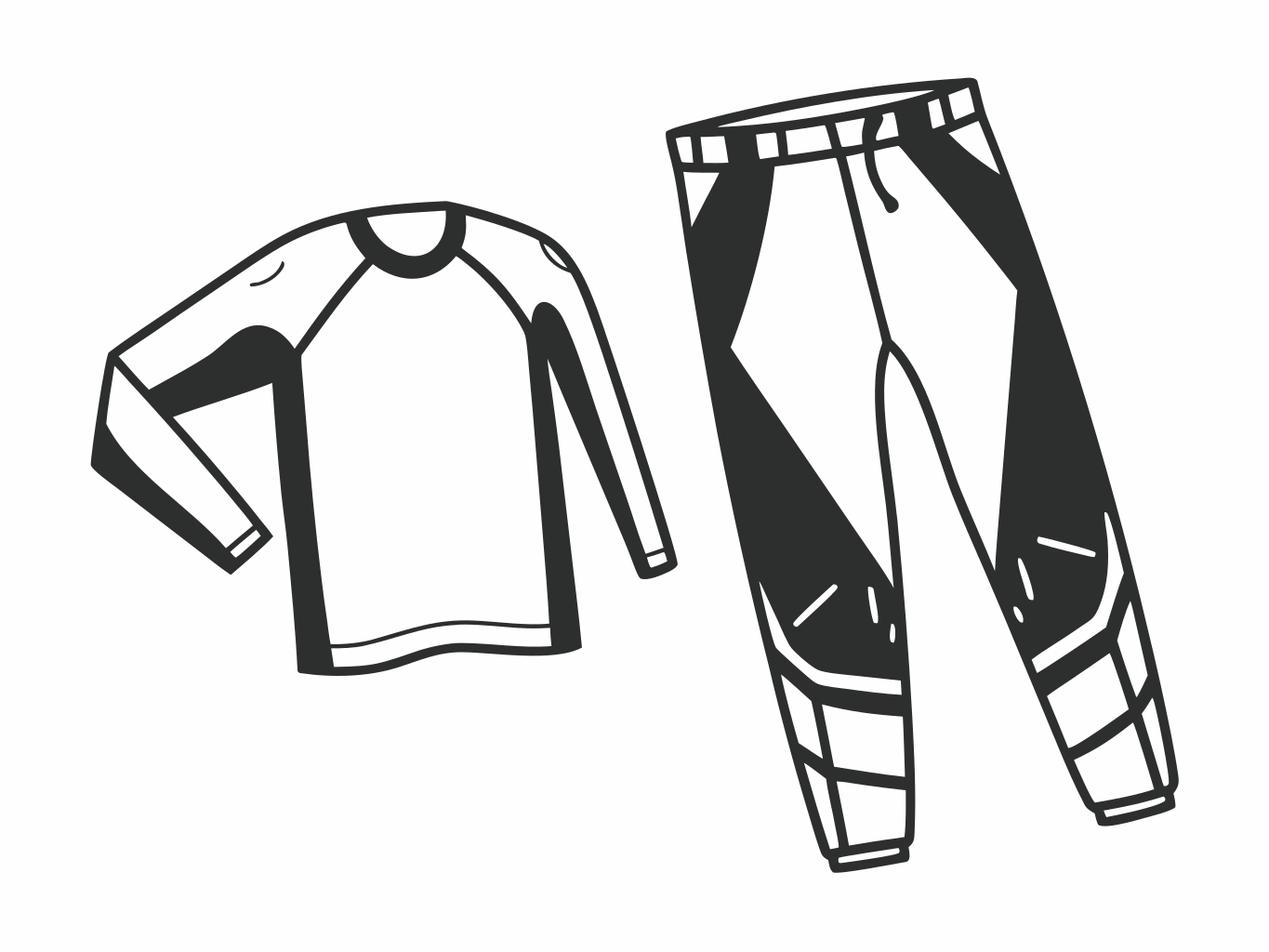
Pants and jerseys are your outer layer. They take the scrapes from rock and brush, hold your armor in place and decide how hot you run. This guide explains the garment standards, where off-road race kit sits in relation to them, and what to look for on a hard enduro day.
On this page
What pants and jerseys do in hard enduro
Off-road pants and jerseys do four jobs:
- Resist wear. Rock, roots and brush scrape the knees, seat and shins all day. Pants take it so your skin doesn't.
- Carry and cover protection. Pants go over knee braces or guards. Jerseys go over or under a chest protector and elbow guards. Both keep that armor where it belongs.
- Manage heat and sweat. Hard enduro is slow and physical: lots of heat, little airflow.
- Grip the bike. Makers put leather or grippy, heat-resistant panels on the inner knee.
They do not replace armor. Our view: buy protection first, then buy pants and a jersey that fit over it. The reason is simple: none of the race pants and jerseys on this page carries a protective certification. See the gear hub for how we weight each category.
EN 17092 and EN 13595 explained
EN 17092: the current garment standard
EN 17092:2020, Protective garments for motorcycle riders, has six parts. Part 1 sets the test methods. Parts 2 to 6 set the requirements for five classes. The Estonian Centre for Standardisation lists EVS-EN 17092-4:2020 (Class A) as valid from 19 March 2020 and linked to the PPE Regulation. Alpinestars' booklet describes its certified garments as Category II PPE under Regulation (EU) 2016/425, type-examined by a notified body.
Alpinestars' EN 17092 user booklet prints the key requirements for the most exposed areas (shoulders, elbows, hips, knees):
| Class (part) | Impact abrasion speed | Tear strength | Seam strength |
|---|---|---|---|
| AAA (EN 17092-2) | 120 km/h (75 mph) | 50 N | 12 N/mm |
| AA (EN 17092-3) | 70 km/h (43 mph) | 40 N | 8 N/mm |
| A (EN 17092-4) | 45 km/h (28 mph) | 35 N | 6 N/mm |
| B (EN 17092-5) | 45 km/h (28 mph) | 35 N | 6 N/mm |
| C overgarment (EN 17092-6) | 45 km/h (28 mph) | 35 N | 6 N/mm |
| C undergarment (EN 17092-6) | not applicable | 10 N | 4 N/mm |
What each class means, per the booklet and SATRA's summary of EN 17092:
- AAA, AA and A protect against both abrasion and impact. Elbow, shoulder, knee and hip protectors to EN 1621 are mandatory in AAA and AA. Hip protectors are optional in Class A. Class A is aimed at hot conditions and lighter materials.
- B gives Class A abrasion resistance but no impact protectors. Alpinestars says Class B trousers should be worn with at least EN 1621-1 knee protectors.
- C only holds impact protectors in place. It offers no minimum abrasion protection and is meant to be worn with an AAA, AA, A or B garment.
In the abrasion test, SATRA explains, the rig simulates a 75 kg, 1.75 m rider sliding to a stop on a real concrete surface. Material samples on rotating arms drop onto a concrete tile. To pass, the layer closest to the body must have no hole of 5 mm or more.
The label shows the motorcycle pictogram, the class (for example "AA") and the part number (for example "EN 17092-3:2020").
The catch: EN 17092 is written for the road
The scope of each class part limits it to on-road riding. The Class AA scope on EVS reads: "It applies to protective garments for motorcycle on-road use". The boot standard is different: EN 13634 names on- and off-road riding (see hard enduro boots).
EN 13595: the old standard
EN 13595, Protective clothing for professional motorcycle riders, came first. EVS lists EVS-EN 13595-1:2002 as withdrawn from 19 March 2020, replaced by the EN 17092 series. SATRA notes that once the standard is withdrawn, "no product can be certified against it". Parts 2 and 4 live on as test methods: EN 13634:2017 still uses them for boots.
If you see a garment sold today with an EN 13595 claim, it is old stock or an old certificate.
Where motocross and enduro kit fits
Off-road race pants and jerseys are sold as riding apparel, not as certified PPE. The product pages for the kit on this page list materials, stretch panels and vents. None of them lists a CE mark, a garment class or EN 17092:
- Alpinestars' 2026 Techstar Nomur Pants and Jersey, its "premier off-road competition" kit.
- Leatt's Moto 4.5 Enduro X-Flow and Moto 5.5 Enduro pants.
The same makers do certify adventure gear built for road use. Leatt states that its ADV DriTour 5.5 pant is "tested to Class AA standards and is certified for road use", and lists it as "EN 17092-3-2020, Class AA tested and certified". That pant is a touring garment with a membrane, not race kit.
What this means for you:
- Do not assume a race pant is PPE. No CE mark, pictogram and EN 17092 class on the label means no certification.
- Your protection is underneath. Braces, chest protector and elbow guards each have their own page and standards.
- A road class is not the goal off-road. For hard enduro, don't choose pants for an EN 17092 class. Two things argue against it. The class test models a slide on concrete at 45 to 120 km/h, far from a walking-pace tumble on rock. And Alpinestars' own booklet warns that higher classes bring extra weight, less range of motion and more heat stress. If your enduro loop includes long road sections, an adventure pant with a class is a reasonable choice for those days.
Fit with braces and armor
Fit your pants and jersey over the protection you actually ride in.
- Pants over knee braces. Try pants on with your braces. Alpinestars says the Techstar Nomur's single-layer, linerless build gives "easier wearability with knee braces or guards". Leatt lists its Moto 4.5 Enduro X-Flow pant as "Knee Braces or protection compatible".
- Pants that stay up. Braces and wet fabric drag pants down. Leatt uses a "360° Waistlock system". Alpinestars puts a silicone strip inside the Nomur waistline.
- Boot interface. Race-cut pants go inside the boot. Check that the hem sits flat and your boots still close.
- Jersey over or under armor. Leatt says its Moto 4.5 Lite jersey is a "classic fit with or without protection". If you wear a chest protector over the jersey, size the jersey for your body. If you wear armor under it, size up for the armor.
- Overlap. The jersey should stay tucked when you stand and reach. Alpinestars gives the Techstar Nomur Jersey an "extended rear profile" for coverage with its pants.
Alpinestars' garment booklet adds a general rule: try the garment with everything you wear underneath, keep it on for a few minutes, and check that protectors stay in place as you move.
What matters in hard enduro pants and jerseys
Stretch
You stand, squat, climb on foot and swing a leg over a stuck bike all day. Stretch panels let the pants move with you. Alpinestars puts four-way stretch panels on the Nomur's yoke, thighs and upper knees. Leatt's enduro pants use a four-way stretch shell.
Ventilation and heat
Hard enduro makes heat at low speed, when airflow is lowest. Look for perforations or mesh where you sweat most. Leatt's Moto 4.5 Enduro X-Flow pant has 132 laser-cut ventilation perforations. Its Moto 5.5 Enduro pant has four adjustable vents. The Techstar Nomur Jersey has laser-cut perforations on the chest and arms. For heat on long days, see hydration and endurance training.
Abrasion at the knee and seat
Knees and seat wear through first. Alpinestars reinforces the Nomur's seat and knees with 600D coated polyfabric. Leatt adds "deflection, abrasion and cut-resistant" overlays on the knees and seat of its enduro pants.
Inner-knee panels
The inner knee grips the bike and sits near hot parts. Alpinestars uses goat leather there "for heat resistance and grip". Leatt uses its own HeatGrip panels, which it says are machine washable and replace leather.
Water and drying
There are two approaches to water crossings, mud and rain:
- Water-resistant and vented. DWR treatments and coatings in key areas. Leatt's X-Flow pant uses a DWR treatment and a "3L waterproof coating in key areas".
- Waterproof. A full membrane. Leatt's Moto 5.5 Enduro pant has a waterproof HydraDri Max 3 membrane.
Our view: for summer hard enduro with deep crossings, choose vented, single-layer pants over a membrane. Here's why: a membrane that keeps water out also slows drying once water comes in over the top, and fewer layers hold less water. For cold, wet trail days, the membrane wins. For crossing technique, see water crossings.
Layering
Build from the skin out: an optional wicking base, then armor, then jersey and pants. Alpinestars gives the Nomur Jersey a "moisture-wicking treatment"; Leatt uses "MoistureCool" fabric on the Moto 4.5 Lite. In heat, skip extra layers, because each layer slows sweat evaporation, and that is how you shed heat at low speed.
How to choose pants and jersey for hard enduro
- Sort your protection first. Braces or guards, chest, elbows. Bring them to the fitting.
- Check the knee. Room for braces, reinforced outer knee, heat-resistant inner knee.
- Check the seat. Reinforced fabric where you sit and slide.
- Check stretch. Squat, lift a knee to your chest, step up onto a chair. Nothing should pull.
- Pick your water approach. Vented for heat and deep water. Membrane for cold and wet.
- Check retention. Waist system that holds with braces on. Jersey long enough to stay tucked.
- Check the boot interface. The hem must sit inside the boot without bunching.
Care, inspection and replacement
Follow the care label on your garment. Two makers' guidance shows the range:
- Leatt designs its current enduro pants for machine washing, citing "improved machine-washing durability for longer-lasting wear", and says its HeatGrip inner-knee panels are machine washable.
- Alpinestars, for its EN 17092 certified textile garments, says: remove the impact protectors first, hand wash at 30°C (85°F), do not bleach, tumble dry, iron or dry clean, and hang to store.
Always take out removable armor before washing.
Inspection, per Alpinestars' garment booklet: after each use, check for worn areas and damaged zips or fasteners. After a crash, inspect the garment and remove any impact protector to check it, even with no visible damage. For certified garments, Alpinestars recommends replacement 5 years from first wear.
For race kit, replace pants when the knee or seat wears through or the waist no longer holds with braces on.
Common mistakes
- Treating race pants as armor. They carry no EN 17092 class. Your protection is the brace and protectors underneath.
- Buying pants without braces on. Pants that fit bare legs can bind over braces.
- Choosing a road-rated pant for a hot race. Alpinestars warns that higher classes bring weight and heat stress.
- A jersey too short for the pants. It rides up when you stand and pulls out at the back. Alpinestars extends the rear of the Nomur jersey for coverage with its pants.
Priority: ★★☆☆☆. Suggested share of a full kit's budget: 5%.
What the rating rests on: Pants and jersey get two stars and 5% of the budget. The basis is what they are tested for: EN 17092, the European standard for protective motorcycle garments, applies to on-road use, and the off-road race pants and jerseys below carry no class under it. In hard enduro, impact protection comes from the knee braces, chest protector and elbow guards worn underneath, which have their own pages and a larger share of the budget.
Our suggested picks for hard enduro Pants & Jersey
Grouped by the maker's list price. No paid placements, no affiliate links. Every fact on a card links to the maker's own page.
Alpinestars 2026 Techstar Nomur Pants
- Alpinestars
- US$219.95 list price (US)
Alpinestars' premier off-road competition pants, with 600D polyfabric and stretch ripstop in a linerless, single-layer build.
Materials: 600D coated polyfabric, Stretch ripstop, Goat leather inner knee panels
Features: Babel knee gussets, SX2 magnetic closure, Silicone inner waistline
Alpinestars builds the 2026 Techstar Nomur Pants from 600D coated polyfabric and stretch ripstop. They have four-way stretch panels on the yoke, thighs and upper knees, reinforced seat and knees, goat leather inner knee panels for heat resistance and grip, and revised Babel knee gussets for flexibility and airflow. The single-layer, linerless build is designed for reduced weight and easier wear with knee braces or guards. A silicone inner waistline helps hold them in place. Alpinestars sells a matching Techstar Nomur Jersey with laser-cut perforations and a moisture-wicking treatment (list $84.95).
Why it is listed: reinforced knees and seat, leather inner knees and a brace-friendly linerless cut, at $219.95 (Alpinestars US list price), the lowest-priced pant here. The maker lists no EN 17092 class for it.
Leatt Moto 4.5 Enduro X-Flow Pant
- Leatt
- US$239 list price (International (Leatt online store))
The lightest and most flexible pant in Leatt's enduro range, with 132 laser-cut ventilation perforations.
Materials: Four-way stretch micro-mesh shell, HeatGrip inner knee panels, Hypalon trims
Features: 132 laser-cut perforations, 360° Waistlock, DWR treatment
Leatt calls the Moto 4.5 Enduro X-Flow "the lightest and most flexible pants in the Enduro range". It has a four-way stretch micro-mesh shell with a DWR treatment, a 3L breathable waterproof coating in key areas, and 132 laser-cut ventilation perforations. Knees and seat carry deflection, abrasion and cut-resistant overlays, and the inner knees use Leatt's HeatGrip panels. A 360° Waistlock system holds the waist. Leatt lists it as knee brace or protection compatible, with a moto-derived in-boot race cut and taped seams.
Why it is listed: it is the most ventilated pant here, built for heat, with reinforced knees and seat and a brace-compatible cut, at $239 (Leatt international store list price, USD). The maker lists no EN 17092 class for it.
Sources
Leatt Moto 5.5 Enduro Pant
- Leatt
- US$349 list price (International (Leatt online store))
A heavy-duty enduro pant with a waterproof HydraDri Max 3 membrane and four adjustable vents.
Materials: Four-way stretch shell, HydraDri Max 3 membrane, HeatGrip inner knee panels
Features: Four adjustable vents, 360° Waistlock, Waterproof pockets
Leatt describes the Moto 5.5 Enduro as "heavy duty pants perfect for extreme endurance riding". It has a four-way stretch shell with a DWR treatment and a waterproof HydraDri Max 3 membrane. Knee and seat panels are deflection, abrasion and cut-resistant, and the machine-washable HeatGrip inner-knee panels replace leather. Four riding-adjustable vents control airflow. It has space for knee braces or protection, waterproof pockets and the 360° Waistlock system.
Why it is listed: it is the waterproof option here, for cold and wet enduro days, with reinforced knees and seat and brace room, at $349 (Leatt international store list price, USD). The maker lists no EN 17092 class for it.
Sources
Budget tiers explained
Where a category has picks, they sit in three tiers. The tier follows the maker's list price within the category. A higher tier does not mean a higher certification level: check the label.
- Budget:
- Entry price. The essentials without the extras: a sound start for new riders or occasional use.
- Value:
- More for the money. More enduro-specific features, better adjustment and ventilation, at a mid-range list price.
- Premium:
- Top tier, fewer compromises. Lighter materials, more adjustment or more coverage, often with diminishing returns unless you ride a lot.
Explore other Top Hard Enduro Gear Categories

Gear lowers the cost of a fall. Control lowers how often you fall. Train it in Controls 101.