Lesson 3 of 7 in Riding Fundamentals
Full‑Lock Figure‑Eights
A full-lock figure-eight is two slow circles joined in the middle, ridden with the bars turned as far as they go. It trains balance, clutch and throttle timing and lower-body steering at walking pace, all at once. Put two markers a few bike-lengths apart and ride round them in an eight: eyes looking through the turn, bars at full lock, weight on the outside peg, a light drag of rear brake and the clutch slipping. Start wide, then move the markers closer until you're at full lock with no dabs, in both directions.
Updated September 2026. Sources are listed below. How we work
On this page
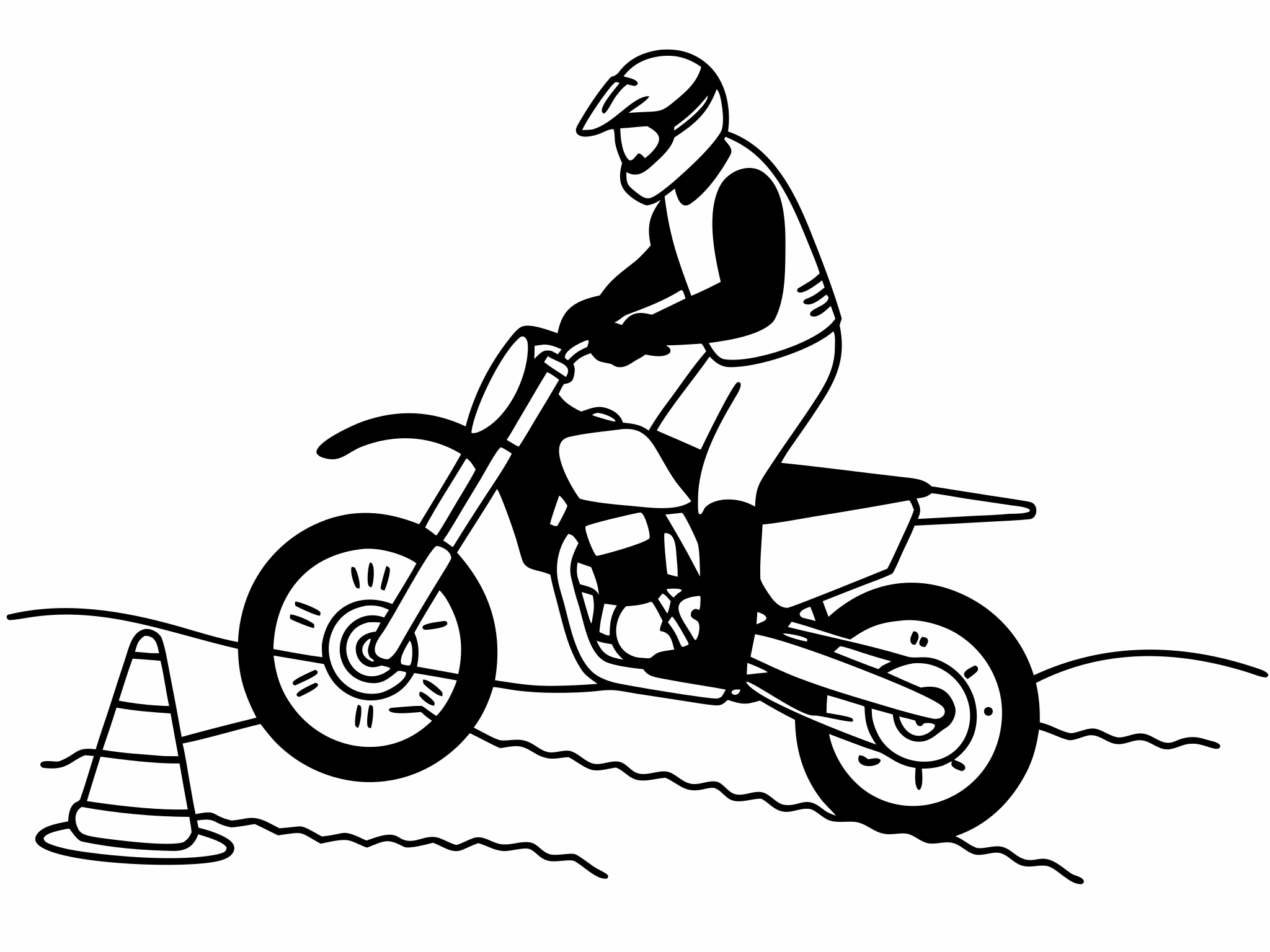
Why figure-eights matter in hard enduro
Tight turns teach balance, throttle and clutch timing, and lower-body steering. They're the safest place to learn traction management: the speed is low, the ground is flat and a mistake means a dab, not a crash.
Hard enduro is full of turns that have to be ridden at walking pace: switchbacks on climbs, turns between trees, U-turns on narrow trail, lining up for a log or a rock step. Riders who can't turn slowly either put a foot down, take a wider line into worse ground, or stop and drag the bike round.
The figure-eight works because it combines every control. Dirt Bike Magazine's balance feature calls full-lock turns "great for learning clutch and throttle control to maintain pressure and balance", and describes the method: "applying pressure to the front and rear brakes while using smooth throttle control and lightly slipping the clutch". The eight adds one more thing a circle can't: the switch in the middle, where the bike stands up and leans the other way. That's the move you make every time the trail changes direction.
How a slow, full-lock turn works
At walking pace, a bike balances in a turn by leaning into it. The tighter the turn, the more it has to lean. Your job is to let the bike lean while your body stays balanced over it.
- Look through the turn. Turn your head and look at where you'll be in half a circle, not at the marker or the front wheel. The Trials Training Center says "the most common mistake in turning is to let the head fall into the turn", which forces you to add speed to stay up.
- Let the bars go to full lock. Don't fight the bars. At the slowest speeds, full lock is where they want to be.
- Body upright, bike leaning. Keep your torso tall and let the bike lean under you. The Motorcycle Safety Foundation's (MSF) coaching tip for sharp turns: "Keep your weight centered over the motorcycle, lean the motorcycle underneath you when turning sharply."
- Weight the outside peg. Dirt Bike Magazine: "When turning the bike to the right, you will be weighting the outside peg (the left one)." Outside-peg weight balances the lean and pushes the tyres into the ground.
- Clutch and rear brake together. Hold a steady throttle, keep the clutch slipping and keep a light drag on the rear brake. The brake stops the bike surging; the clutch keeps it driving. The MSF says to "put foot over the rear brake, and use the brake lightly" and to use the clutch friction point "to prevent the engine from stalling."
- Front brake, only a touch. A little front brake settles the bike. Too much near full lock tips it into the turn.
The two failures tell you what to change. Falling into the turn: a small release of the clutch gives drive and stands the bike up. Running wide: pull a little clutch in, add a touch more rear brake, and turn your head further.
What each control does in the turn
| Control | What it does | Common error |
|---|---|---|
| Eyes and head | Lead the bike round; set the size of the circle | Looking at the marker or the front wheel |
| Bars | At full lock, held lightly | Pulling against the lock, or letting it straighten |
| Outside peg | Balances the lean and loads the tyres | Weight on the inside peg or the seat |
| Throttle | Steady, slightly above idle | Revs rising as the bars turn |
| Clutch | Slipping: out to stand the bike up, in to slow it | Fully out, so the bike surges or stalls |
| Rear brake | Light, steady drag for stability | No brake, or so much the bike stops |
| Front brake | A touch to settle, or none | Too much, which drops the bike into the turn |
Swipe the table sideways to see every column.
The switch in the middle
The crossover is where most dabs happen. The bike has to stand up, the bars have to go from one lock to the other, and your weight has to move to the other peg, all at walking pace.
Do it in this order:
- Look first. As you finish one circle, turn your head to the next.
- Stand the bike up with a small release of the clutch and pressure on the outside peg.
- Swap pegs. Your weight moves to what will be the new outside peg. A push on the new inside peg tips the bike into the new turn: the Trials Training Center calls this "steering with your feet".
- Bars to the other lock, and settle back into the clutch-and-brake drag.
Jarrod Bewley, an outright winner of the Australian 4-Day Enduro, told Transmoto that standing forward over the bike in tight turns "helps me flip-flop the bike from left to right in one action." The figure-eight is where you learn that flip.
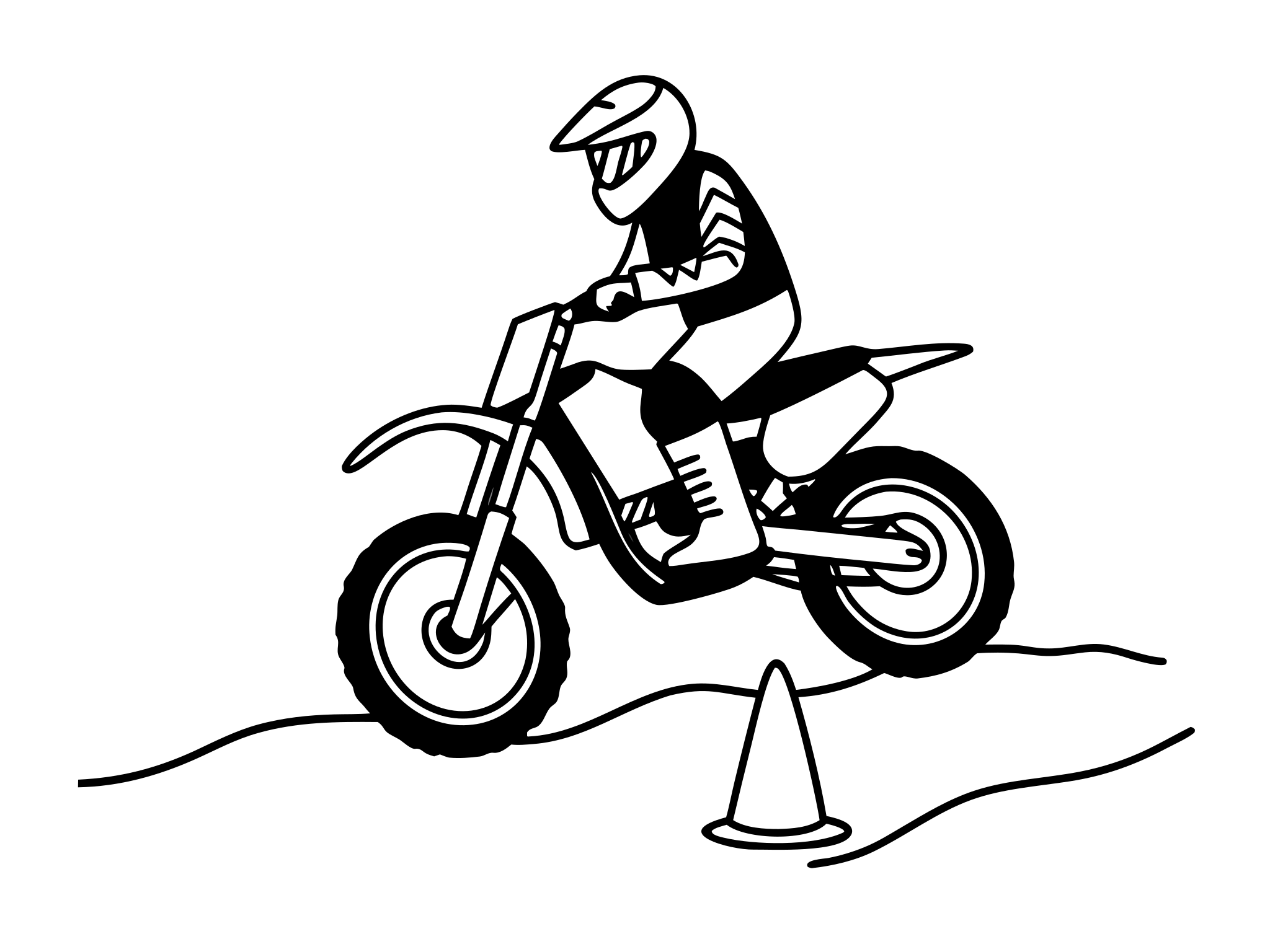
Figure-eight progression
You need a flat, grippy area and two markers. Do every step in both directions. Most riders have a weak side; spend extra time on it.
1Big, seated eights
Place the markers about six bike-lengths apart. Ride a relaxed eight round them, seated, in first or second. Focus on looking through each turn and keeping the engine note steady. The MSF also practises its sharp-turn exercise seated first, then standing.
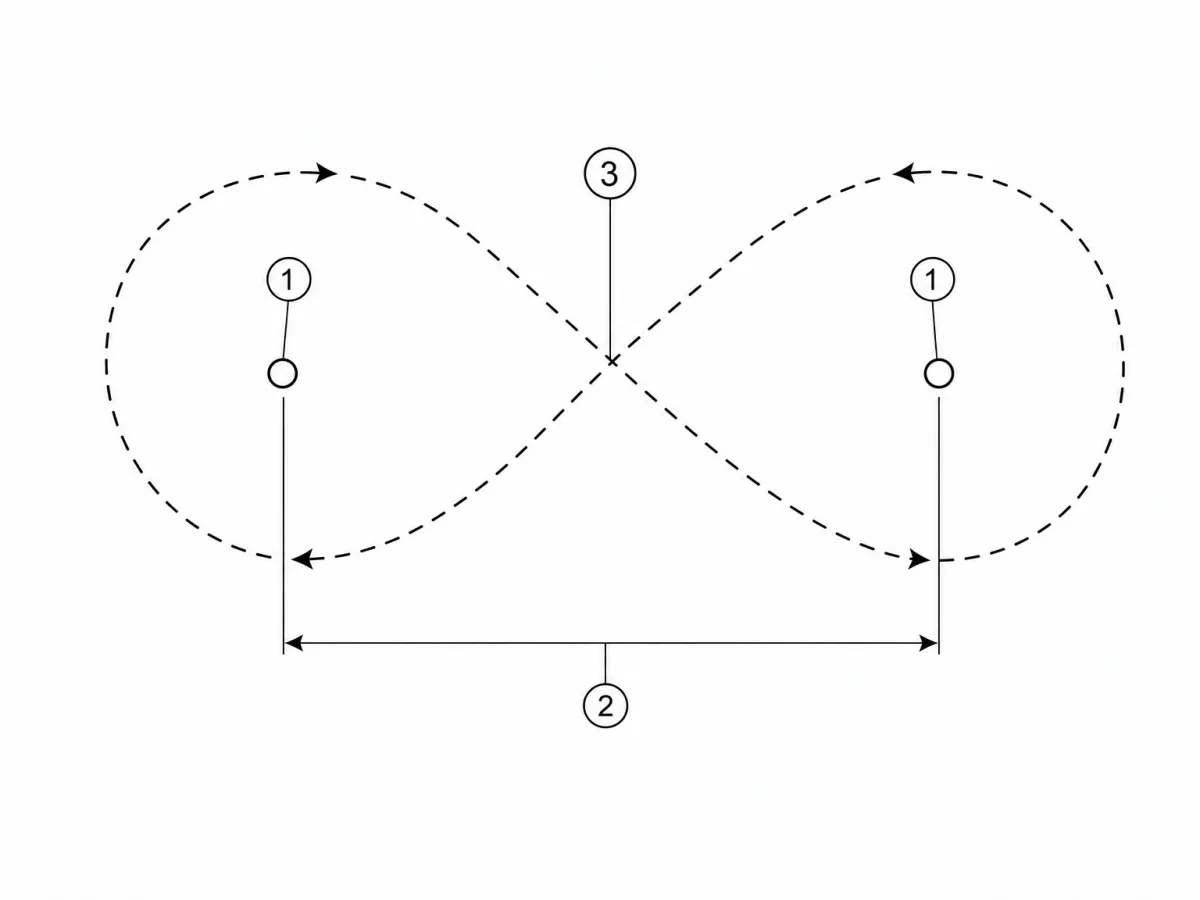
The layout from above. 1 Markers · 2 Start about six bike-lengths apart, then close in towards two · 3 The switch in the middle, where you change direction. 2Big, standing eights
Same size, now standing. Weight the outside peg in each turn and keep your torso tall while the bike leans. Feel the clutch and light rear brake working together.
3Tighten until full lock
Move the markers a little closer each time you can ride five clean eights. The MSF's instruction for its figure-8 drill: "As your skills increase, move the markers closer together so that the figure 8 becomes smaller." Keep going until the bars are at full lock through most of each circle. Around two bike-lengths between markers is a good target.
4As slowly as possible
Keep the markers where they are and halve your speed. Dirt Bike Magazine's instruction: "You want to perform this drill as slowly as you possibly can." Slower means more clutch and brake work and more balance. If you dab, you've found your limit for today.
5Lean the bike further
Once slow eights are clean, let the bike lean further under you while your body stays upright. Dirt Bike Magazine says this "helps you gain more confidence in letting the bike lean beneath you" and teaches more outside-peg pressure. The tighter and slower the turn, the more the bike leans and the less your body does.
6Add slopes and bad ground
Move the eight onto a gentle slope, so one turn is uphill and one is downhill. Then try loose or slippery ground. The Trials Training Center recommends practising turns in "the most slippery, greasy spot possible", because poor technique won't work there. Shane Watts' advice for tight downhill switchbacks applies: stand, "grip the tank with your knees and apply both brakes", and "weight the outside peg heavily".
Figure-eight mistakes and fixes
You keep running wide of the marker.
Fix: Turn your head further and look past the marker to your exit. Then use a touch more rear brake and a little less clutch to slow down, and let the bike lean more.
The bike falls into the turn and you dab.
Fix: Your head or body fell into the turn, or drive stopped. Keep your torso upright over the outside peg and let a little clutch out to stand the bike up.
The engine stalls mid-turn.
Fix: The clutch went out too far or the rear brake dragged too hard. Keep the throttle steady and slightly raised, and pull the lever in a touch as the engine note drops.
The revs jump as the bars reach full lock.
Fix: Turning the bars rotates your right wrist. Brace your thumb against the throttle housing, or adjust your grip so your wrist stays still as the bars turn.
One direction is always worse.
Fix: Almost everyone has a weak side. Ride two eights the weak way for every one the strong way until they feel the same.
You look at the front wheel.
Fix: The bike goes where you look. Pick a point beyond the marker and keep your eyes on it until the next switch.
A 25-minute figure-eight session
Take a short break every ten minutes to cool the clutch.
| Time | Drill | What to focus on |
|---|---|---|
| 0–5 min | Big eights, seated then standing | Eyes through the turn, steady engine note. |
| 5–12 min | Tighten the markers step by step | Five clean eights before each move. |
| 12–18 min | Tightest eight, as slowly as possible | Clutch and rear brake together. No dabs. |
| 18–22 min | Weak side only | Same speed and size as your good side. |
| 22–25 min | Eights on a gentle slope | Outside peg, both brakes on the downhill turn. |
Swipe the table sideways to see every column.
Progress cues: you're ready to move on when…
- You can ride five clean full-lock eights in a row in both directions without a dab.
- The engine note stays quiet and steady all the way round, including the switch.
- Your cadence is steady: each circle takes about the same time.
- You can halve your speed and still ride clean eights.
- You can ride an eight on a gentle slope without the downhill turn running wide.
Figure-eight questions
Should I ride figure-eights sitting or standing?
Both. Start seated to learn the pattern, then stand. Standing is how you'll ride most tight turns in hard enduro, and it makes the switch from one lock to the other much faster.
How close should the markers be?
Start about six bike-lengths apart and move them closer until the bars are at full lock. Around two bike-lengths is a good target. When a turn is too tight to ride round at full lock, you're into pivot-turn territory.
Why use the rear brake if I'm already going slowly?
The drag gives the clutch something to push against, so the bike can't surge. It makes the speed steadier and the bike more stable. The clutch feathering drills use the same idea in a straight line.
What comes after figure-eights?
Static balance takes the speed to zero. Later, pivot turns handle turns too tight to ride round at full lock.