Loud is not fast
A big handful of throttle feels fast. The engine screams, the rear tyre roosts and the bike moves around. But a spinning tyre is not driving the bike. It digs a hole and throws the back end sideways. Dirt Bike Magazine puts it simply: "too much throttle elevates the spin factor".
The aim is drive you can use: power the tyre can turn into grip. That takes a smooth right hand, the right gear and help from the clutch.
This article covers throttle control at trail speed. For the slow, technical end, where the clutch does most of the fine work, start with the lessons:
Smooth comes first
Chris Hollis, writing for Transmoto about racing enduro on hardpack, put it plainly: "Being smooth is the absolute number one priority with hardpack terrain. This involves all aspects of controls use – from braking through to clutch use and throttle control."
Smooth means:
- Roll on, don't snap. Open the throttle gradually, and only as far as the tyre can use.
- Roll off only as far as you need. Closing it completely pitches the bike forward and stops the drive.
- Hold it steady. A throttle that goes on, off, on, off breaks traction every time.
Corners: carry speed, then roll on
Braking and throttle meet in the corner. Do your braking before the turn, as in the braking guide. Then let the bike roll. Hollis: "I will usually carry speed with no throttle through part of the corner before gradually rolling on the gas."
The drive out of the corner comes from that gradual roll-on, not from a burst of revs.
Try a taller gear
In too low a gear, every twist of the grip is a big kick at the tyre. One gear taller softens the response. That is why the gear selection lesson suggests third for flowing, slippery or rocky trail, where you want softer, smoother drive.
Try it on a short loop you know:
- Ride it in your usual gears. Time it.
- Ride it one gear taller, focusing on smooth roll-ons and carrying speed through corners. Time it again.
- Compare the times and how calm the bike felt.
The gear selection lesson also explains when not to go up a gear.
The clutch keeps power smooth
The clutch is part of throttle control. Hollis again: "If you're using the clutch, it should be done to keep the power smooth, and not to build the revs quickly …"
At trail speed that means a touch of clutch to soften the hit as you roll on out of a slippery corner, or to stop a spin on wet rock or clay. At walking pace the roles swap: the throttle sets a steady baseline and the clutch shapes the drive. Sherco rider Cooper Abbott told Enduro21 that with a clutch that modulates well, "you can just use the clutch lever because it slips so well".
Don't lean on the clutch to cover for the wrong gear. Constant slipping heats it. The clutch control lesson covers the friction zone, and clutch feathering has the drills.
When the tyre spins
When the rear tyre spins, more throttle makes it worse. Hold or reduce the throttle, ease the clutch in a touch and move your weight to load the rear tyre. When a bike is dug in and you're off it, helping it out, Dirt Bike Magazine's advice is to "carefully ladle out throttle so that it will bite rather than spin".
Taming a snappy engine
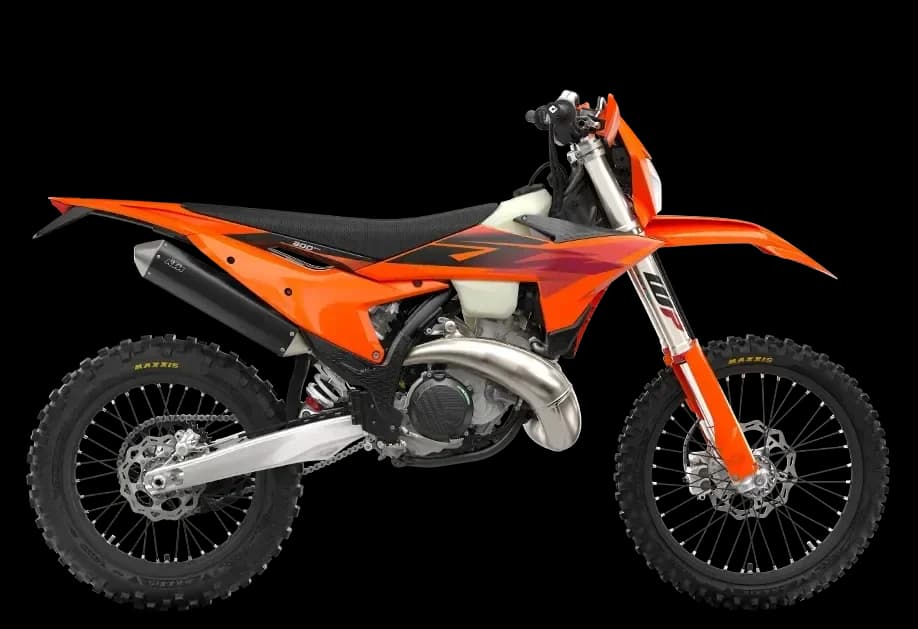
Some bikes deliver power sharply off a closed throttle. Before you change parts, check your owner's manual. Many modern enduro bikes have a softer engine map or a slower throttle cam option. The throttle lesson shows the options on the 2024 KTM 250 and 300 EXC.
Calm hands, longer rides
A steady throttle also means fewer corrections and less tension in your right forearm. If arm pump limits your ride time, see the arm pump guide.